Take every muzzleloading and black powder record in this catalogue and check how many of them say, in the product name, which ignition system the gun uses. The answer is 54 out of 247.
That leaves 193 records where the single most consequential thing about the gun, the thing that decides which consumables you buy and whether it will fire in the rain, is not in the name at all.
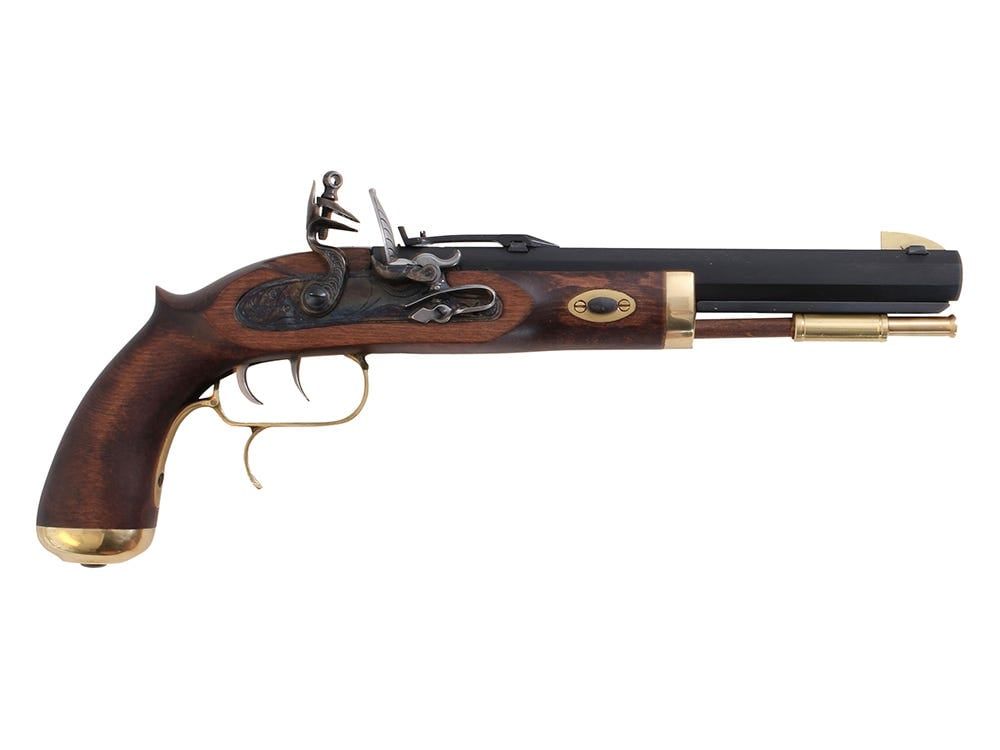
Look at the lock on that pistol. A shaped stone clamped in a pair of jaws, a hinged steel plate for it to scrape down, and a small covered pan underneath. Nothing about the ammunition, the powder or the projectile follows from that; everything about how you feed it does.
The three ignition systems
System
How ignition happens
What you buy
Flintlock
flint scrapes the frizzen, sparks fall into a priming pan, flash passes through a touch hole
flints, priming powder
Percussion, or caplock
Invalid Date
More Articles
hammer crushes a copper cap on a nipple, sparks pass through the hollow nipple
percussion caps
Inline
modern breech plug takes a 209 shotgun primer or a musket cap
209 primers, pellets or loose powder
These are not variations on a theme. A flintlock owner and an inline owner have almost nothing in common at the bench, and a gun of one type cannot be fed the other's supplies.
How the systems arrived
Reverend Alexander John Forsyth of Scotland patented the first percussion system in 1807, and the copper cap that everyone eventually used came from Joshua Shaw around 1822. The change from flint took decades to work through: the United States military moved to percussion around 1833 with the Hall rifle carbine, and Britain did not convert the Brown Bess until 1842.
Flintlock
Percussion cap
Available from
long established by 1800
early 1820s commercially
US military adoption
the standard before
around 1833
British military adoption
the standard before
1842
Loading
slower, two powder charges
quicker, one charge and a cap
In wet weather
the pan is exposed
far more resilient
Reliability
the baseline
far more reliable
Loading, weather and reliability are the three things the percussion cap improved, and it is worth noticing that every one of them is about the ignition rather than about what comes out of the barrel. The ball and the powder charge did not change.
Cap and ball, which is a third category again
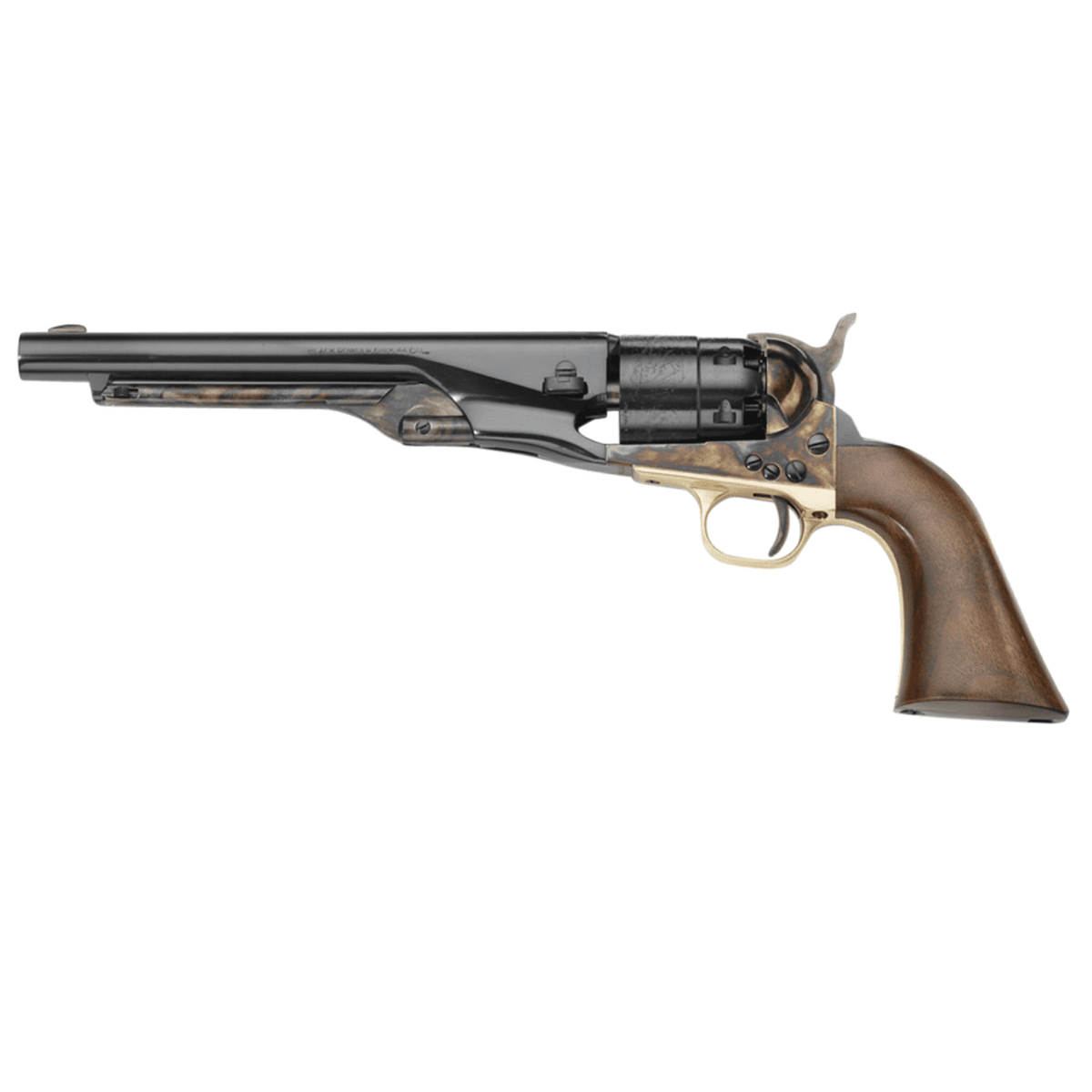
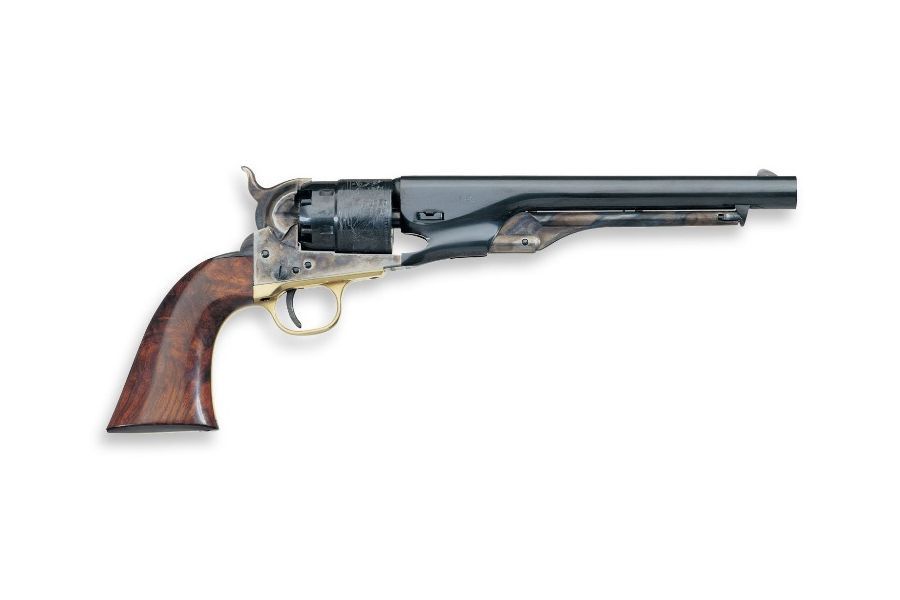
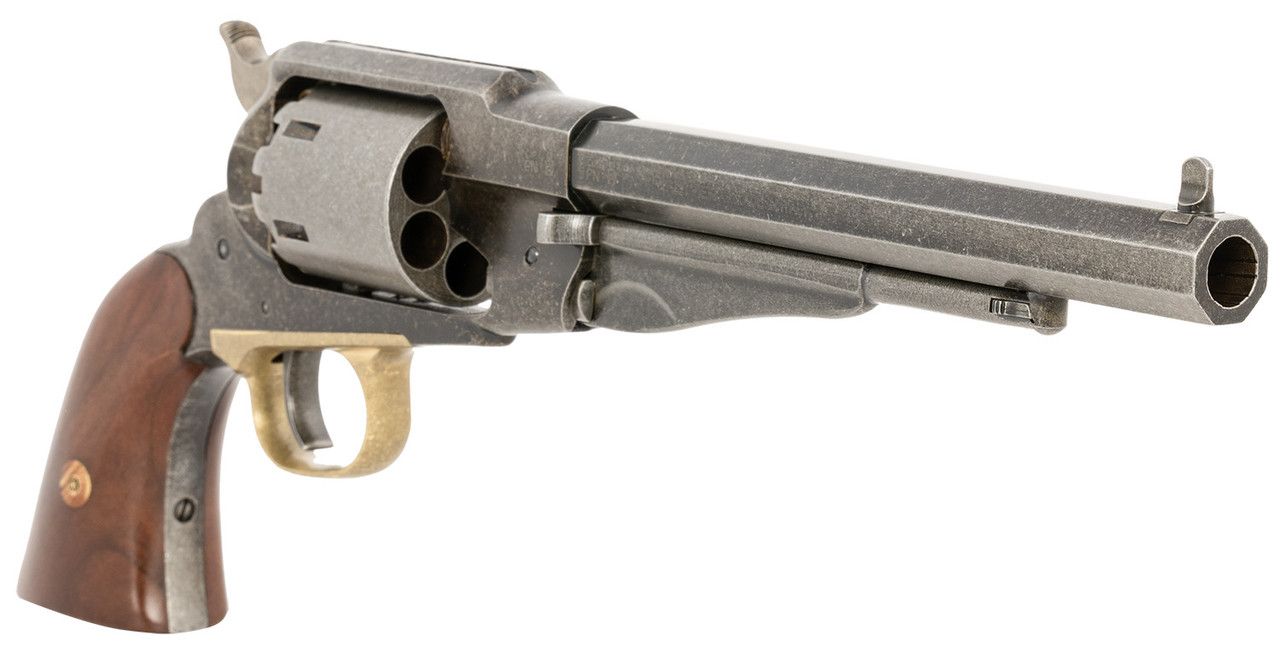
Revolvers came along in the percussion era rather than the flint one, which is why every black powder revolver in this catalogue is a cap and ball gun and none of them is a flintlock. The Colt Navy and Remington patterns of the American Civil War period used caps and round balls, and many original guns were later converted to cartridges.
The reproductions are what the catalogue actually holds, and they follow a small number of historical patterns.
Pattern
Notes
1851 Navy
open-top frame, usually .36, often seen in .44 in reproduction
1858 Remington
solid top strap, .44, the stronger frame of the two
1860 Army
open-top, .44, the later Colt profile
Sheriff and Pocket variants
shortened barrels on the same frames
Pietta and Uberti build most of them in Italy, and they reach buyers under Taylor's, Cimarron and Traditions badges as well as their own, which is the same importer pattern that runs through single-action cartridge revolvers. Loading one is a genuinely different operation from loading a rifle, because each chamber is charged from the front of the cylinder and then capped from behind.
What the catalogue holds
Group
Records
.50 calibre muzzleloading rifles
104
CVA muzzleloaders
88
Traditions muzzleloaders
81
CVA .50 calibre
57
Traditions .50 calibre
65
.44 calibre black powder handguns
36
Flintlock, across two tags
23 deduped
Deduplicated the whole thing comes to 247 records, which for a category with almost no search traffic in this site's data is a substantial and completely unwritten surface.
Most of it belongs to two brands. CVA and Traditions between them account for the bulk of the modern muzzleloading rifle market, and both sell overwhelmingly inline guns with 209 primers, which is the type least likely to say so in its name.
Reading the name for what is missing
Word in the name
What it tells you
Flintlock
flint ignition, buy flints and priming powder
Percussion, caplock, sidelock
caps on a nipple
209, pellet, or a bolt-action description
a modern inline
Hawken, Kentucky, PA Pellet, Deerhunter
a model family that exists in more than one ignition type
Nothing at all
193 of 247 records here
The fourth row is the trap. Traditions sells the PA Pellet in both flintlock and inline form, and the Hawken pattern exists as flintlock and as percussion, so a model name settles nothing on its own. Neither does the calibre: .50 is the common bore across all three systems.
A pair of problems in this catalogue came out of writing this article, and both are the same shape. The tag for flintlocks contained a Traditions Hawken explicitly described in its own name as a percussion kit, which is the opposite ignition system from the tag it was in. And flintlocks are split across two overlapping tags that share only 8 of 23 records between them, so neither page shows the reader the full set. The percussion gun is removed; the split is recorded for a proper merge.
What each system costs to keep running
System
Consumables
Practical note
Flintlock
flints, priming powder, main charge
the flint is a wearing part and needs replacing and knapping
Percussion
caps, main charge
caps are sized, and the wrong size falls off or jams
Inline
209 primers, pellets or loose powder
closest to modern shooting, the breech plug needs removing to clean
Cap and ball revolver
caps, powder, balls, lubricant over the chambers
the slowest to load of anything here
None of that is exotic, but it is all specific. A percussion cap is not a 209 primer and a flint is not either, so working out which one the gun eats belongs before the purchase rather than after it.
What to check before buying one
Start with ignition, since nothing else can be decided without it. Then the calibre, which is mostly .50 with .54 and .45 present and .58 and .69 appearing on the historical reproductions. Then whether the barrel is round or octagonal, which is the fastest visual sort between the traditional guns and the modern hunting ones.
For a revolver the questions are different again: pattern first, since 1851 Navy, 1858 Remington and 1860 Army handle and load differently, then calibre between .36 and .44, then whether the frame is brass or steel.
The one thing worth doing that no listing will do for you is looking at the lock in the photograph. A flint clamped in jaws above a pan is unmistakable once you have seen it, a percussion hammer sits over a small nipple, and an inline has neither because its ignition is hidden inside the breech. The picture is more reliable than the name for the whole of this category.
Nick Sawinyh - Nick Sawinyh is a father, husband, hobby farmer, and gun enthusiast from Kentucky. He founded GunsNation and writes most of what appears on this blog.