Sort every .357 Magnum revolver in this catalogue by action type and the result is not what the cartridge's history would predict. Single-action revolvers, the Colt Peacemaker pattern, come to 254 records. Double-action revolvers come to 143.
The .357 Magnum was designed in 1935 for a double-action Smith & Wesson. The single most common thing to find it in today is a replica of a gun that was designed in 1873, for black powder, and discontinued before the cartridge existed.
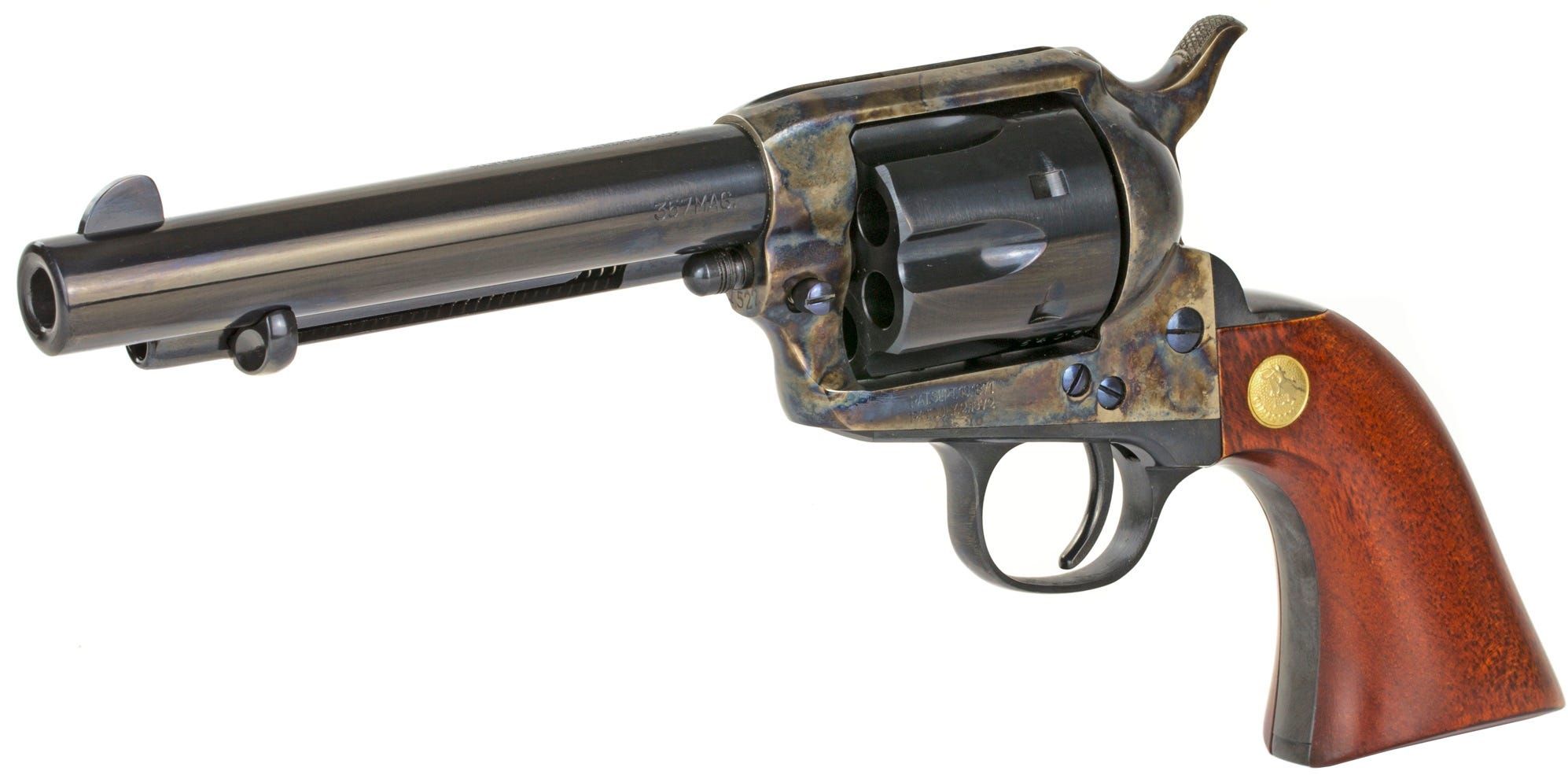
Case-hardened frame, one-piece walnut grip, loading gate, ejector rod, and the barrel says 357 MAG.
What the cartridge was actually for
Elmer Keith, Phillip B. Sharpe and Douglas B. Wesson developed the .357 Magnum together, and it went on sale in 1935. Part of the motivation was Colt's .38 Super, at the time the only American pistol cartridge that would go through a car body or an early ballistic vest, which took velocities above 1,000 feet per second.
The first gun chambered for it was Smith & Wesson's Model 27, a heavy, hand-fitted double-action revolver aimed squarely at police work. The original load put a 158 grain bullet out at an advertised 1,525 ft/s for 816 ft⋅lbf, and that figure came off an 8.75 inch barrel, which is worth remembering every time you see it quoted next to a three inch carry gun.
Invalid Date
More Articles
Detail
Introduced
1935
Developed by
Elmer Keith, Phillip B. Sharpe, Douglas B. Wesson
First revolver
Smith & Wesson Model 27
The problem it answered
Colt's .38 Super and the demand for penetration above 1,000 ft/s
Original advertised load
158 gr at 1,525 ft/s, 816 ft⋅lbf, from an 8.75 in barrel
Maximum pressure
44,000 psi under C.I.P.
Reputation and design intent both point at a large double-action revolver, and the catalogue does not.
The .38 Special relationship, which is the useful part
Both cartridges fire a bullet of the same 0.357 inch diameter. The .357 case is about an eighth of an inch longer, and that extra length is doing a safety job: it will not chamber in a .38 Special revolver, so the more powerful round cannot be loaded into a gun that was not built for it.
The relationship runs one way only.
In a .38 Special revolver
In a .357 Magnum revolver
.38 Special
correct
works, and is the normal practice round
.357 Magnum
will not chamber, the case is too long
correct
That asymmetry is the most practically useful fact about buying one. Every .357 revolver in this catalogue is also a .38 Special revolver, which means the cheap, mild, low-recoil practice ammunition and the heavy defensive load run through the same cylinder. For a new shooter that is the whole argument for the chambering.
What the catalogue actually holds
Action
Records
Single action
254
Single and double action
281
Double action
143
The three groups do not overlap. Add the last two together and the conventional modern revolver still leads at 424 records, but a third of the entire .357 surface is the Colt Single Action Army pattern, which needs the hammer cocked by thumb for every shot and unloads one chamber at a time through a side gate.
Nothing about that design is optimised for a 44,000 psi cartridge. It persists because the cartridge fits it and because cowboy action shooting is a real sport with real equipment requirements, which is a more durable reason than nostalgia.
The single-action half
Most of it comes from five importers and makers whose guns are more closely related than the badges suggest.
Maker
What they build
Cimarron
1873 Model P and Frontier patterns, heavily period-correct
Taylor's and Co
the largest single-action surface here, same 1873 lineage
Uberti
the Italian factory behind much of what the others sell
Pietta
the other Italian factory, same story
Chiappa
1873 patterns plus its own designs
Buyers comparing a Cimarron against a Taylor's against a Uberti are frequently comparing three importers of guns from the same two Italian factories, finished and specified differently. That is the same badge-engineering pattern that runs through imported shotguns, and it is worth knowing before treating the brand as the variable.
The double-action half
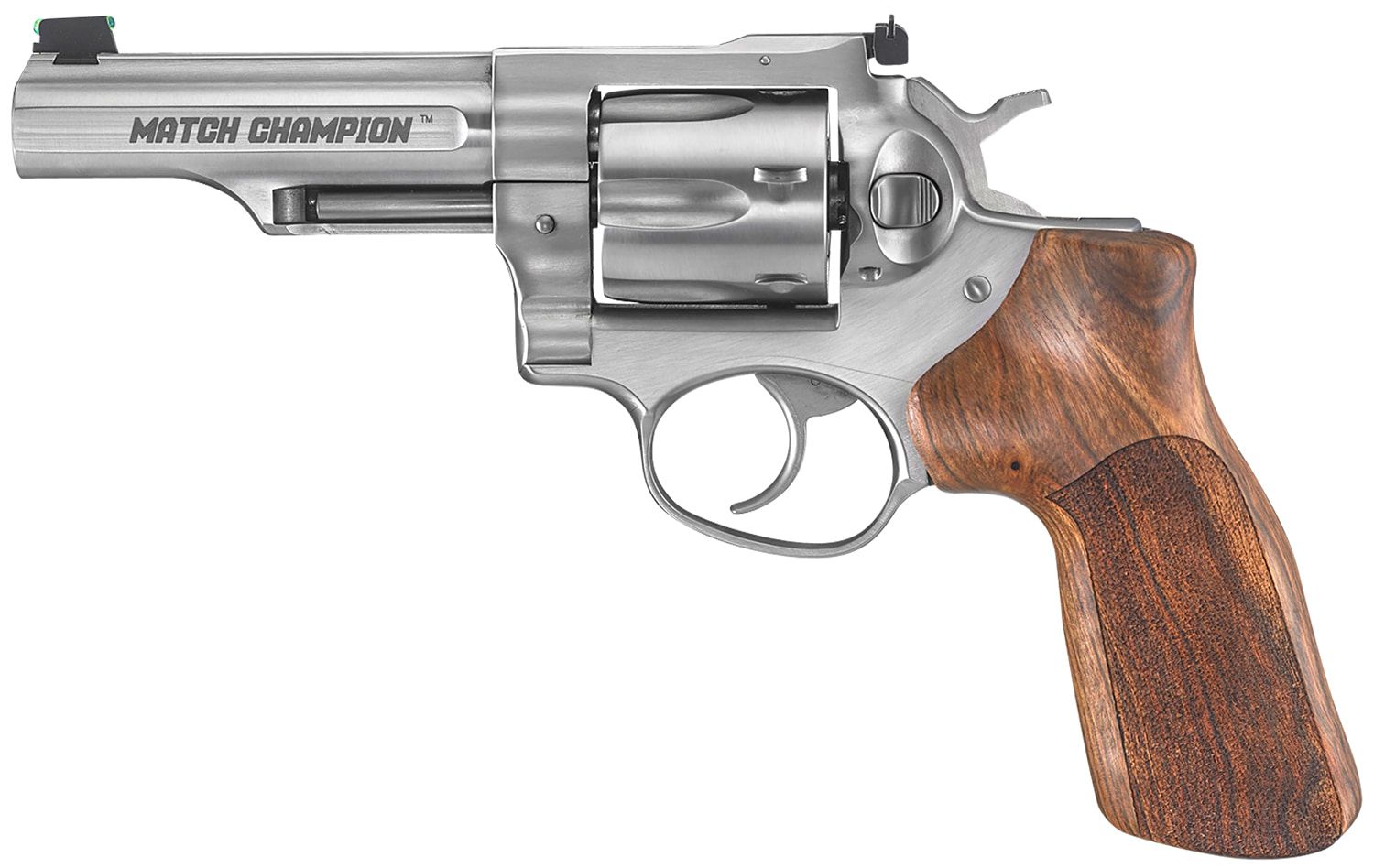
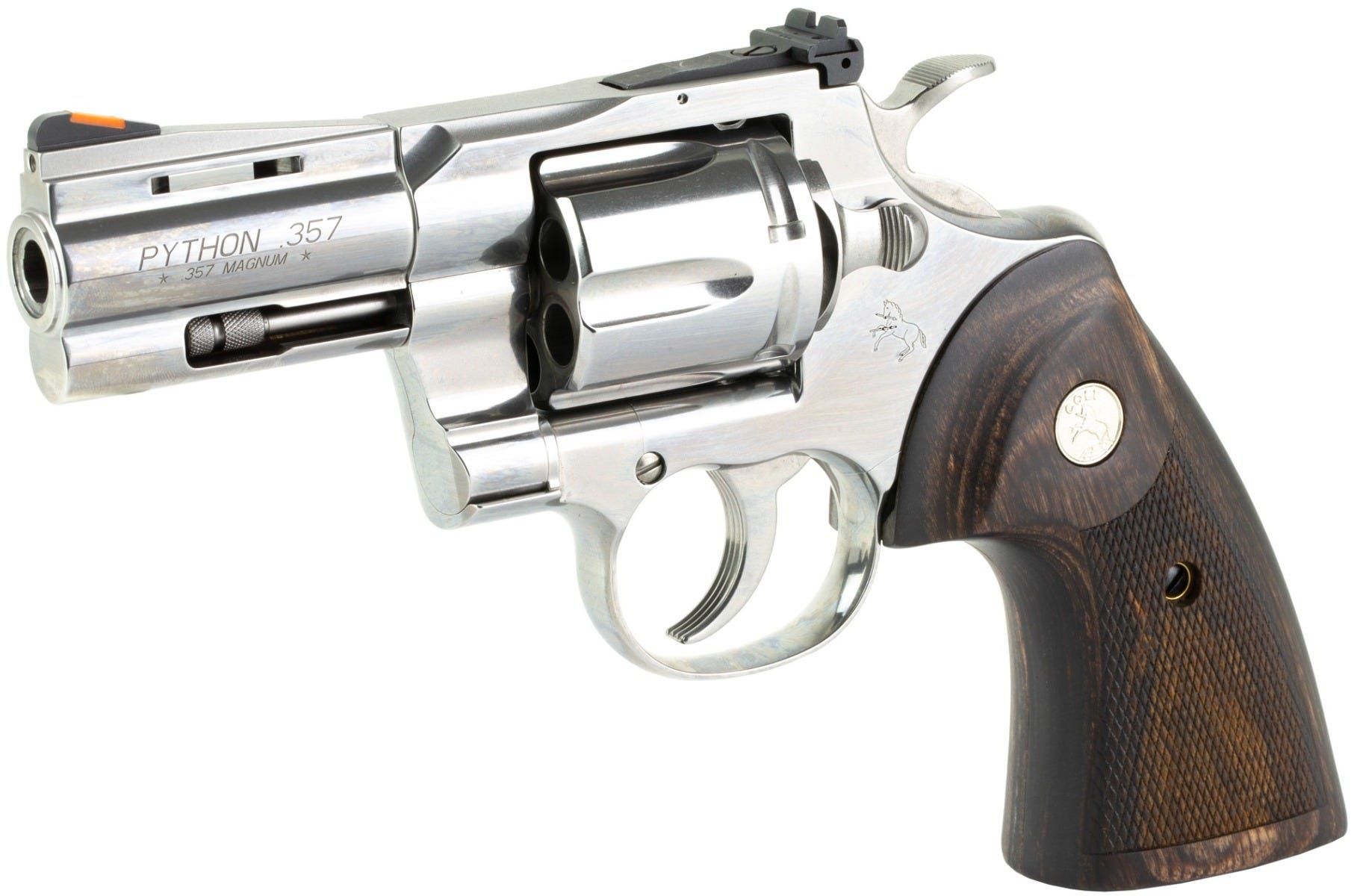
The names here are the ones the cartridge's history would lead you to expect: Smith & Wesson's L-frame 686 and its seven-shot Plus version, Ruger's GP100 and its match variants, Colt's Python, reintroduced after decades away and still the most talked-about trigger in the category, and Taurus at the accessible end with a deep bench of models.
Barrel length is where this half of the catalogue actually varies, and it varies more than the cartridge's advertising ever admitted.
Barrel length
Records
under 3 in
118
3 to 4 in
179
4.1 to 5 in
173
5.1 to 6 in
146
6.1 to 8 in
41
over 8 in
5
That 1,525 ft/s came off 8.75 inches of barrel. Of the 662 .357 revolvers here that record a barrel length, three reach 8.75 inches or more. The number everyone quotes for this cartridge came off a barrel almost nobody buys, while 118 records sit under three inches, where it means something quite different. A short-barrelled .357 is a real thing to buy, but it is not the gun the ballistics table describes.
The oddities worth knowing
Chiappa's Rhino fires from the bottom chamber of the cylinder rather than the top, which drops the bore axis nearly in line with the hand and changes how the gun moves in recoil. It is the one genuinely different mechanism in the category, and it comes in both single-action and double-action forms.
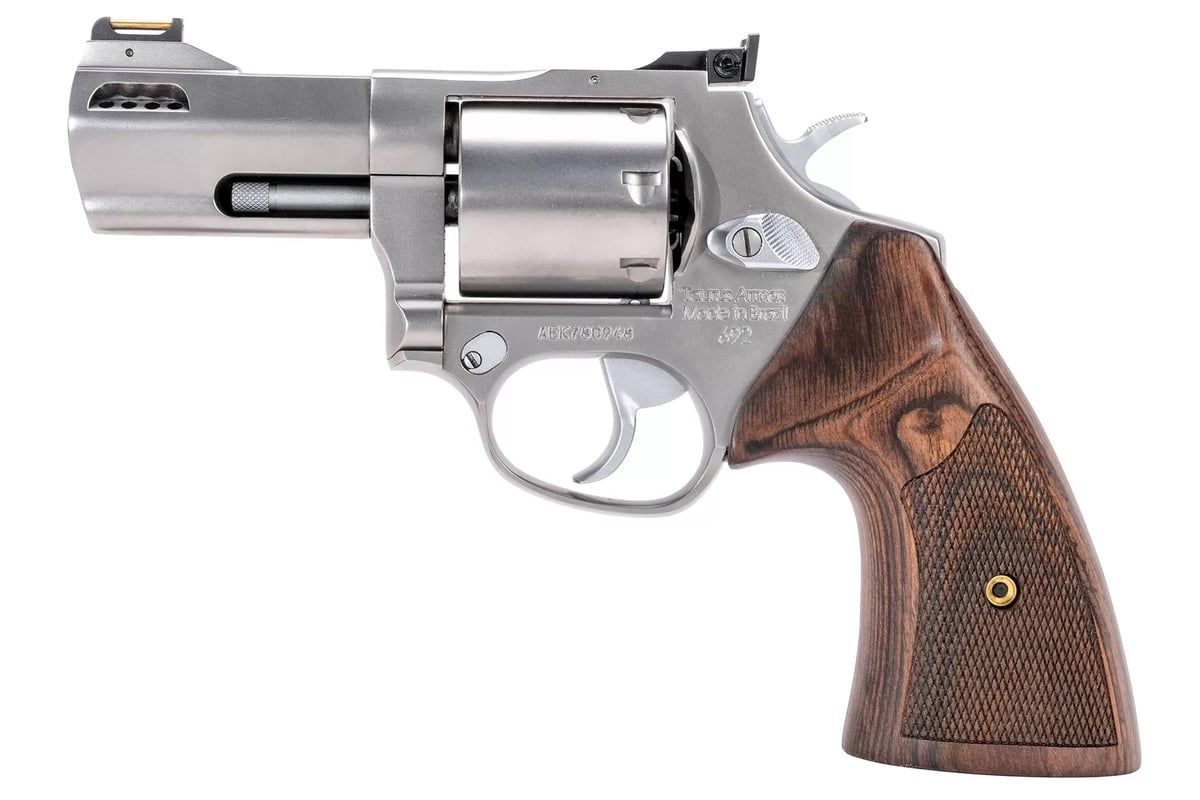
Taurus's 692 ships with two cylinders, one in .357 Magnum and one in 9mm, swapped by the user. It solves the ammunition-cost problem in a different direction from the .38 Special trick.
Manurhin's MR73 is the outlier at the top: a French service revolver built for the Gendarmerie, made in small numbers, and now sold in the United States under the Beretta name. The catalogue lists it in Sport, Gendarmerie and Match configurations, and one record had it filed as a pistol until this article was written.
Reading a .357 listing
Step
What to read
What it tells you
1
Action type
single action means an 1873 pattern, thumb-cocked, gate-loaded
2
Barrel length
the quoted ballistics almost never come from a barrel this short
3
Importer versus factory
Cimarron, Taylor's, Uberti and Pietta overlap heavily
4
Frame size
a .357 on a small frame is a different gun to shoot than one on an L-frame
5
Second cylinder
a 692 or a convertible ships with two, most guns do not
The .38 Special question does not need to be in that list, because the answer is always yes. Any revolver chambered in .357 Magnum will fire .38 Special, and for most owners that is the ammunition it will actually see most of the time.
What the list will not settle is the single-action question, and that one is not a specification. A gate-loaded 1873 replica and a swing-out-cylinder GP100 are both correctly described as .357 Magnum revolvers, and they are not remotely the same purchase.
Nick Sawinyh - Nick Sawinyh is a father, husband, hobby farmer, and gun enthusiast from Kentucky. He founded GunsNation and writes most of what appears on this blog.