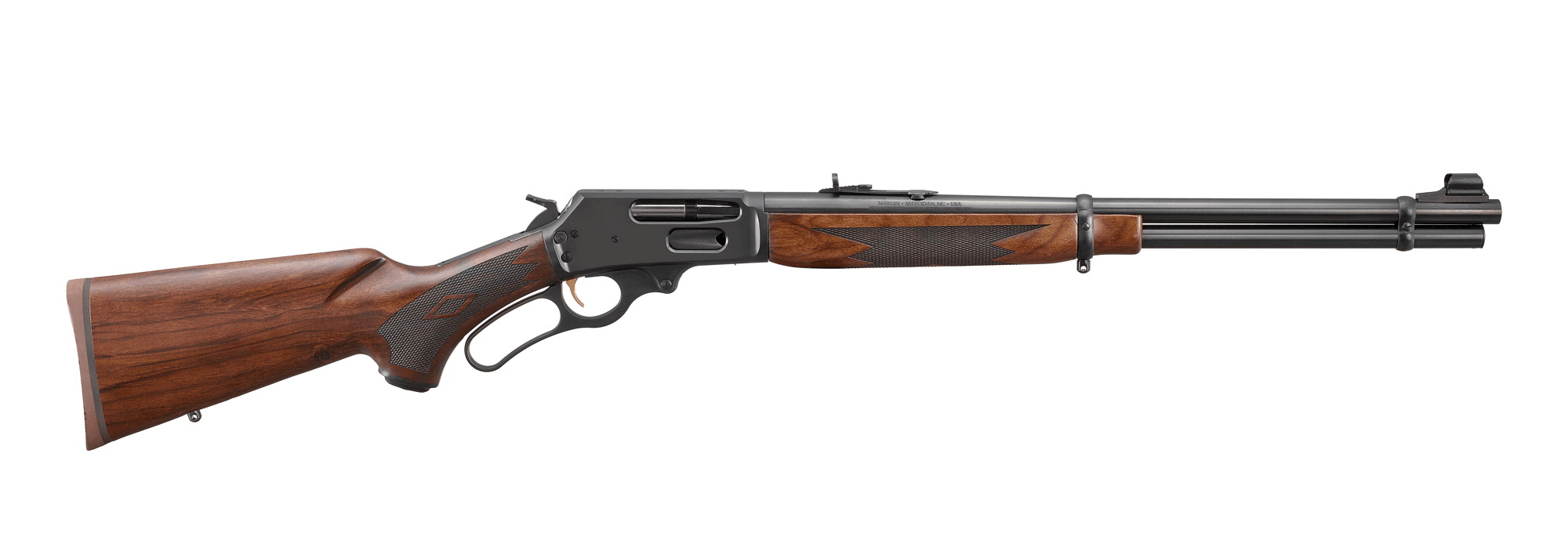
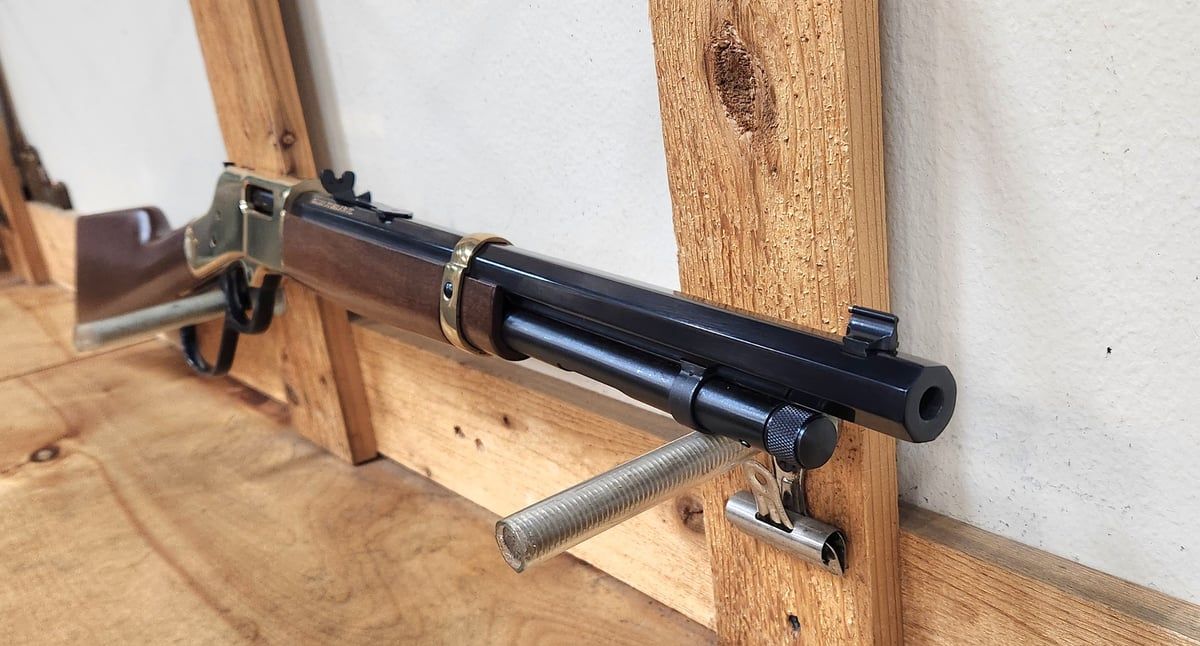
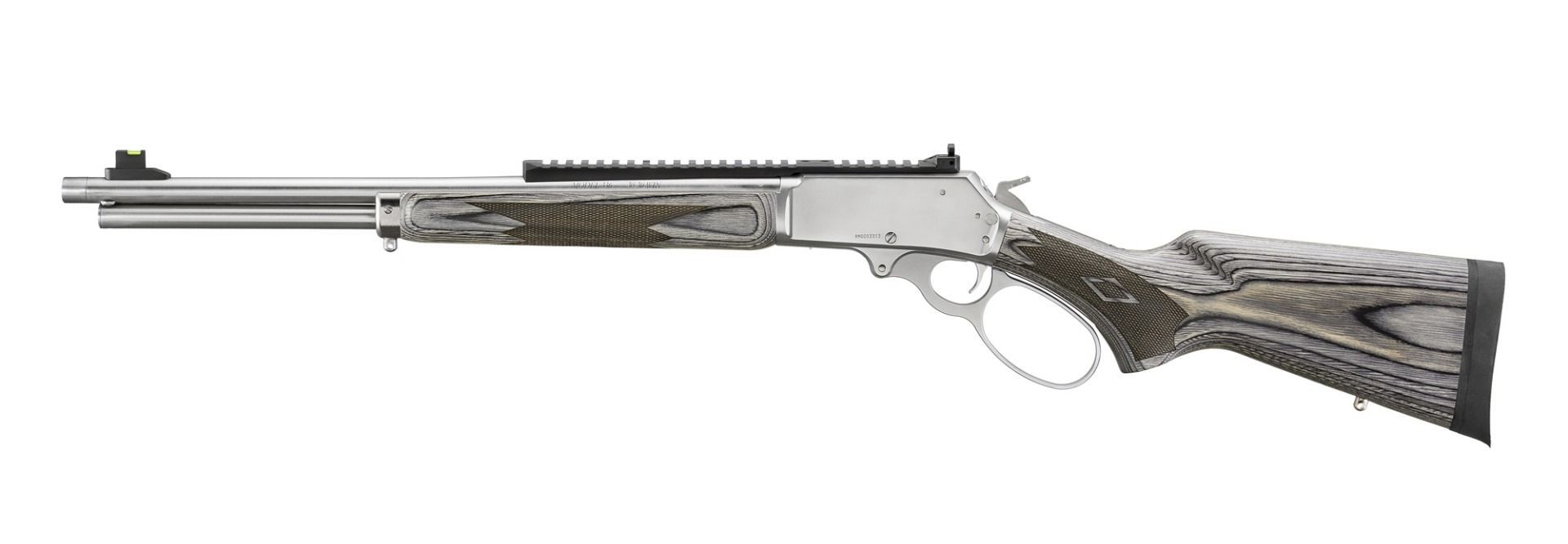
When Marlin put the 1894 out in 10mm Auto, the most-repeated response from people who already own lever guns was a question: what is this for, when .357 Magnum exists and has since the 1930s?
It is a fair question, and it applies to the whole category. A lever gun is not one rifle. It is a mechanism that has been fitted to more than a dozen cartridges, and those cartridges do not overlap the way a rack of them at a gun store suggests. Some share ammunition with a revolver. Some throw a bullet heavy enough for any animal on the continent. Two are rimfire. One is a shotgun shell.
The tube magazine decides almost everything
Most lever guns feed from a tube running under the barrel, cartridges nose to tail in a line. Each bullet tip rests against the primer of the round in front of it, and under recoil that column slams backwards.
A pointed bullet sitting on a primer is a firing pin waiting for a hard enough jolt. So tube-fed lever guns take flat-nosed or round-nosed bullets, which rules out most modern high-velocity rifle cartridges, because those need a sharp point to hold velocity downrange.
The rest of the chambering list follows from that. Black powder era cartridges work, because they were designed around flat bullets already. Revolver cartridges work for the same reason. Modern pointed rifle cartridges do not, unless the rifle abandons the tube.
Invalid Date
More Articles
Hornady's LEVERevolution line exists to narrow that gap, using a soft polymer tip that deforms against a primer rather than striking it. It moved .30-30 and .45-70 performance up meaningfully without changing the underlying rule.
Henry's Long Ranger shows what happens when the rule is removed. It drops the tube and feeds from a detachable box magazine, and its chambering list changes completely: .223 Remington, .243 Winchester, .308, 6.5 Creedmoor. Pointed bullets, because nothing is resting on a primer.
Family one: revolver cartridges
The largest group in the catalog, and the one that has grown fastest. A lever gun in a revolver cartridge does something no rifle cartridge can, which is share ammunition with a handgun.
Chambering
Also fires
Typical use
Catalogue depth
.357 Magnum
.38 Special
The default. Deer at short range, hogs, targets, cheap practice on .38
Deepest of any lever chambering
.44 Magnum
.44 Special
More weight than .357, same logic, heavier recoil
Second deepest
.45 Colt
none commonly
Cowboy shooting, big bore at low pressure
Very deep, mostly reproduction rifles
.44-40 Winchester
none
The original 1873 pairing, now a period choice
Shallow, and specialist
10mm Auto
none
The newcomer, and the one people question
A handful of models
The .357 lever gun rewards a closer look, because the ballistics shift more than most people expect. A .357 Magnum load leaving a revolver has four to six inches of barrel to work with. The same cartridge in a rifle has sixteen to twenty. That is not a marginal gain. It turns a defensive handgun round into a workable short-range deer cartridge, out of a gun that stays light and reasonably quiet.
The .38 Special compatibility matters as much as the ballistics. Practice ammunition costs less, recoil drops to almost nothing, and the rifle a hunter carries in November is the same rifle a new shooter can learn on.
.44 Magnum runs the same argument with more weight and more recoil. It hits harder, costs more to feed, and is the better choice when the animals are bigger or the range is shorter.
The 10mm question has an honest answer. It exists because 10mm is popular in handguns at the moment, and the shared-ammunition logic that justifies .357 applies just as well. It fills a shelf rather than a ballistic gap, which is a perfectly good reason to build a rifle if your handgun is already a 10mm.
Family two: rifle cartridges
These do not pair with a handgun. They exist because a rifle can use pressure and case capacity a revolver cannot.
Chambering
Character
Where it makes sense
.30-30 Winchester
The reference point for a century
Woods deer inside two hundred yards
.45-70 Government
Heavy, slow, enormous frontal area
Big animals, close, including bear country
.35 Remington
Wider than .30-30, similar range
A quieter cult favourite, thinner on the shelf
.450 Marlin
.45-70 performance in a belted case
Modern actions, factory pressure headroom
.243, .308, 6.5 Creedmoor
Box-fed only
Long Ranger, where the tube rule stops applying
.30-30 has outlasted every attempt to replace it, and not out of nostalgia. It puts a heavy enough bullet into a deer at woods distance, from a light rifle with mild recoil, in a pattern that has been in production since the 1890s.
.45-70 has the opposite temperament. The case dates to 1873 and the original load was black powder, which is why modern manufacturers publish three separate pressure tiers: loads safe in an original trapdoor Springfield, loads for lever actions like the 1895, and heavy loads intended only for the strongest modern actions. Those tiers are not interchangeable. A load built for a modern Marlin can wreck a nineteenth-century rifle, and this is the most important safety fact in the category.
What .45-70 buys is frontal area and momentum up close. It is a poor choice past two hundred yards and a very good one at fifty.
The rimfires
Chambering
Notes
.22 LR
Cheap, quiet, the traditional first rifle. Tube capacity often in the high teens
.22 WMR
More velocity and range, more cost, a genuine small-game step up
A .22 lever gun does something the mechanism is unusually good at. Working a lever is a deliberate, visible action, which makes it a better teaching platform than a semi-automatic that cycles invisibly. Henry built much of its business here, and the Browning BL-22 has long had a reputation for a very short lever throw that suits smaller shooters.
The lever shotguns
.410 bore lever shotguns are the more practical of the two, useful on small game and pests. The 12 gauge guns are mostly Winchester 1887 reproductions, and their appeal is largely that they look like the gun from the film. That is a fine reason to buy one, but they are not competitive with a pump gun on any measure except character.
What changed recently
For most of the last century, choosing a lever gun meant choosing a wood-stocked hunting rifle. That is no longer the whole market.
The .357 and .30-30 shelves now carry rifles with threaded barrels, optics rails, M-LOK handguards and ghost ring sights: the Smith & Wesson 1854, the Marlin 1894 and 336 Dark series, the Citadel Levtac-92, the GForce LVR, Heritage's Model 92. The action underneath is the traditional one. What is bolted to it is not.
Two things drove the shift. Suppressors became common enough that a threaded muzzle reads as an expected feature rather than a specialist request, and the lever action suits them unusually well, since there is no gas system venting at the shooter and no reciprocating bolt carrier adding noise of its own. Separately, red dot optics got small and durable enough to make sense on a rifle that throws its brass upward.
Choosing, in the order that actually matters
Start with the animal or the target, not the rifle.
If you already own a revolver, match it. A .357 rifle beside a .357 revolver keeps your ammunition supply down to one cartridge, and the rifle will outperform the handgun by a margin that surprises people the first time they chronograph it.
For deer in woods, .30-30 remains correct, and the used market is full of them. .35 Remington does the same job with a wider bullet, if you can find ammunition reliably.
For large animals at close range, .45-70, with careful attention to which pressure tier your particular rifle is rated for.
For a new shooter's first rifle, .22 LR. The lever action is a genuinely better teaching tool than the alternatives here.
If you want range, accept that you are leaving the tube behind, and look at a box-fed rifle in a pointed-bullet cartridge.
If you want the look, .45 Colt and .44-40 in a reproduction 1873 or 1892 will give you exactly that, and they shoot well.
The one mistake worth avoiding is choosing a chambering because that was the rifle on the rack. Ammunition availability varies enormously across this list. .357, .44 Magnum, .30-30, .45-70 and .22 LR sit on nearly every shelf. .44-40, .35 Remington and .450 Marlin do not, and a rifle you cannot feed conveniently is a rifle you will not shoot.
Nick Sawinyh - Nick Sawinyh is a father, husband, hobby farmer, and gun enthusiast from Kentucky. He founded GunsNation and writes most of what appears on this blog.