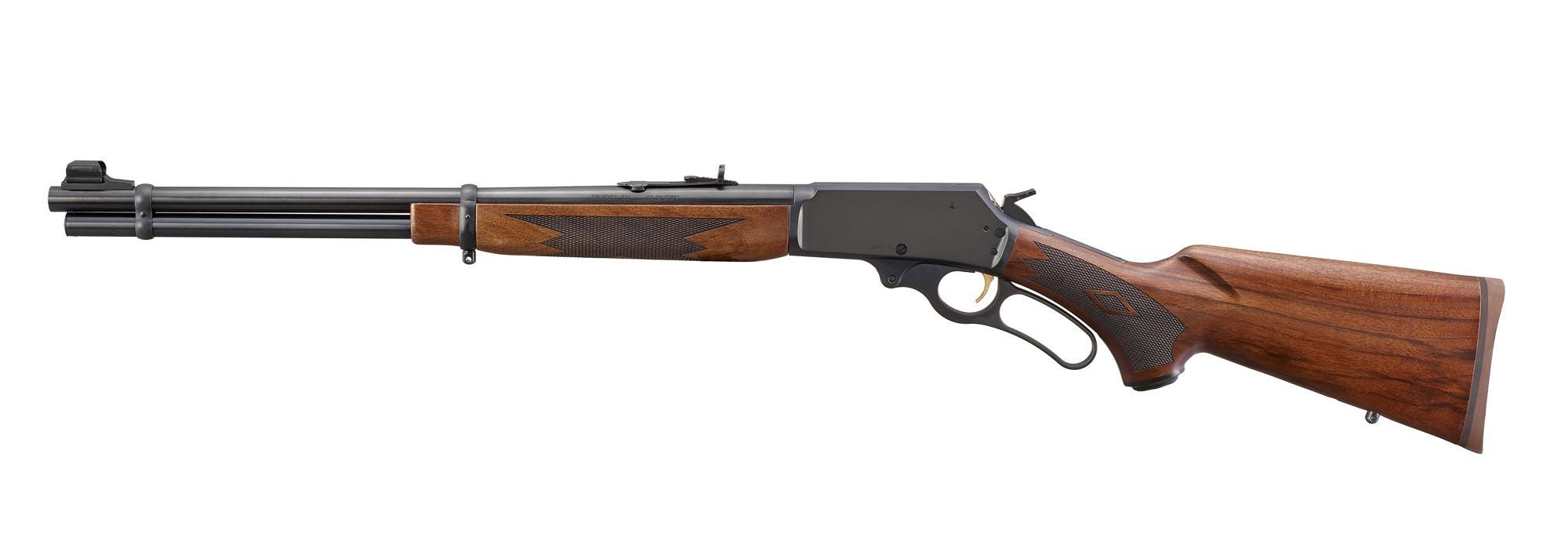
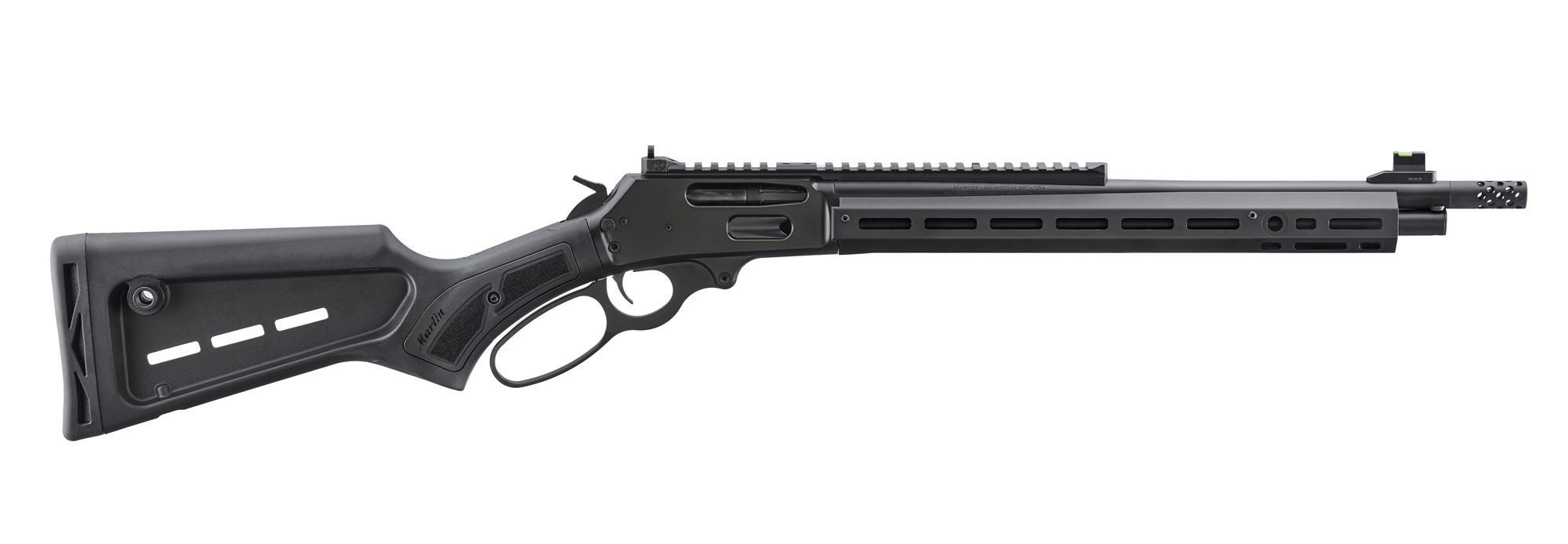
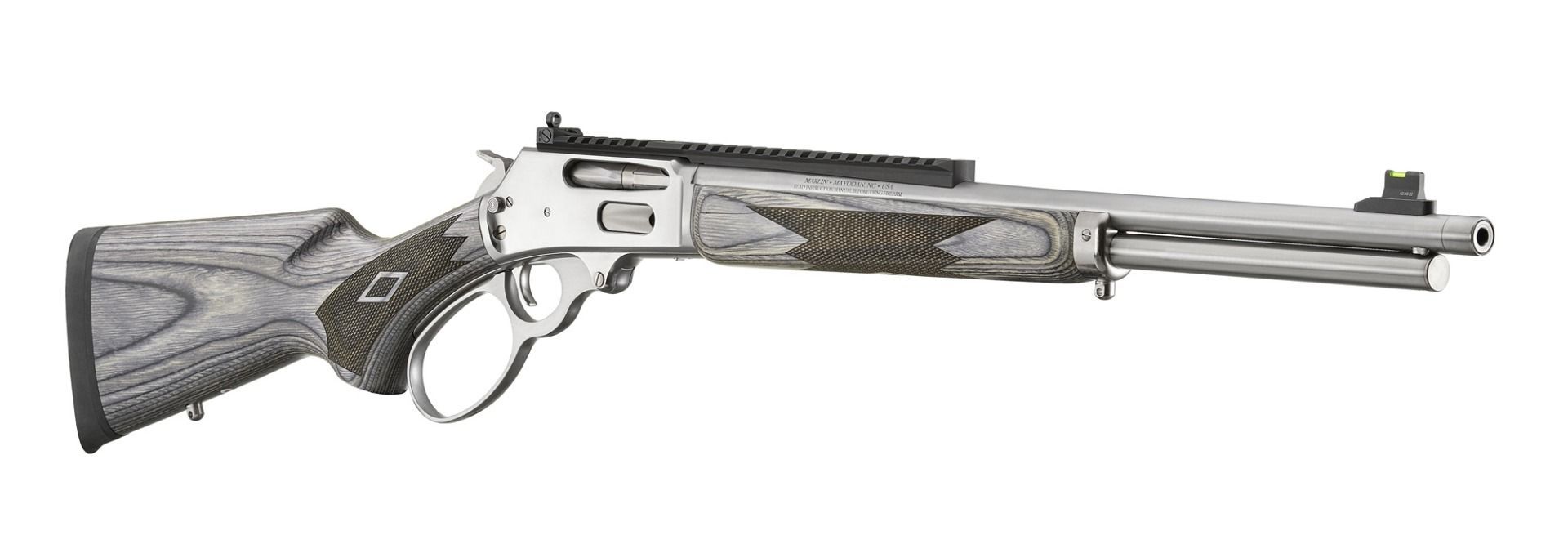
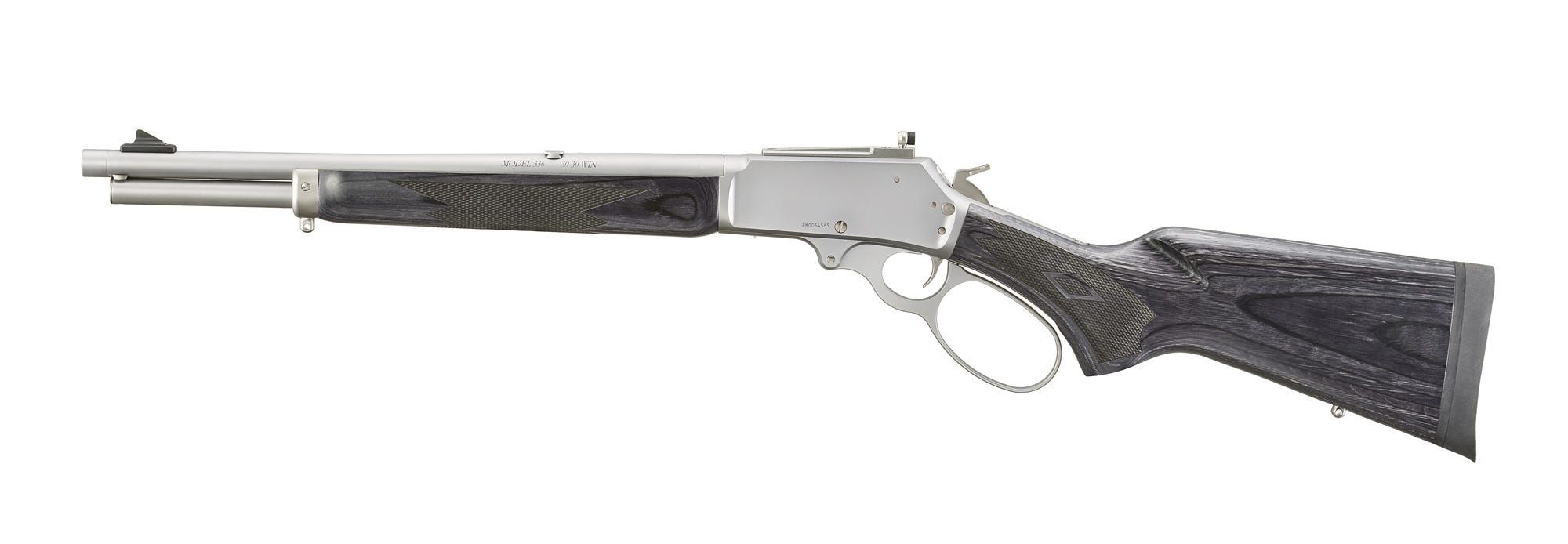
Most people meet this rifle before they learn its name. It hangs behind bars and turns up in cabin scenes, and it comes out of dead grandfathers' closets with no paperwork attached. On screen, viewers reliably call it a shotgun. @amygobrrr, correcting a cabin scene in Yellowjackets, had to spell it out: it is a rifle, specifically a Marlin 336 in .30-30, and it is not a shotgun.
The confusion is fair enough. For most of a century the 336 has been the generic American lever gun in the public imagination, while the actual product line split into dozens of versions that are not interchangeable and are not equally well made. Introduced in 1948 to replace the Model 36 (itself a renamed Model 1893), it has passed four million rifles, second only to the Winchester Model 94 among lever actions ever built.
It has also been built by three companies in three places, which is the thing the used market actually argues about.
One action underneath all of them
Every rifle here is the same gun wearing different furniture, which is why the variants read as options rather than separate models.
The 336 has a solid-top receiver and ejects to the side. That one decision separates it from its lifelong rival. The Winchester Model 94 throws empty cases straight up out of an open-topped receiver, so a scope mounted over the bore sits in the ejection path. The Marlin throws its cases out the right side and leaves a flat closed roof, drilled and tapped at the factory. That is why the 336 became the default scoped woods rifle while the 94 stayed an iron-sight gun. It is a geometry problem the Winchester never solved without side mounts or offset rings.
Invalid Date
More Articles
Inside, the 336 runs a round-profile breech bolt, chrome plated, in a machined receiver, with coil main and trigger springs rather than the flat springs of the older designs. The lever throw is short and the action is famously slick once broken in.
Rifling is the other Marlin signature. The company introduced Micro-Groove in 1956, cutting a larger number of shallower grooves than conventional rifling. The argument was that shallow grooves deform a lead bullet less and seal gas better. It works well with jacketed hunting ammunition and has a long reputation for being fussy with heavy cast lead, which is why some later and larger-bore Marlins went back to deep-cut Ballard rifling. If a barrel is stamped Micro-Groove and you intend to shoot cast, find that out before you buy rather than after.
The default chambering is .30-30 Winchester and always has been. Over its life the 336 has also come in .35 Remington, .32 Special, .219 Zipper, .38-55, .375 Winchester, .307 and .356 Winchester, and .338 Marlin Express. Of those, .35 Remington is the one you will still meet with any regularity, and it remains a good close-cover cartridge.
The letters after the number
Marlin's naming convention is not a code so much as an accumulation. Letters got appended as configurations appeared, reused across decades, and occasionally dropped. The table below gives the measured configuration from our catalog listings.
Variant
Barrel
Overall
Weight
Stock
Finish
336 Classic
20"
38.5"
7.5 lb
Walnut
Satin blued
336C Heritage (.35 Rem)
20"
38.5"
7.0 lb
American black walnut
Blued
336W
20"
38.5"
7.0 lb
Walnut
Blued, Micro-Groove
336SS
20"
38.5"
7.0 lb
American black walnut
Stainless
336BL
18"
37"
7.0 lb
Brown laminate
Blued, big loop
336XLR
24"
42.5"
7.5 lb
Black/gray laminate
Stainless
336Y
16.25"
33.25"
6.5 lb
Walnut-finished hardwood
Blued
336TDL
20"
38"
7.0 lb
Walnut
Blued
336 SBL
19.1"
37.25"
7.3 lb
Laminate
Stainless
336 Trapper
16.2"
34.25"
7.1 lb
Black laminate
Satin stainless
336 Dark
16.17"
35.5"
6.9 lb
Polymer
Satin, threaded
C is the Classic carbine, the 20-inch pistol-grip walnut gun most people picture. For most of the rifle's life this was simply "the 336".
W is the working-grade version. Same barrel, same action, walnut-finished hardwood instead of figured wood, less polish on the metal. It was the cheap one to buy, not the cheap one to own.
Y is Youth: a shortened stock and a 16.25-inch barrel. At 6.5 lb it is the lightest 336, which also makes it a good rifle for a small-framed adult.
SS is stainless throughout, meant for wet country.
BL is Big Loop, the oversized lever, usually paired with laminate.
XLR is the long-range experiment: a 24-inch stainless barrel and laminate stock, built around flexible-tip spitzer ammunition to stretch the .30-30 past what the traditional carbine allows.
TDL is Texan Deluxe, a straight-grip dress variant.
SBL is stainless, big loop, laminate, and in modern form it adds a full-length top rail and ghost ring sights.
Trapper is the short-barrelled stainless carbine, threaded in current production.
Dark is the blacked-out modern series: polymer or blacked hardwood, parkerized or matte metal, threaded muzzle, XS sights.
Two cautions. The Dark Series is not exclusively a 336, because the same treatment was applied to the big-bore guns, and the .444 and .45-70 versions are 1895-family rifles that dealers routinely file under the 336 heading anyway. And "Heritage" and "Classic" are marketing overlays rather than model designations, attached to guns from different decades.
Three companies have built this rifle
Which era a rifle came from changes what it is worth, by a wide margin.
Era
Built by
Where
Roughly
Original
Marlin Firearms
New Haven, then North Haven, Connecticut
1948 to 2010
Remington
Remington Arms
Ilion, New York and Mayfield, Kentucky
2011 to 2020
Ruger
Sturm, Ruger & Co.
Mayodan, North Carolina
2021 onward
Remington completed its acquisition of Marlin on January 28, 2008. In March 2010 it announced it would close the North Haven plant, and the Connecticut operation shut in 2011 after 141 years, with tooling and work moved to Remington facilities. Rifles built in the years right after the move earned a reputation and a nickname that stuck: Remlin. The complaints were about fit and finish, wood-to-metal gaps, rough actions, and inconsistent quality control, not about the design.
Remington Outdoor went through bankruptcy in 2020 and its assets were broken up. Sturm, Ruger acquired the Marlin brand, intellectual property and hard assets at the September 2020 auction and closed that November. Ruger restarted the big-bore 1895 first, then announced new 336 production on March 27, 2023.
The JM stamp, and what it is actually telling you
JM is a proof mark. Connecticut-built rifles were proof tested after assembly, fired with overpressure test rounds, and hand stamped if they passed. Because a person applied it by hand, its exact position moves around from rifle to rifle, usually on the barrel near the receiver. When production left Connecticut, the mark went with it.
So the stamp reliably tells you one thing: this rifle was assembled and proofed at the Connecticut plant. Given the reputation of the early post-move guns, wanting that is not irrational.
It tells you nothing about the condition of the rifle in front of you, and the market has drifted a long way past that distinction. The honest version comes from owners rather than sellers. @Messianic73 described a stainless 336XLR that was "remarkably accurate" and then developed a fault where the lever would pop out of battery on firing. A repair did not hold. He sold it for twice what he paid, "because it had the JM stamp," and says he told the buyer repeatedly that the gun did not work. The buyer paid anyway.
The misrepresentation runs the other way too. @Dicky_Paul_95 bought a Marlin 1895 GBL that the seller described as Marlin made, and found on arrival it was a Remington-era gun. "Otherwise it's very nice but not what I bought." If you are buying unseen, pin the maker down in writing before money moves.
The stamp does certify something real. It is just being priced as a quality guarantee when what it actually records is provenance.
When the stamp is gone, read the barcode
There is a check that works from a listing photograph, without finding a hand-applied mark on a rifle you cannot handle. Look at the UPC. Manufacturers own their barcode prefixes, and Marlin's changed hands with the company.
Prefix
Belongs to
Means
026495
Marlin Firearms
Connecticut or Remington-era production
736676
Sturm, Ruger & Co.
Ruger-built Marlin
Ruger uses 736676 across its whole catalog, on 10/22s and revolvers and everything else, and the Marlins it builds carry it too. Every Ruger-era 336 in our listings begins 736676 and every earlier one begins 026495.
The limitation: this separates Ruger from everything before it, and it will not separate Connecticut from Remington, because Remington kept using Marlin's existing prefix. For that you still need the JM stamp, the serial prefix, or the seller's word. But if the question is whether a rifle is one of the new ones, the barcode answers it off a photograph of the box.
What Ruger actually changed
Ruger kept the 1948 action and rebuilt the process around it.
Stainless components are heat treated before machining rather than after, which removes the warpage that used to complicate assembly. Barrel and receiver threads are cut precisely enough to eliminate the barrel shim, the small spacer previously needed to time a barrel to its receiver at the right clock position. Hammer notches are cut by wire EDM, which is what makes trigger pulls repeatable from rifle to rifle. Stock inletting was redesigned so recoil loads land on the parts of the stock built to take them. Ruger's stated machining tolerance is one to two thousandths of an inch.
None of that changes how the rifle works. All of it goes at the complaints that attached to the previous decade of production.
The rebuilt line covers four configurations, which map onto the historical letters:
336 Classic, 20-inch blued barrel and checkered black walnut, the traditional carbine.
336 SBL, stainless with laminate, a full-length rail and ghost ring sights.
336 Trapper, 16.2-inch stainless, threaded, with a Skinner rear sight.
336 Dark, the lightest of the four at 6.9 lb, polymer stocked and threaded for a suppressor.
Why the magazine tube dictates your ammunition
Rounds in a tubular magazine sit nose to primer in a line, each bullet tip resting against the primer of the cartridge ahead of it. Under recoil, a pointed tip hammering a primer is how you get a chain fire. That is why .30-30 ammunition has traditionally been loaded with flat or round-nosed bullets, and why the cartridge got its reputation as a short-range proposition: blunt bullets shed velocity quickly.
The workaround is a soft flexible polymer tip, aerodynamic in flight but deformable enough to sit harmlessly against a primer in the magazine. Hornady's LEVERevolution is the well-known example, and it extends the useful range of a .30-30 by a real margin. The 336XLR exists to exploit exactly that, its 24-inch barrel wringing more velocity out of flexible-tip loads than a 20-inch carbine can.
Otherwise, treat the 336 as what it is. Inside about 150 yards in timber, on deer and hog, it is close to ideal: fast to shoulder and shaped to be carried all day.
Which one to look for
There is no single best 336, but the choice narrows fast once you name the job.
A woods rifle you will scope. Any 20-inch C or W. The receiver comes drilled and tapped, and this is the configuration the rifle was designed around.
Weather and boat work. 336SS, or a stainless SBL or Trapper.
Shortest and handiest. Trapper or Dark, both near 34 to 35 inches overall.
A smaller shooter, or a light rifle for anyone. 336Y at 6.5 lb, the lightest in the family.
Stretching the cartridge. 336XLR, fed flexible-tip ammunition.
Buying used and unsure. Handle it first. Cycle the lever and check the wood-to-metal fit at the receiver, and get the maker confirmed in writing. The mechanism is simple enough that a good one announces itself.
The action itself has not changed since 1948. What changed is who machined the parts, and how well.
Nick Sawinyh - Nick Sawinyh is a father, husband, hobby farmer, and gun enthusiast from Kentucky. He founded GunsNation and writes most of what appears on this blog.