Most people meet the triple-barrel shotgun in a video game. It has been a loot drop in Fortnite, a Warbond weapon in Helldivers 2, and a boss gun in half a dozen indie shooters, and it shows up in each of them for the same reason: three barrels look absurd in the best way. The question that follows is always the same one, and it is the reason you are probably reading this.
Yes, it is a real gun, and you can buy one.
What almost nobody explains is that virtually every triple-barrel shotgun sold in the United States is the same gun wearing a different name. Once you know that, the whole category gets a lot easier to shop.
It is not an over-under, and it is not a side-by-side
This is the first thing to get straight, because dealer listings get it wrong constantly. You will see the same gun advertised as an "over-under" on one site and a "side-by-side" on another. Both descriptions are wrong.
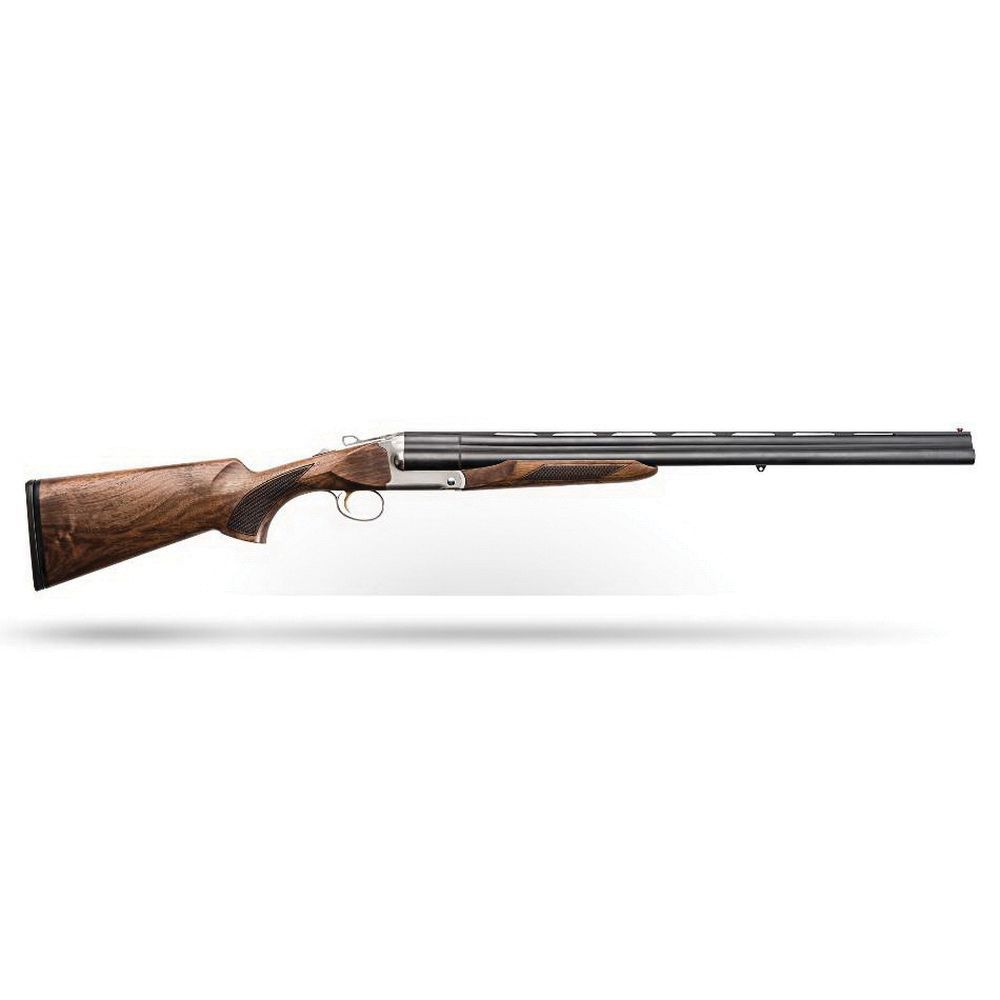
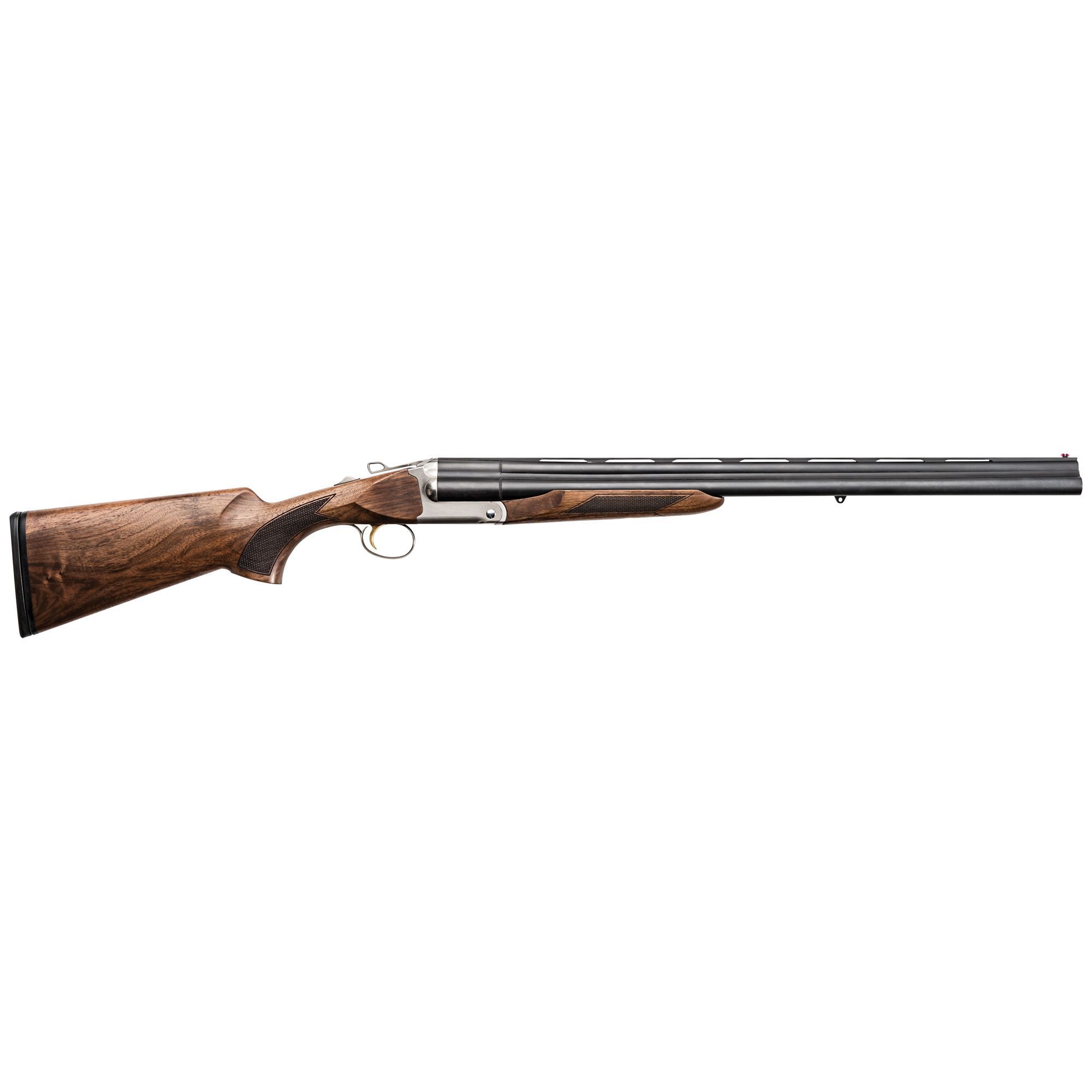
The barrels sit in a triangle. Two of them run side by side along the bottom, and the third sits on top, centered above the gap between them. Look down the rib and you see one barrel, not three, which is the entire point of the layout: you get a conventional single sight plane and a conventional cheek weld, and the extra tube hides underneath your sight picture instead of cluttering it.
Invalid Date
More Articles
The gun fires from a single trigger in a fixed order. Right barrel first, then left, then top. The mechanism is mechanical rather than recoil-driven, which matters more than it sounds: a dud shell does not stall the sequence, so a second trigger pull moves you to the next barrel instead of leaving you standing there. Opening the action to reload resets the sequence and cocks the firing pins, so the gun always starts from the right barrel.
Three chambers, one trigger, one sight plane, break action. That is the whole design.
One gun, six badges
The triple-barrel shotgun on the American market is designed and built by Akkar Silah Sanayi, in Istanbul. Akkar sells it under its own name as the Mammut. Everything else is a badge.
Chiappa imports it and sells it as the Triple Crown (long barrels) and the Triple Threat (short barrels).
Charles Daly, which Chiappa owns, sells it as the Triple Crown, Triple Threat, Triple Magnum, TripleTac, and Triple Honcho.
In the UK it has been sold as the Akkar Triple Crown, at one point through Edgar Brothers.
Chiappa is an Italian company, which leads a lot of buyers to assume the gun is Italian. It is not. It is Turkish, and it comes out of the same factory regardless of which of those names is on the receiver. Akkar is a serious high-volume shotgun manufacturer, and the metalwork on these reflects that more than the badge does.
Practically, this means you should shop across all of those names as one pool rather than treating a "Chiappa" as a different animal from a "Charles Daly." The differences that actually matter are barrel length, gauge, and stock type.
Why anyone built a three-barrel gun in the first place
Multi-barrel guns are not new, and the modern triple is not really descended from the famous ones.
The German drilling (from drei, three) has been around since Sauer & Sohn took out patents on the three-barrel configuration in 1881, developing the barrel steel with Krupp. But a drilling is a different idea: usually two shotgun barrels over a rifle barrel, built so one gun could handle birds and deer on the same walk. The M30 Luftwaffe Drilling issued to German aircrew as a survival gun is the best-known example. Those are combination guns. Mixed purposes, mixed barrels.
The modern triple is the simpler idea: three barrels, all the same gauge, all doing the same job. It exists for two reasons.
Capacity where repeaters are capped. In the UK, a shotgun held on a standard shotgun certificate is limited to two in the magazine plus one in the chamber. A pump or semi-auto gives you three, and so does a break-action triple, except the triple does it without the paperwork of a firearms certificate. One British shooter put it plainly while shopping for one: on a shotgun certificate, the repeaters "have to be limited to 2 in the mag and 1 in the chamber, there's no point." That logic drove a real chunk of the gun's European sales and it is invisible to most American buyers.
Mixed loads. Three chambers means three different shells, fired in a known order. Birdshot, birdshot, slug. Or less-lethal first and buckshot behind it. No pump or semi-auto lets you stage ammunition that way, because they feed from one stack.
If three sounds excessive, the Italian maker FAMARS built the Rombo, a four-barrel break action in 28 gauge and .410 arranged in a diamond, also firing sequentially from a single trigger. So there is a ceiling above this, and somebody has already hit it.
The lineup, decoded
There are four families, and they differ mainly in barrel length and what is bolted to the back of the receiver.
Triple Crown is the full-size sporting gun. Long barrels, walnut, meant for clays and birds.
Triple Magnum is the Triple Crown in camouflage with heavier chambering, aimed at waterfowl.
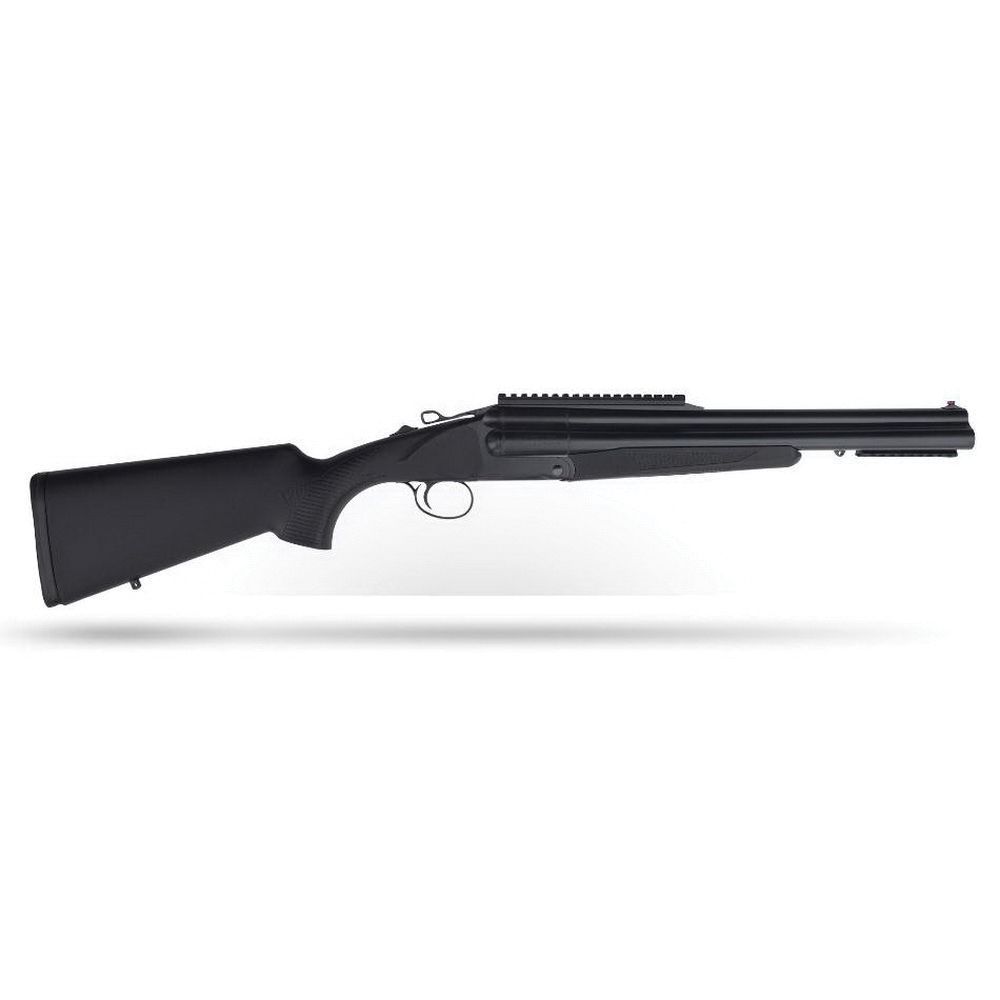
Triple Threat is the short-barrel version with a shoulder stock. Same action, 18.5-inch barrels.
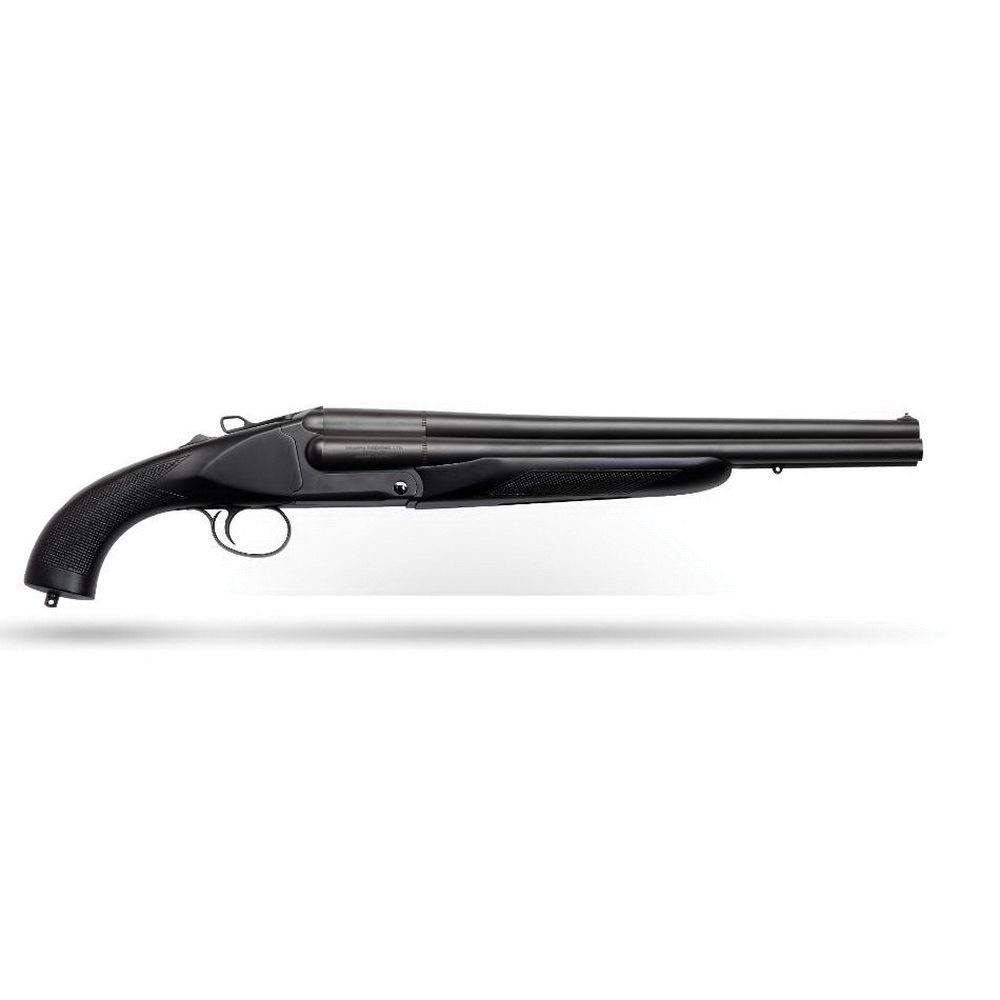
TripleTac and Triple Honcho are the pistol-grip versions. No shoulder stock, which is how a gun with an 18.5-inch barrel gets down to 27 inches overall.
Family
Model
Gauge
Barrel
Overall
Weight
Triple Crown
12ga
12
28"
45"
8.7 lb
Triple Crown
Gen 2 12ga
12
28"
43"
8.0 lb
Triple Crown
20ga
20
26"
43"
7.6 lb
Triple Crown
20ga Elite
20
26"
42"
7.5 lb
Triple Crown
28ga
28
26"
43"
7.6 lb
Triple Crown
.410
.410
26"
41"
6.8 lb
Triple Crown
Combo .410/28
.410 + 28
26"
43"
6.8 lb
Triple Crown
Combo 20/28
20 + 28
26"
-
-
Triple Magnum
MAX-5 camo
12
28"
46"
8.2 lb
Triple Magnum
Timber camo
12
28"
45.25"
8.6 lb
Triple Threat
12ga walnut
12
18.5"
35.5"
8.2 lb
Triple Threat
12ga black chrome
12
18.5"
35.75"
8.2 lb
Triple Threat
12ga railed
12
18.5"
35.5"
-
Triple Threat
20ga
20
18.5"
35.5"
7.2 lb
Triple Threat
.410
.410
18.5"
35.5"
7.1 lb
TripleTac
12ga
12
18.5"
27"
6.0 lb
Triple Honcho
Gen 2 .410
.410
18.5"
27"
6.0 lb
Note on weights: dealer listings for the small-bore guns very often repeat the 12-gauge figure of 8.7 lb, which is wrong by more than a pound. The numbers above are the manufacturer's, cross-checked against spec sheets by UPC. If you see a 28 gauge or a .410 advertised at 8.7 lb, the listing has copied the 12-gauge spec.
Two combination guns are worth calling out separately. The .410/28 combo and the 20/28 combo ship with two sets of barrels, so one receiver covers two gauges. At 6.8 lb the .410/28 is the lightest of the full-size sporting guns, tied with the straight .410, and if the appeal of a triple is novelty plus versatility, that is the most versatile configuration offered. Only the stockless pistol-grip guns come in lighter, at 6 lb.
How it actually handles
Weight is the trade-off, and it runs in both directions depending on which version you pick.
A 12-gauge Triple Crown lands around 8.7 lb. A comparable two-barrel over-under sits closer to 7.5 lb, so you are carrying about a pound of extra steel, and it is all forward of your hands. Two things follow from that. Felt recoil is mild, because mass in front of the receiver soaks it up. The gun is also tiring to carry all day and slow to start moving on a crossing bird. Reviewers describe it as muzzle heavy and note that swinging it well takes deliberate technique, powering it through the swing rather than steering it.
The pistol-grip versions invert the problem. A TripleTac is 6 lb with 12-gauge chambering and no stock to put against your shoulder. That combination produces exactly the recoil you would expect, and it is the most consistent complaint owners raise about that configuration. If you want a pistol-grip triple, the .410 Honcho is the version that makes sense for most people.
On patterning, American Rifleman's testing of the Triple Threat at seven yards produced patterns from four to nine inches across various choke and load combinations, with slight left-to-right deviation between the two lower barrels. That is expected geometry, not a defect: the bottom pair are offset from centerline, so they print marginally off from the top barrel. At shotgun distances with a reasonable choke it is not something you will notice on game. It is something you might notice on paper.
All of them take standard Rem Choke style tubes, and they ship with five, typically skeet through full. That is a genuine convenience and it is worth counting in when you compare against guns that ship with two.
What to know before you buy
Drawn from published tests and from customer reviews across our own listings.
It has extractors, not ejectors. A single extractor lifts all three hulls slightly and you pick them out by hand. On a driven day or a fast clays stage that is genuinely slower than an ejector gun. Nobody mentions this in the marketing.
The trigger is heavy. Testers describe pulls as usable but heavier than ideal, with three to four pounds cited as the target a gunsmith could get it to. Since the mechanism is mechanical rather than inertial, the weight is a comfort issue rather than a reliability one.
The comb is low on the sporting guns. A UK test measured 1.5 inches at the front and 2.5 at the rear and recommended a comb raiser. If you shoot a gun that fits you, expect to shoot under the bird until you fix it.
Quality control varies unit to unit. This is the single most repeated criticism in owner reviews across every version of this gun. Most units are described as solid and well finished for what they cost, and a minority arrive with fit-and-finish problems or minor misalignment that sends them back to the dealer. Buy where you can inspect it or return it.
Parts and support are thin. Owners repeatedly report difficulty sourcing replacement parts and inconsistent response times from support. The accessory ecosystem is close to nonexistent compared to a Mossberg or a Beretta. This is a gun to buy and shoot, not a gun to build out.
It is heavy, and three shots is still three shots. If the appeal is capacity, a pump gives you more for less money and less weight. The triple wins on staging different loads and on being a break action, and it loses on everything a repeater is good at.
Which gauge
12 gauge is the default and where most of the lineup lives. It is also where the weight penalty bites hardest. Pick it if you want one gun for clays, upland, and the occasional slug, and you do not walk far.
20 gauge is the sweet spot for most buyers. About a pound lighter than the 12, still enough payload for anything you would shoot with a break action, and the recoil stays civil in a gun this heavy.
28 gauge is the enthusiast's choice and the one people fall for in the shop. The handling is lovely. Ammunition costs more and you will not find it in every rural hardware store, which owners flag as the practical annoyance.
.410 makes the most sense in the short and pistol-grip guns, where light recoil offsets a light gun with no stock. In a full-size 26-inch sporting gun it is a specialist's toy, and a fun one.
The dual-gauge combos are the interesting outlier. Two barrel sets on one receiver is a genuinely useful package if you want range flexibility, and it is the configuration that best justifies the money.
So who is it for
I will be straight about this. If you want to break clays better, buy a used Beretta over-under and you will shoot better scores for similar money. If you want a home defense shotgun, a pump holds more, costs a third as much, and has parts available everywhere. On pure merit against a defined task, the triple loses most comparisons.
If you live somewhere repeaters are capacity-capped, it is a legitimately clever answer, and that is the market it was designed for.
If staging three different loads in a known firing order solves a real problem for you, nothing else on the market does it.
And if you simply want a triple-barrel shotgun, that is a complete and sufficient reason. It is well made, it is not expensive for what it is, it draws a crowd at every range it visits, and it is one of the few guns left that makes people walk over and ask what they are looking at. Novelty is a real thing to buy, as long as you know that is what you are buying and you do not talk yourself into believing it is also the optimal clays gun.
The mistake to avoid is buying it as a practical decision and then being disappointed that it is heavy, slow to unload, and awkward to find parts for. Buy it with clear eyes and it is a great gun to own.
Nick Sawinyh - Nick Sawinyh is a father, husband, hobby farmer, and gun enthusiast from Kentucky. He founded GunsNation and writes most of what appears on this blog.