One rack at the dealer holds a Ruger PC Carbine and the next holds a Ruger LC Carbine. Both are semi-automatic, both are chambered for a pistol cartridge, and both wear a barrel almost exactly sixteen inches long. The reasonable assumption is that somebody at Ruger changed a letter for marketing reasons.
The letters turn out to be the most useful thing printed on either gun. They tell you where the magazine goes, which magazines will fit, how long the gun is once assembled, and whether it comes apart in your hands or folds. Most of the rest of the listing is finish and furniture.
PC has also meant two different things at Ruger, separated by more than a decade of it meaning nothing at all.
PC, the first time
Ruger's first pistol-calibre carbine was the Police Carbine, launched in 1996. The 9mm version was the PC9 and the .40 S&W version was the PC4, and the design was a shoulder-fired companion for the P-series pistols the company was selling to police departments at the time. The two guns shared a cartridge and, more usefully, a magazine.
That sharing was the pitch. The PC9 fed from P89, P93, P94 and P95 magazines. The PC4 fed from the P91 and P944. An officer carrying a Ruger pistol could drop the same magazine into the carbine in the trunk, and the department bought one supply of magazines instead of two.
The gun borrowed heavily from the 10/22, which is why photographs of it look so familiar and so unlike anything Ruger sells under the name now. It weighed about seven pounds, ran a 16.24 inch barrel, and measured roughly 34 inches overall.
Invalid Date
More Articles
It did not sell. The Hi-Point 995 and the Kel-Tec SUB2000 undercut it at the cheap end of the market, and the police departments it was designed for spent the same years switching to M4 pattern rifles in 5.56, which outclassed a 9mm carbine at every distance that mattered to them. Ruger discontinued it, and by 2007 the Police Carbine was gone.
Then, on 29 December 2017, Ruger announced a new one.
PC, the second time
The gun that came back in 2017 shares a cartridge and two letters with the Police Carbine and very little else. It takes down into two pieces, its receiver is aluminium rather than steel, and it answers the magazine question in a way the first gun could not, because the first gun's answer had been to tie itself to a pistol line Ruger no longer makes.
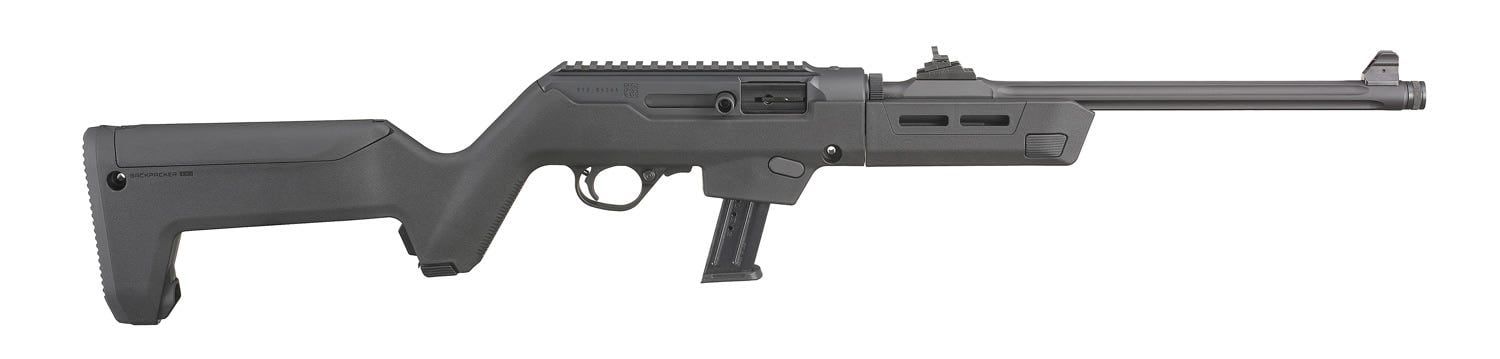
The modern PC Carbine ships with an interchangeable magazine well. Ruger's specification sheet for the base model, number 19100, describes "interchangeable magazine wells for use of common Ruger and Glock magazines," with the SR-series and Security-9 well installed at the factory and a Glock-compatible well included in the box. Swapping them is a user job, not a gunsmith job.
Note where the magazine sits in that photograph. It hangs out of a well ahead of the trigger guard, in the same place a magazine sits on an AR-pattern rifle, and the pistol grip behind it holds nothing. That one detail is what separates this gun from the other Ruger carbine on the rack.
Here is what changed between the two guns that both wore the letters PC.
Police Carbine (PC9, PC4)
PC Carbine
Introduced
1996
announced 29 December 2017
Chamberings
9mm, .40 S&W
9mm, with .40 S&W added in 2019
Magazines
Ruger P-series pistol only
interchangeable well, Ruger SR-series and Security-9 or Glock
Barrel
16.24 in
16.12 in
Overall length
about 34 in
34.37 in
Weight
about 7 lb
6.8 lb
Comes apart
no
yes, barrel and forend separate from the action
The magazine row is the one that killed the first gun and sold the second.
The magazine well is the design
Ask which magazines a Ruger pistol-calibre carbine takes and you get four different answers depending on which line you are holding, and none of them is guessable from the outside.
Line
Chambering
Magazine
PC Carbine
9mm
Ruger SR-series and Security-9 well fitted, Glock well supplied
PC Carbine
.40 S&W
same interchangeable well system
PC Charger
9mm
same interchangeable well system
LC Carbine
5.7x28mm
Ruger-5.7 pistol magazines, fed through the grip
LC Carbine
.45 ACP and 10mm Auto
Glock pattern, fed through the grip
LC Charger
5.7x28mm
Ruger-5.7 pistol magazines, fed through the grip
A buyer who already owns a Glock and wants one magazine supply for both guns can be served by either line, but by different halves of it. On the PC side the Glock well is a part you fit. On the LC side it depends entirely on the chambering, and the 5.7 version will never take a Glock magazine, because no Glock is chambered for the cartridge.
LC is not a PC with a different letter
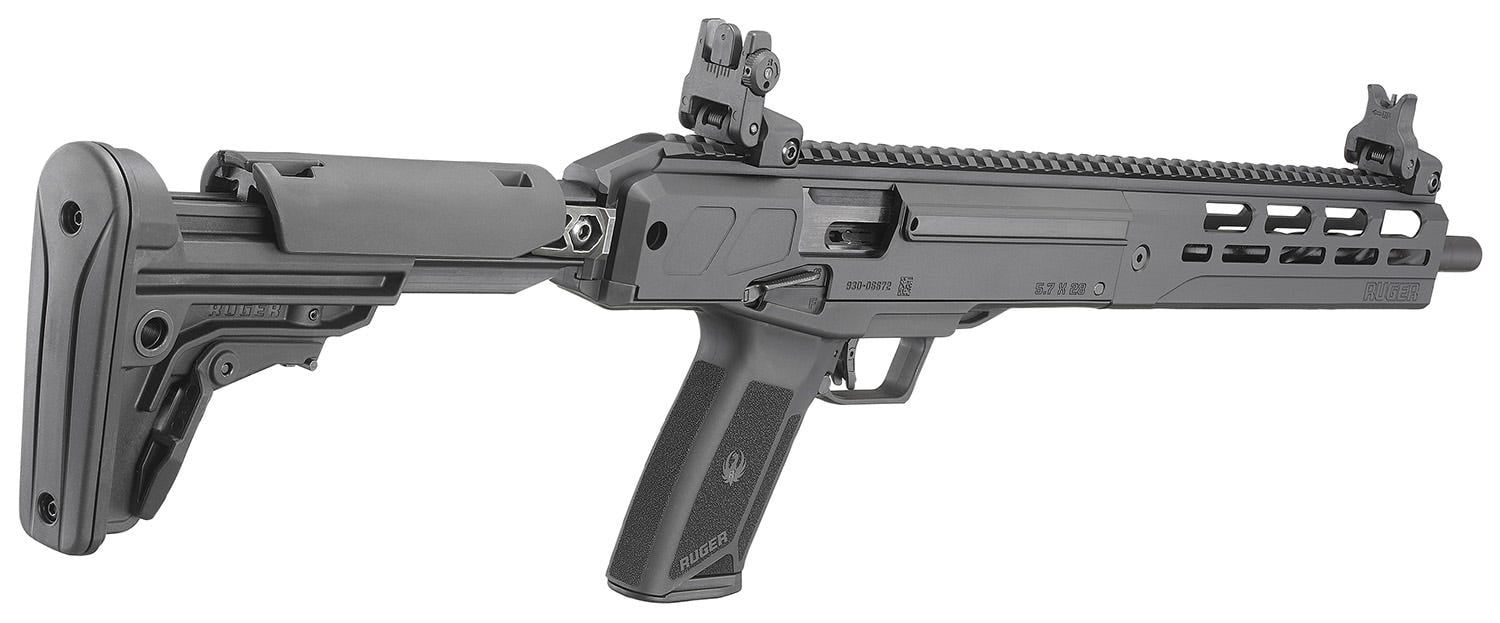
Ruger's specification sheet for the LC Carbine, model 19300, describes a "unique bolt-over-barrel design with the magazine in the grip." Both halves of that sentence do real work. Ruger wrapped the bolt and its recoil assembly back over the barrel rather than sitting them behind it, and moved the magazine into the pistol grip, where a submachine gun carries it, instead of into a well in front of the trigger.
The consequence shows up in a number that looks like a misprint the first time you see it.
Model
Barrel
Overall length
Weight
PC Carbine 19100
16.12 in
34.37 in
6.8 lb
LC Carbine 19300
16.25 in
30.60 in
5.9 lb
The LC Carbine has the longer barrel of the two. It is also 3.77 inches shorter overall and nearly a pound lighter. Ruger cut nothing off the barrel to get there. It folded the receiver back over the barrel and moved the magazine into the grip, so no length had to be reserved in front of the trigger for a magazine well.
The trade is not free. A grip-fed magazine has to be short enough to clear your hand, which is part of why the 5.7 chambering pairs with a slim, high-capacity pistol magazine, and why the .45 and 10mm versions use Glock magazines rather than anything proprietary. A bolt-over-barrel layout also puts the reciprocating mass over the supporting hand instead of behind it, which changes how the gun moves under recoil. Ruger's phrase for the benefit is "excellent balance and control."
The PC Carbine solves length differently, and for storage its answer is arguably the better one: it comes apart. Twisting the barrel and forend assembly off the action leaves two short pieces instead of one long one, which is why the Magpul Backpacker stock exists for it and why so much of its aftermarket is bags and cases.
Charger means the stock came off
Both lines have a stockless variant, and both variants are called Charger. They are not built the same way, and putting them side by side is the clearest demonstration of the bolt-over-barrel point anywhere in the catalogue.
Model
Barrel
Overall length
Weight
Magazine sits
PC Charger 29100
6.50 in
16.50 in
5.2 lb
ahead of the trigger guard
LC Charger 19304
10.30 in
16.00 in
66.5 oz
in the grip
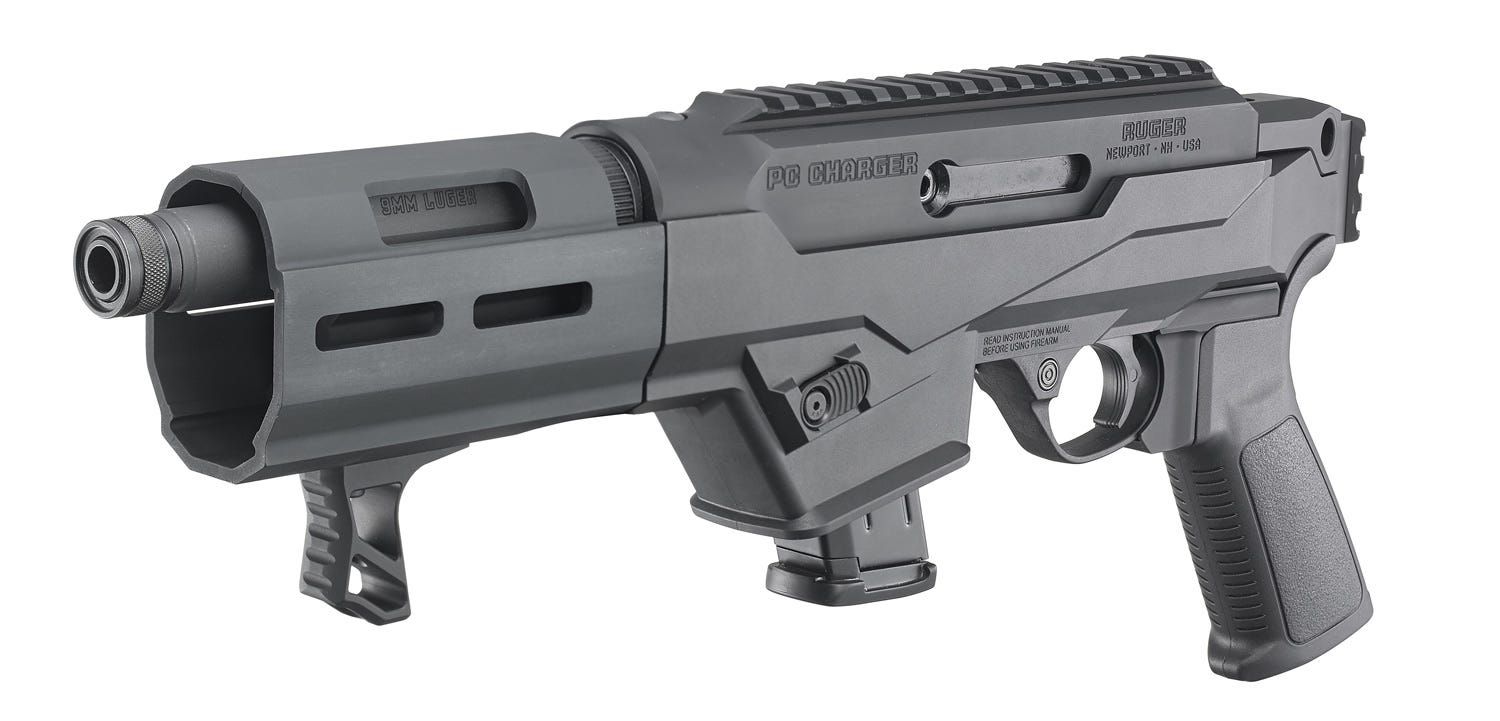
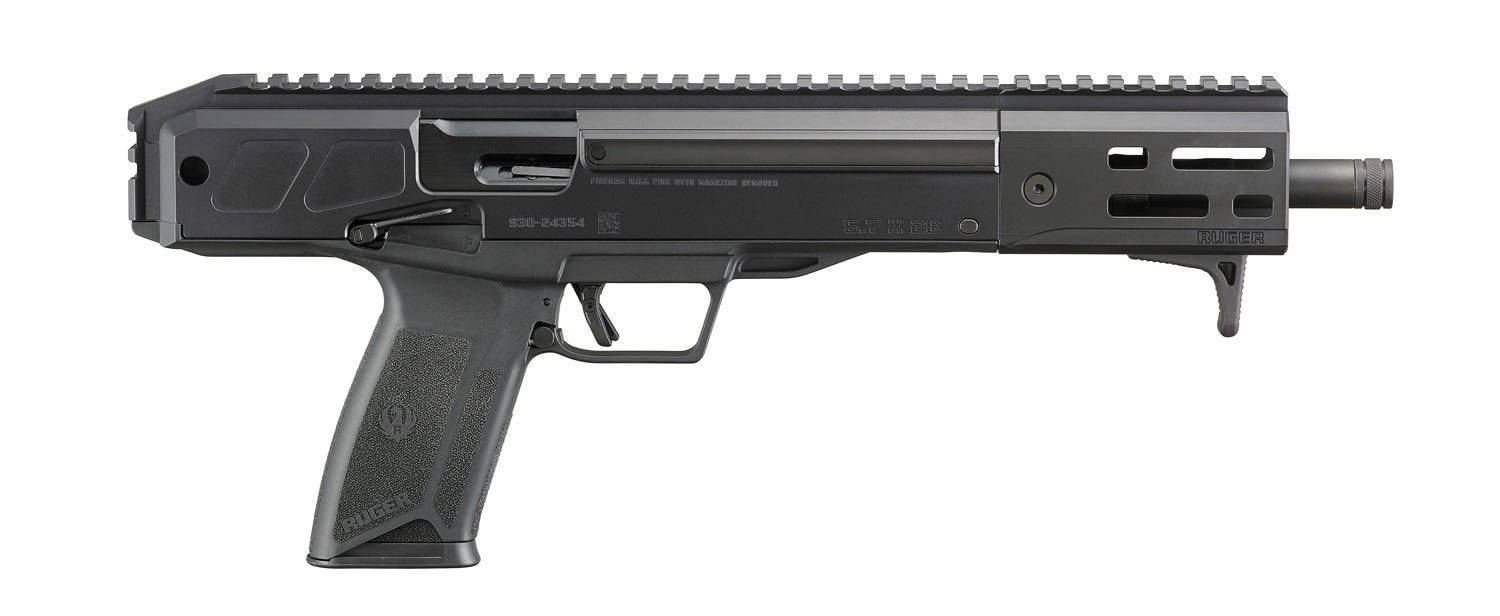
The LC Charger carries a barrel 3.8 inches longer than the PC Charger's and is still half an inch shorter overall. Same manufacturer, same shelf, and the whole difference is where the magazine went and which way the bolt travels.
The PC Charger keeps the takedown lever and the interchangeable well, so it is a PC Carbine with the stock removed and the barrel cut back. Ruger's specification sheet gives it the same "quick separation of the barrel/forend assembly from the action" the carbine has. The LC Charger keeps the LC Carbine's grip feed and adds Ruger's Secure Action fire control, with a protected internal hammer, a bladed-safety trigger and a reversible charging handle.
What a variant actually varies
Once you can read the line and the layout, a listing comes down to a handful of things that genuinely differ between one catalogue number and the next.
Stock is the consequential one on the PC side. A standard synthetic stock, a Magpul PC Backpacker stock and a reversible side-folding stock all sit on the same action, and they do not weigh the same. The Backpacker version, model 19129, comes in at 6.2 lb against the standard gun's 6.8, with the saving coming from the fluted barrel, the aluminium receiver and the stock's stripped profile. Any listing quoting the standard weight on a Backpacker configuration is repeating a figure it never checked.
Length of pull adjusts on both lines by different means. The PC Carbine runs from 12.62 to 14.12 inches using supplied spacers. The LC Carbine's folding stock runs from 12.69 to 14.62 inches without tools. Ruger has been moving the LC arrangement across to the PC line, and said so in February 2025, when the company posted that a PC Carbine model "features a reversible folding stock and adjustable length of pull, just like the LC Carbine you love."
Barrels are threaded at 1/2 inch by 28 on both lines, fluted on the PC Carbine, fluted and nitride treated on the LC. The rifling differs more than you would expect between two guns so often described as the same thing.
PC Carbine 19100
LC Carbine 19300
Twist
1:10 in RH
1:9 in RH
Grooves
6
8
Thread
1/2 in by 28
1/2 in by 28
Receiver
aluminium alloy, Type III hard-coat anodised
aluminium alloy, Type III hard-coat anodised
Sights
protected blade front, adjustable ghost ring rear
adjustable Ruger Rapid Deploy
Finish and colour cover everything else, from plain black through OD green, FDE, stealth grey and the various camouflage patterns. Most catalogue numbers differ here and nowhere else, and it is worth saying plainly that this is the least important row in any of these tables.
Chamberings, and which line got them
Chambering
PC line
LC line
9mm
yes, both carbine and Charger
no
.40 S&W
yes, carbine, from 2019
no
5.7x28mm
no
yes, both carbine and Charger
.45 ACP
no
yes, carbine
10mm Auto
no
yes, carbine
The PC line stayed with the two cartridges the original Police Carbine used, which is neater continuity than Ruger usually gets credit for. The LC line arrived in 2022 chasing cartridges the PC action was never designed around, and the company was explicit about where the 5.7 came from: Ruger posted in May 2025 that it "joined the fun in 2020 with the Ruger-5.7, then added the LC Carbine and LC Charger." The carbine came out of the pistol rather than the other way around, which is exactly why its magazine lives in the grip.
The 10mm and .45 ACP versions are what make the LC line something other than a 5.7 curiosity. They put a serious pistol cartridge behind a 16 inch barrel in a package a foot shorter than an AR.
Reading one listing, start to finish
Take a listing that says "Ruger PC Carbine Takedown 9mm, threaded barrel, 17 rounds" and work through it in order.
PC tells you the magazine well is ahead of the trigger guard and that the gun ships able to take Ruger magazines with a Glock well in the box. Carbine rather than Charger tells you there is a stock and a barrel around 16 inches. Takedown confirms the barrel and forend come off the action, which is standard on this line rather than a feature worth paying extra for. The 9mm and the round count together tell you which well is fitted from the factory. Threaded tells you 1/2 inch by 28.
What the listing does not tell you is the stock, and on this gun the stock is the specification that changes the weight and the packed size. Check the photograph for a Backpacker profile before you trust a weight figure.
Do the same with "Ruger LC Carbine 10mm, 16.25 inch, folding stock" and the reading comes out different at every step. LC puts the magazine in the grip, which for 10mm means Glock pattern. The barrel is longer than the PC Carbine's and the assembled gun is shorter. The stock folds instead of the barrel coming off. And the round count comes from whichever Glock magazine is in the box, not from anything proprietary.
Nick Sawinyh - Nick Sawinyh is a father, husband, hobby farmer, and gun enthusiast from Kentucky. He founded GunsNation and writes most of what appears on this blog.