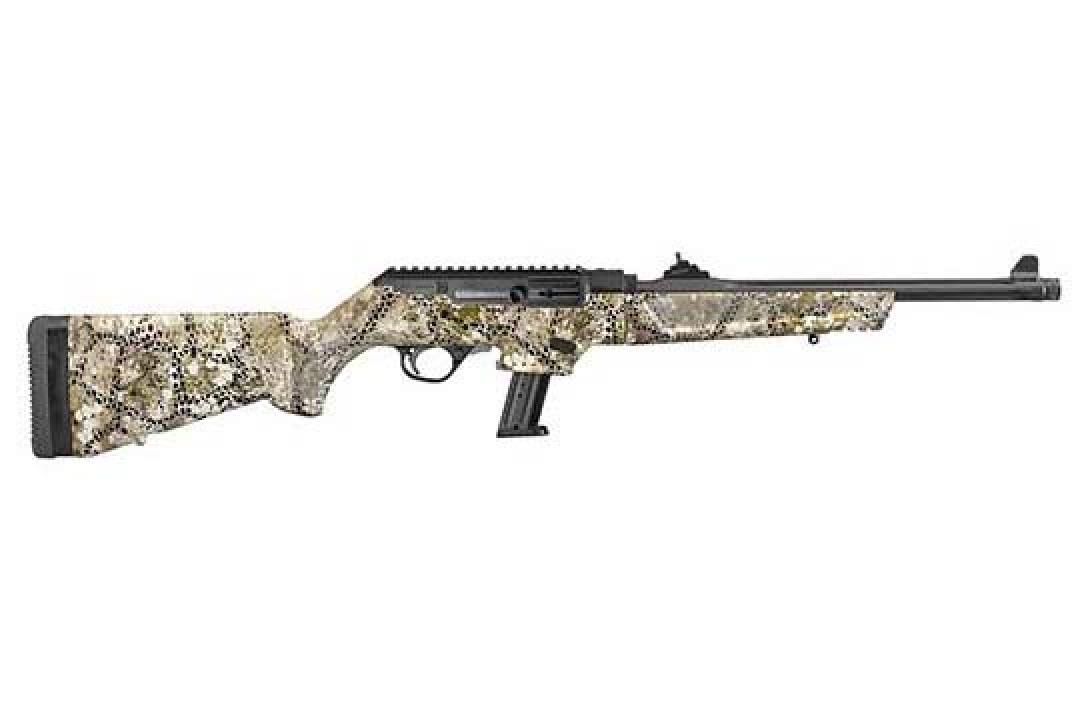
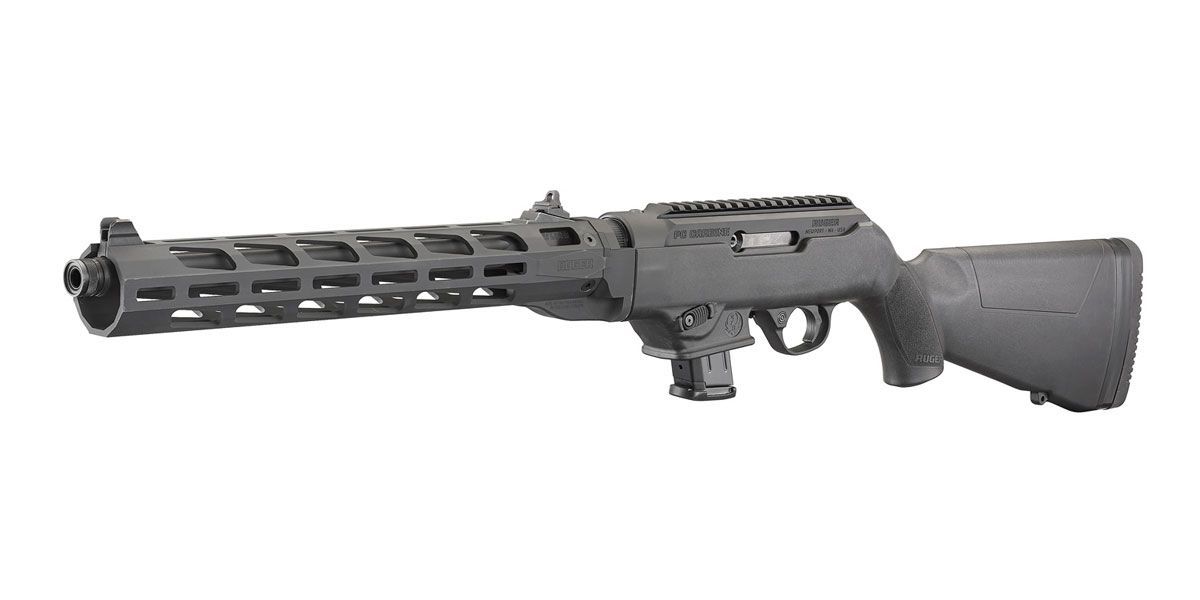
Nearly every 9mm carbine is listed as semi-automatic, which is true and tells you nothing. The differences that matter between one and the next are in how the bolt is held shut, and almost no listing says.
There are four common answers, and they produce guns that feel completely different to shoot even when the cartridge, the barrel length and the magazine are identical.
Simple blowback, and why the bolt is so heavy
Most pistol-calibre carbines use straight blowback, which is the simplest repeating action anyone has built. Nothing locks. The bolt is held against the chamber only by its own weight and the recoil spring, and when the cartridge fires, gas pressure pushes the case back against the bolt face and shoves the whole assembly rearward.
The design problem is timing. The case must stay in the chamber until pressure drops, or it will be pulled out while still under pressure and rupture. With no locking mechanism, the only things resisting are mass and spring tension.
So blowback guns have heavy bolts. That is the mechanism working as intended, and it produces characteristics people often describe without connecting them to the cause:
The recoil impulse is a shove rather than a snap, because a heavy mass is moving a long way rather than a light one moving quickly.
The gun is nose-light and rear-heavy compared with a rifle-calibre carbine, since the mass sits in the receiver.
Invalid Date
More Articles
The action is loud in a way separate from the muzzle, because a heavy bolt slamming into its stop makes a sound of its own. Suppressing one of these makes the mechanical noise much more noticeable.
Straight blowback scales badly. It works well at 9mm pressures and gets unpleasant as the cartridge gets hotter, which is why the design dominates in pistol calibres and disappears in rifle ones.
Roller-delayed, and why an MP5 feels different
The roller-delayed system holds the bolt shut mechanically for a moment rather than relying on mass alone.
Two rollers sit in the bolt head and are forced outward into recesses in the barrel extension. To open, the bolt head has to push those rollers back inward, which it can only do by driving a wedge-shaped carrier rearward. That geometry means the bolt carrier has to travel a long way for the bolt head to travel a short one, and that mechanical disadvantage is the delay.
The result is a lighter reciprocating mass and a noticeably softer, flatter impulse. It is the reason MP5-pattern guns have the reputation they do, and the reason clones of them keep being built decades after the original.
The cost is complexity. Roller-delayed guns need correct roller sizing and headspacing, they are more expensive to build properly, and a badly executed one is worse than a good simple blowback.
Radial delayed blowback
A more recent approach, most associated with CMMG. The bolt rotates slightly against a cam as it begins to move, and the energy spent rotating it is energy not spent opening the action.
The practical effect sits between the other two: lighter reciprocating mass than straight blowback, less mechanical complexity than roller delay. It also reduces the amount of gas coming back at the shooter, which matters more once a suppressor is involved.
The AR-pattern question
A large share of the 9mm carbine market is built on the AR-15 pattern, and these are almost always straight blowback with a heavy buffer rather than a gas system. The upper looks like a rifle upper and works nothing like one, because there is no gas tube.
That has consequences worth knowing. Buffer weight is a tuning variable rather than a fixed spec, and changing it changes how the gun runs with different ammunition. Bolt catch behaviour varies between designs, because the magazine is not the one the pattern was designed around.
System
Reciprocating mass
Impulse
Complexity
Straight blowback
Heavy
Firm shove, audible bolt
Lowest
Roller-delayed
Lighter
Soft and flat
Highest
Radial delayed
Moderate
Between the two
Moderate
AR-pattern blowback
Heavy buffer
Firm, tunable by buffer weight
Low, but fiddly to tune
The magazine is the other half of the decision
The action determines how the gun feels. The magazine pattern determines whether it fits your life.
Pattern
Notes
Glock pattern
The de facto standard. Cheap, everywhere, huge aftermarket, and shares with a very common handgun
SIG P320 and M&P patterns
Growing, for people whose handgun is one of those
Colt pattern
The legacy 9mm AR magazine, still supported, less common now
Proprietary
Ruger's original PC Carbine wells, Kel-Tec, and various imports
The strongest practical argument for a pistol-calibre carbine has always been commonality: one cartridge and one magazine feeding both the handgun on your belt and the carbine in the safe. A carbine that takes a proprietary magazine gives up most of that. Ruger's answer, an interchangeable magazine well that converts between its own and Glock pattern, is a direct response to exactly this complaint.
Folding, takedown, and why these guns exist at all
Pistol-calibre carbines are disproportionately built to get small. The Kel-Tec SUB2000 folds in half at the receiver. The Ruger PC Carbine separates into two pieces. A great many others are short-barrelled or braced.
That is not a coincidence. The case for a 9mm carbine is not ballistic superiority over a rifle, because there is none. It is a gun that is easier to shoot accurately than a handgun and softer than a rifle, cheap to feed, and small enough to store conveniently. Those are all arguments about handling rather than terminal performance, so the designs lean into handling.
What to look for
The action type, which the listing usually will not state directly. Roller-delayed and radial-delayed are advertised because they are selling points. If nothing is said, assume straight blowback.
The magazine pattern, which is the decision you live with.
Barrel length and whether the muzzle is threaded, since these are common suppressor hosts and a blowback action changes what suppression feels like.
Buffer and spring arrangement on AR-pattern guns, if you intend to run varied ammunition.
Whether it folds or comes apart, if that is the reason you want one.
Nick Sawinyh - Nick Sawinyh is a father, husband, hobby farmer, and gun enthusiast from Kentucky. He founded GunsNation and writes most of what appears on this blog.