The word is misspelled, and it has been since 1865.
Henry Deringer was a Philadelphia gunmaker, and he spelled his name with one R. He made small percussion pocket pistols that were widely copied, and one of them was the gun John Wilkes Booth carried into Ford's Theatre. In the reporting that followed, a newspaper added a second R, the misspelling was repeated everywhere, and "derringer" with two Rs became the generic English word for a very small handgun with a very small number of barrels.
That is the only thing most people know about these guns, and it is not much use when you are looking at one.
A derringer is not a small revolver
This is the single most common confusion, and it turns up in product listings as well as in conversation. We corrected one while preparing this article: a Bond Arms Honey-B, which is a two-shot derringer, was described in its own listing as a "break-open single-action revolver", in both the name and the description.
The difference is not a nuance. A revolver has one barrel and a rotating cylinder that brings each chamber into line with it in turn. A derringer has no cylinder at all. It has two barrels, each with its own chamber machined directly into it, and the firing pin alternates between them.
Invalid Date
More Articles
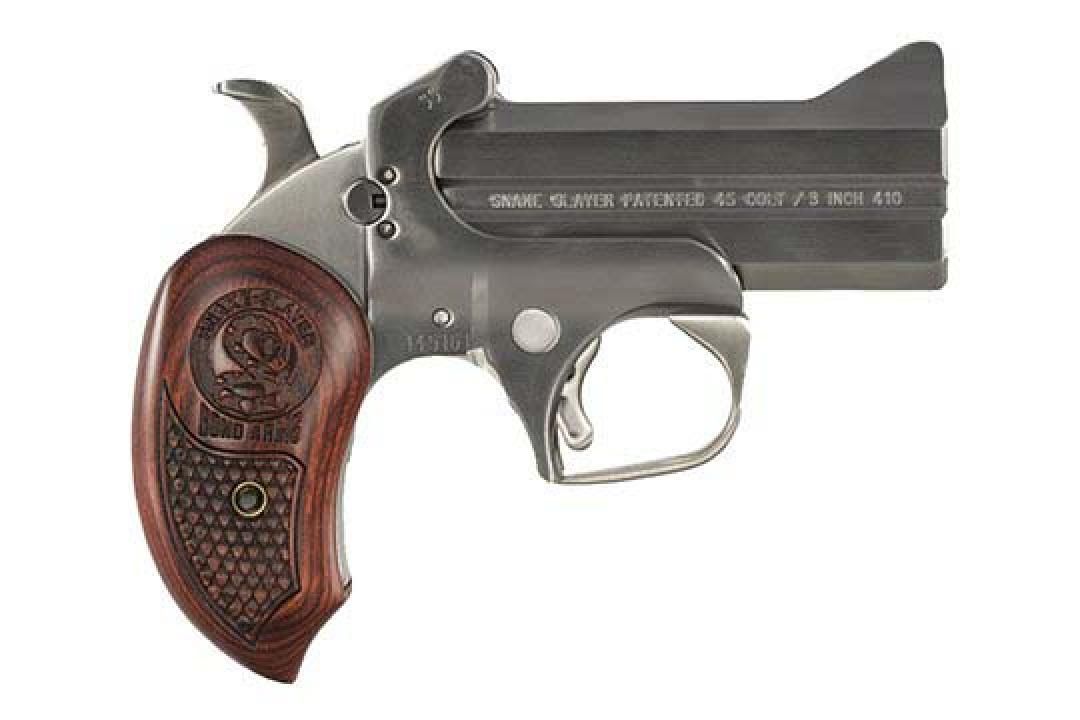
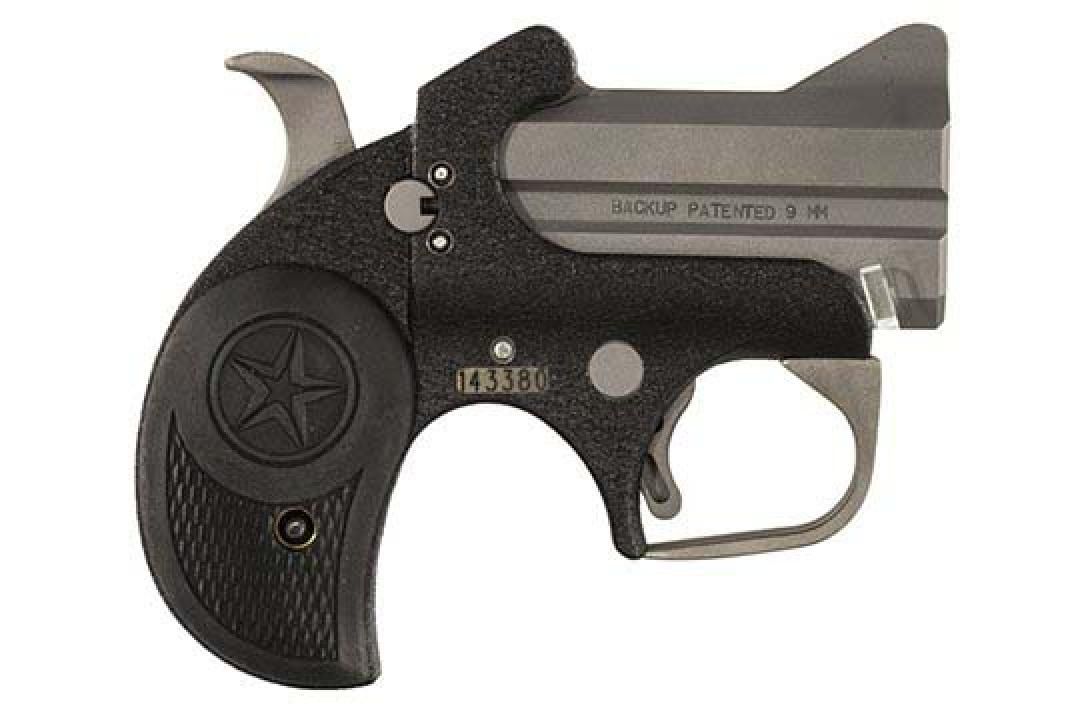
Look at the photograph above and the whole mechanism is visible. Two stacked barrels, a hinge at the front of the frame, a single hammer, and nothing that rotates. You break it open, drop two rounds in, close it, and you have two shots.
The practical consequences follow directly. Reloading is slow, because it is a break-open action with no ejector doing meaningful work. Capacity is two, and no design will change that. And because there is no cylinder, the gun can be extraordinarily flat, which is the entire reason anyone carries one.
The category is one company
Something unusual shows up in the inventory. Of the derringers listed here, roughly nine in ten are Bond Arms.
That is not a cataloguing artifact. Bond Arms took a Victorian concept, rebuilt it in stainless steel to modern tolerances, and made a business of it, and the competition mostly consists of much cheaper zinc-alloy guns and a handful of specialty makers. If you are shopping for a new derringer, you are largely shopping for a Bond Arms and choosing between its models.
The models are mostly frame sizes and barrel lengths with names attached. Snake Slayer, Texas Defender, Ranger, Roughneck, Cyclops, Patriot. Working out which is which from the names alone is not possible, so read the barrel length and the chambering rather than the model name.
Interchangeable barrels are the actual product
The design decision that matters most is that Bond Arms barrels detach and swap. One frame accepts barrel assemblies in more than twenty-five calibers and lengths, changed with a single screw.
This reframes what you are buying. The frame is the firearm and the barrels are accessories, so a single gun can be a .45 Colt and .410 combination for the trail, a 9mm for the pocket, and a .22 for cheap practice, without buying three guns.
It also explains the chambering spread in the listings, which is much wider than the category's size would suggest. Alongside the .45 Colt and .410 pairing that dominates, there are 9mm, .38 Special, .357 Magnum, .380, .22 LR, .22 Magnum, .45 ACP and .327 Federal barrels in this inventory, and a few oddities including .50 AE and .45-70.
The .45 Colt and .410 pairing, and why it exists
Roughly a fifth of these guns are chambered for both .45 Colt and .410 shotshells in the same barrel, which is possible because the two cartridges share a compatible rim and case diameter.
Read the barrel on the gun above and it says "45 COLT / 3 INCH 410". That second number matters. A .410 chamber is either 2.5 inch or 3 inch, and a 2.5-inch chamber will not safely take a 3-inch shell. On a derringer the marking is right there on the barrel where you can read it, which is more than most .410 firearms manage.
What the combination is actually for is close-range work against snakes and similar, which is where the Snake Slayer name comes from and is a genuine use rather than marketing. The shot column out of a three-inch barrel does not stay together for long, so this is a several-feet proposition rather than a several-yards one.
The numbers, and what they tell you
The dimensions in this inventory are remarkably consistent, which is what happens when one company defines a category.
Measurement
What the listings show
Barrel
Overwhelmingly 3 inches, with a 2.5-inch group below and 3.5 and 4.25-inch above
Overall length
Around 5 inches typical
Weight
Around 20 ounces typical
Capacity
Two, without exception
Twenty ounces is the figure worth sitting with. That is heavier than several polymer subcompact pistols that hold ten or more rounds and reload in seconds. A derringer is not light for its capacity, it is flat for its capacity, and those are different virtues.
Who these are honestly for
Three answers, and only one of them is about defence.
The first is deep concealment where nothing else fits. A derringer disappears into a pocket, a boot or a bag in a way a subcompact pistol with a grip and a magazine does not, and it does so without printing. That is a real capability and it is the reason the format survived.
The second is the trail gun, in .45 Colt and .410, carried against snakes rather than people, where two shots at arm's length is genuinely the requirement.
The third, and the one people are least honest about, is that they are enjoyable objects. A well-made stainless derringer with rosewood grips is a pleasure to handle, and buying one for that reason is a perfectly good reason. It is worth being clear with yourself about which of the three you are doing.
What a derringer is not is a good first defensive handgun. Two rounds, a slow reload, a heavy trigger and a short sight radius add up to a gun that demands more skill than a service pistol while offering less margin. That is the opposite of what a new shooter needs.
What to look for on a listing
Read the barrel length and the chambering, not the model name. Model names in this category are branding.
If the gun is chambered for .410, find the chamber length before you buy shells. It is usually stamped on the barrel.
Check the weight if it is published. A derringer weighs somewhere between about fifteen and twenty-five ounces. We found one listed at two tenths of an ounce, which is roughly the weight of a stamp, and its own description said twenty ounces four lines further down.
And if a listing calls it a revolver, the listing is wrong, and it is worth wondering what else in it was not checked.
Nick Sawinyh - Nick Sawinyh is a father, husband, hobby farmer, and gun enthusiast from Kentucky. He founded GunsNation and writes most of what appears on this blog.