Every other shotgun size is a gauge. Twelve gauge, twenty gauge, twenty-eight gauge. The .410 is the odd one out, and the reason is that it is not measured the same way.
Gauge is a count. A twelve gauge is the bore diameter you get from a lead ball weighing one twelfth of a pound, a twenty gauge from a ball weighing one twentieth. Smaller number, bigger bore. It is an old system based on weight rather than measurement, and it works fine until the bores get small enough that the numbers become unwieldy.
The .410 is measured instead: the bore is .410 of an inch across, and that is the name. Run it through the gauge formula and it comes out at roughly sixty-seven gauge, which nobody says. The industry did briefly call it a 36 gauge in the 1920s, which was wrong then, and the designation still surfaces occasionally on imported guns and older boxes because "(36)" was added back to dimensional tables in 1969.
A small bore means a small payload, and that used to settle the argument
The practical consequence of a .410 bore is that there is very little room in the shell. A standard 3-inch .410 load carries around eleven sixteenths of an ounce of shot. A 3-inch twelve gauge carries close to two ounces. That is not a small difference, it is a factor of three.
Invalid Date
More Articles
Fewer pellets means thinner patterns, and thin patterns mean a smaller margin for error. The .410 has always been described as a gun for experts or a gun for children, which sounds contradictory until you realise both statements come from the same fact. It is easy to shoot because it barely recoils, and hard to hit with because the pattern has holes in it.
That was the whole story for about a century. Then the shot changed.
Tungsten changed the turkey maths
Tungsten Super Shot has a density of about 18 grams per cubic centimetre. Lead is 11.3. A tungsten pellet of the same weight is therefore substantially smaller, which means a given payload holds far more pellets, and each one retains energy better downrange because density beats size for penetration.
Loaded into a .410, that transforms the cartridge. A .410 TSS turkey load can outperform a twenty gauge firing lead, at a fraction of the recoil, and it is effective on turkeys out to about forty yards. Forty yards was once considered a stretch for a twelve gauge with lead.
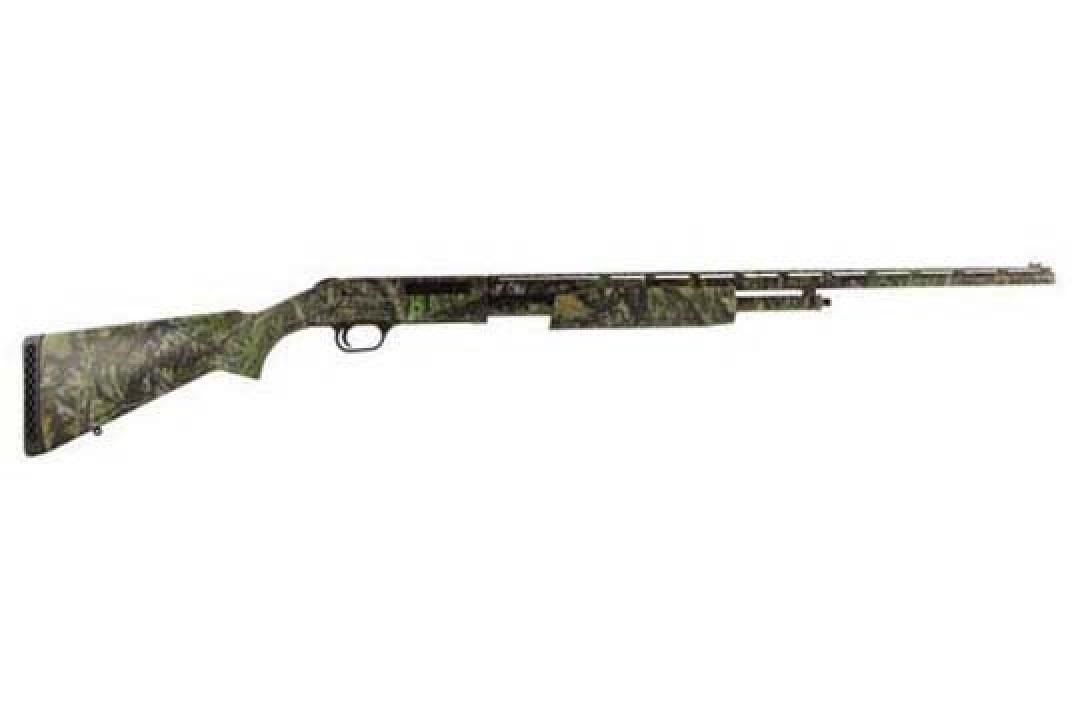
This is why the .410 turkey gun exists as a category at all, and why the makers who build them are pushing camo-finished pump and semi-auto .410s at hunters rather than at children. Twenty-four of the guns in this inventory are explicitly turkey models.
The catch is cost. TSS is expensive in a way that lead is not, and a box of it costs several times what a comparable lead load costs. For a hunter shooting a handful of shells a season that is irrelevant. For anything involving volume it rules the approach out.
Every action, and what the distribution shows
The .410 is built in every shotgun action there is, which is unusual for a small bore.
Action
Share of the .410 inventory
Typical use
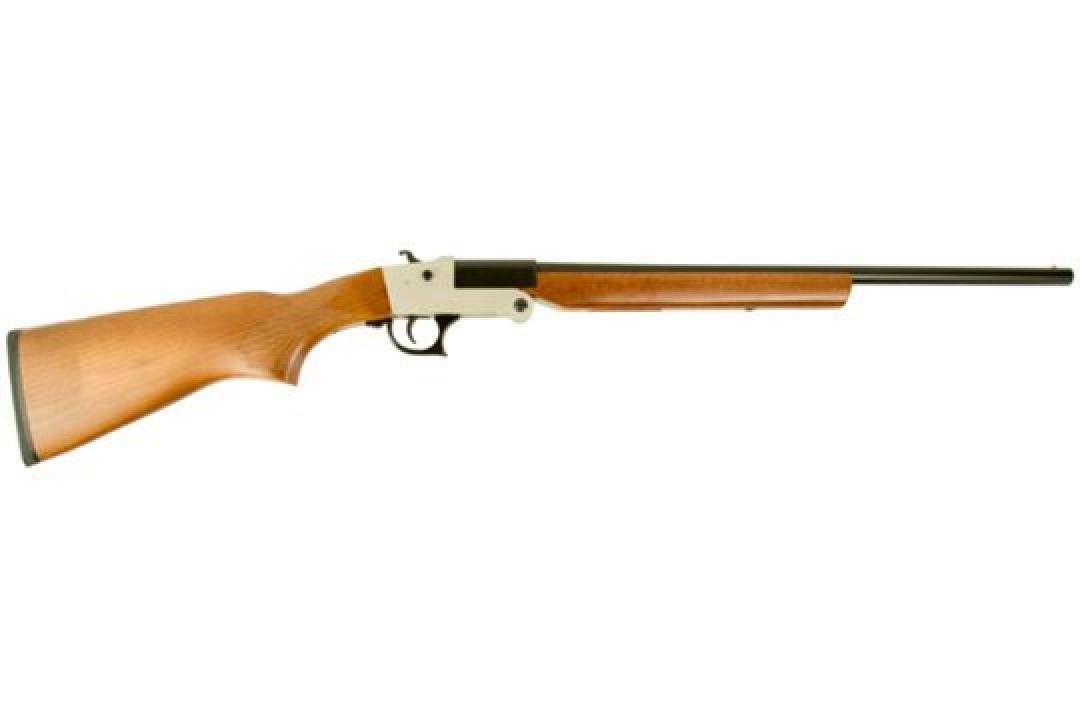
Break action, single shot and combination
The largest block by some distance
Youth guns, farm guns, cheap utility
Pump
Second
Turkey, defence, general
Over/under
Close behind
Clays, upland, small-bore doubles
Semi-automatic
Fourth
Turkey and low-recoil field use
Lever action
Small but distinct
Henry's line, mostly
Side by side
Smallest
Traditional and cowboy-adjacent
The break-action dominance is the tell. Nothing else in shotguns skews this far toward the simplest possible mechanism, and it is because the .410 has spent most of its life as a first gun and a barn gun rather than as a sporting arm.
Charles Daly, Mossberg, Browning, TriStar and Rossi are the largest suppliers here, which is a different list from the one you would get for twelve gauge, where Browning and Beretta dominate. The .410 market is served more by the value tier than by the premium houses.
Barrel length splits the category in two
There is no middle ground in .410 barrels, and the split tells you what the gun is for.
Barrel
What it is
26 and 28 inches
The field guns, and the largest group by far
24 inches
Turkey guns, short enough to swing in cover
18.5 to 20 inches
Defensive and utility guns, plus youth models
A 26-inch .410 is a bird gun. An 18.5-inch .410 is something else entirely, and the guns at that length are being sold on a different premise.
Chamber length is the compatibility trap
.410 shells come in two lengths, 2.5 inch and 3 inch, and the difference matters more here than the equivalent difference does in larger bores.
A gun chambered for 3-inch shells will fire 2.5-inch shells without any issue. A gun chambered for 2.5 inch will not safely take a 3-inch shell, and because the .410 is a small bore the pressure consequences are not academic.
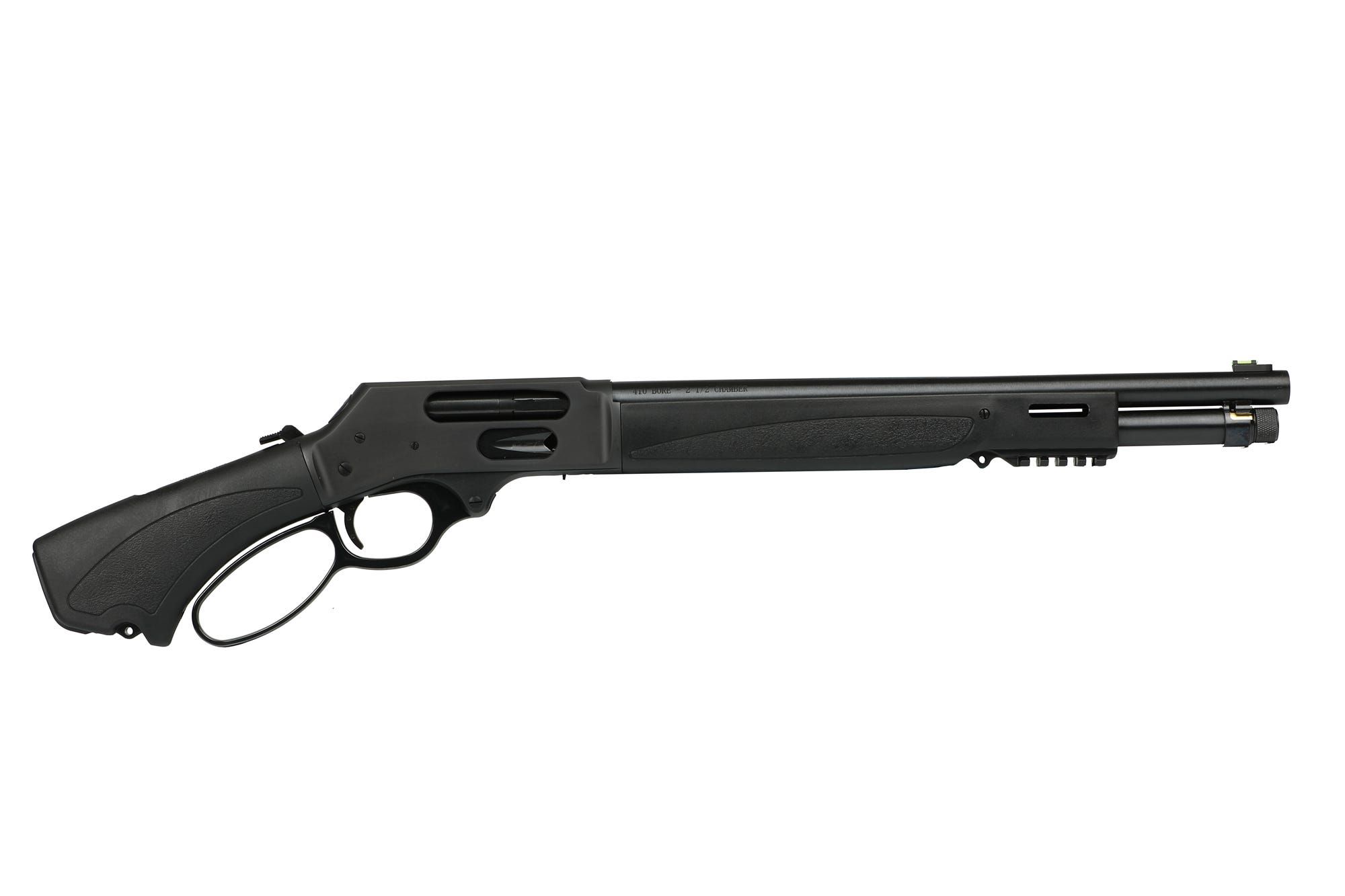
The chamber length is usually stamped on the barrel. On the Henry lever gun below you can read "410 BORE 2 1/2 CHAMBER" along the barrel, which is exactly where you should be looking before buying shells.
Older guns are more likely to be 2.5 inch. Anything modern and marketed for turkey will be 3 inch, because the payload difference is exactly what the TSS loads need.
The youth question, and why the obvious answer is wrong
Forty-one of the guns here are sold as youth models, and the .410's reputation as a starter gun is the single most common thing anyone knows about it.
The logic is recoil. A .410 kicks very little, a beginner flinches less, and a light short gun fits a small shooter. All of that is true.
The problem is the pattern. A new shooter misses a lot, and a .410 punishes a near miss in a way a twenty gauge does not, because there simply are not enough pellets in the air to catch a slightly-off shot. A child with a twenty gauge and a reduced load will often hit more and get discouraged less, which is the actual goal.
The case for a .410 as a first gun is strongest when the shooter is genuinely too small for anything else, or when the shooting is close and deliberate rather than fast. As a general default it is worse advice than it sounds.
The oddities
Two corners of this category do not behave like shotguns at all.
The first is the compact lever gun. Henry's Axe puts a .410 barrel and a lever action behind a bird's head grip with no shoulder stock, which makes it a different kind of object from the rifle-stocked guns around it. Several makers build variations, and they sit in the catalog alongside conventional lever .410s from the same lines.
The second is the .45 Colt crossover. Because a .410 shell and a .45 Colt cartridge share a rim diameter closely enough to work in the same chamber, a family of revolvers and derringers exists that fires both. Those are handguns and are catalogued as such, but they are the reason a lot of .410 ammunition gets sold, and the reason the bore turns up in conversations about defensive shooting that have nothing to do with shotguns.
What to buy
For turkeys, buy a 3-inch chambered pump or semi-auto with a short barrel and a tight choke, and budget for TSS. That combination is the entire modern case for the .410 and it is a genuinely good one.
For clays and upland birds, an over/under .410 is a delightful gun to carry and a demanding one to shoot well. Buy it as a second or third shotgun, after you already know how to hit things.
For a first gun for a small shooter, look hard at a twenty gauge with light loads before defaulting to a .410. If the shooter really is too small for that, a single-shot .410 is the classic answer and works.
For a farm or truck gun, the break-action single shot is cheap, light, simple and has been doing that job for a hundred years.
And whatever you buy, read the chamber length off the barrel before you buy shells.
Nick Sawinyh - Nick Sawinyh is a father, husband, hobby farmer, and gun enthusiast from Kentucky. He founded GunsNation and writes most of what appears on this blog.