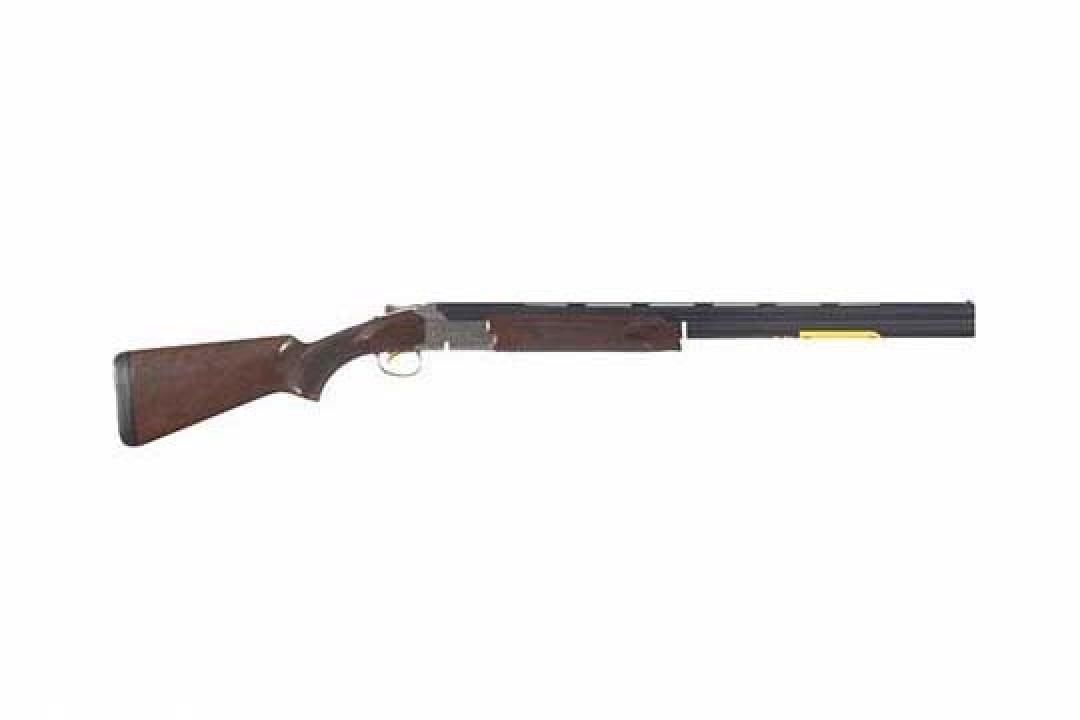
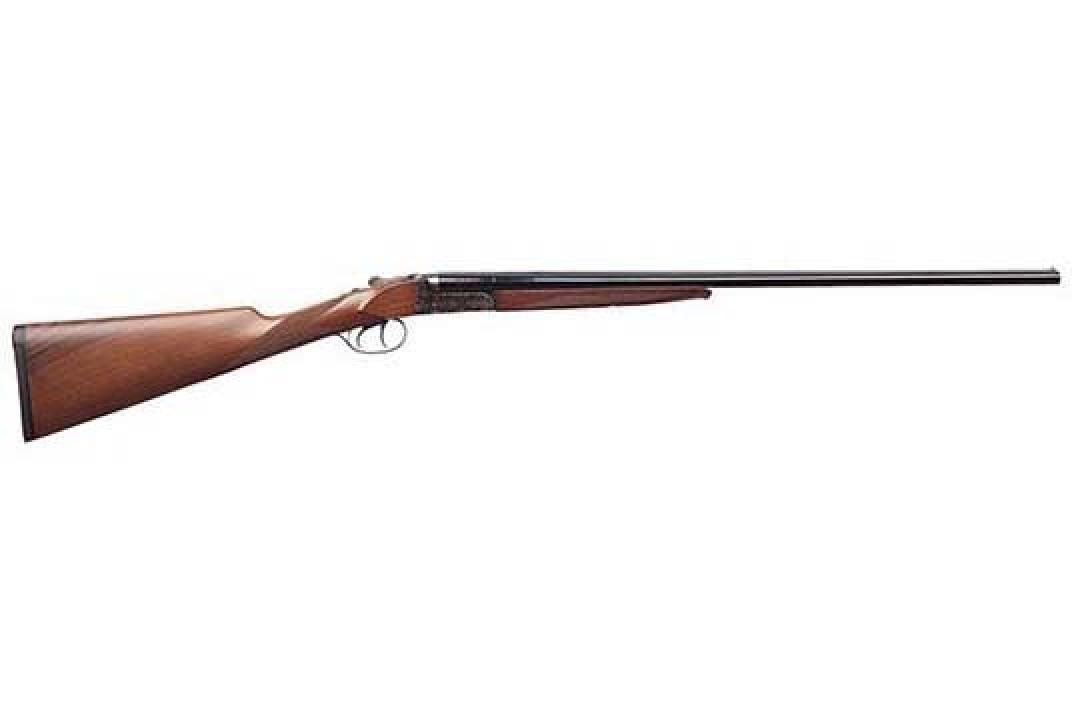
There are only two ways to put two barrels on a shotgun. Stack them vertically and you have an over/under. Set them next to each other and you have a side-by-side. Everything else about the gun follows from that one decision, and the decision has already been made overwhelmingly in one direction.
Across the double-gun inventory here, the guns that state their configuration in the name run about five and a half to one in favour of the over/under. The side-by-side is the older design, it was the standard for a century, and it lost.
What you see down the rib
Point an over/under and you see one barrel. The lower tube is hidden behind the upper one, so the sight picture is a narrow rib running to a bead, with a lot of visible world on either side of it.
Point a side-by-side and you see a wide flat shelf of metal. Two muzzles, a broad expanse between them, and considerably less of the target's surroundings in your peripheral vision below the gun.
Neither is wrong, and shooters who grew up on one often shoot it better than the theoretically superior alternative. But the narrow sight picture is easier to learn on, and it is the reason clay competitions are won by over/under shooters at a rate that is not close.
Invalid Date
More Articles
The wide sight plane has one genuine advantage that gets overlooked. On a driven or crossing bird, some shooters find the two muzzles give them a better sense of lead, because the barrel width itself becomes a rough measuring stick against the target.
What you feel
The mechanical argument for the over/under is about where the recoil goes.
An over/under's barrels sit in a vertical stack, and the lower barrel, which is normally fired first, sits low and close to the line of the shoulder. Recoil travels up and back, roughly in the plane you are braced against.
A side-by-side fires its first shot from a barrel offset to one side of the centreline. The recoil impulse is therefore off-axis, and the gun twists in your hands as well as pushing back. Fire the other barrel and it twists the other way. Experienced side-by-side shooters compensate without thinking about it, and new shooters usually cannot work out why their second shot keeps going somewhere unexpected.
Weight compounds it in the over/under's favour. Gauge for gauge, an over/under typically runs about a pound heavier than a comparable side-by-side, because the receiver has to be deeper to accommodate the stacked barrels. That extra mass is doing real work against recoil, and it is why the lighter, more elegant gun is the harsher one to shoot.
Triggers, and what two of them tell you
Older side-by-sides use two triggers, one per barrel. The front trigger fires the right barrel, the rear fires the left, and you select your choke by choosing a trigger rather than by working a selector.
That system is faster than it sounds, because the choice is made by your finger without any conscious step. It has two costs. Your hand has to move between shots, which is a real loss under time pressure, and a heavy recoiling load can bounce your finger onto the second trigger.
A single selective trigger fires both barrels in sequence, with a selector switch, usually built into the safety, that sets which barrel goes first. Almost every modern over/under uses one. It is the arrangement most shooters find natural, and it is one more reason the over/under took the market.
Double triggers survive mainly on traditional side-by-sides, and they are a reasonable proxy for what kind of gun you are looking at.
Ejectors against extractors
Extractors lift the fired cases part way out of the chambers when you open the gun, and you pick them out with your fingers. Ejectors throw the fired cases clear over your shoulder, using small spring-loaded mechanisms timed to fire only on barrels that have been shot.
Extractors are cheaper, simpler, and better if you reload your own shells or shoot somewhere you would rather not scatter hulls. Ejectors are faster and are effectively standard on anything sold for clays.
If a listing does not say, assume extractors. Ejectors are a selling point and makers mention them.
Barrel regulation, the problem both types have to solve
Two barrels pointing in exactly parallel directions would put their patterns in two different places, separated by the distance between the bores, forever. So double guns are built with the barrels converging slightly, regulated to shoot to the same point at a chosen distance.
That regulation distance is a design decision, and it is usually somewhere around forty yards on a field gun. Closer than that and the patterns have not yet met. Further out and they have crossed and are diverging again. In practice the shot cloud is wide enough that this rarely matters to a bird, but it explains why a double gun cannot simply be re-barrelled or heavily modified without consequences, and why quality in a double is largely about how carefully the barrels were joined.
The side-by-side has more work to do here, because its bores are further apart and the convergence angle is therefore greater.
Where the side-by-side still wins
Cowboy action shooting is the clearest case. Short-barrelled side-by-side coach guns are a required piece of equipment in the sport, and they exist in this catalog as a distinct block. An over/under cannot substitute, because the rules and the period aesthetic both call for the flat gun.
Upland hunting is the second, and it is partly cultural and partly not. A side-by-side is lighter to carry all day, it is slimmer through cover, and the tradition attached to it is genuinely part of what people are buying. That tradition is not a small factor. One of the more widely shared sentiments about these guns is simply that people keep circling back to the side-by-side because it looks like what a shotgun is supposed to look like.
The third is a mechanical detail nobody thinks about until they use one. A side-by-side's barrels do not have to swing as far to clear the chambers, so the gun opens in a shallower arc. In a blind, in a vehicle, or anywhere with something above you, that is a practical difference.
What this inventory actually holds
The gauge distribution is what you would expect from a market led by clays and upland birds.
Gauge
Share of the double-gun inventory
12 gauge
Comfortably the largest, close to half
20 gauge
Second, around a fifth
.410 bore and 28 gauge
Roughly equal small-bore blocks
16 gauge
A small survivor
10 gauge
Almost extinct, a single record
The maker distribution is more concentrated than the gauge spread, and it is close to a duopoly.
Maker
Position
Browning
Largest, driven almost entirely by the Citori
Beretta
Second, driven by the 686 and 687 Silver Pigeon
Charles Daly, CZ-USA
The mid-market tier, CZ carrying most of the side-by-side volume
Tristar, Stoeger, Pointer, Mossberg
The value tier, largely Turkish manufacture
Rizzini, Fausti, Caesar Guerini, Perazzi
The Italian houses above the volume market
Browning and Beretta between them account for something close to two fifths of every double gun listed. If you have no strong opinion, the reason those two names keep coming up is that they built the guns everyone else is priced against.
Reading a listing without being misled
Double-gun listings carry a specific set of errors, and we corrected a large batch of them while preparing this article.
The most common is a weight that has lost its pounds. A double gun weighs six to nine pounds, so a published weight of four, seven or twelve is not a weight. It is the ounces remainder of something like "7 lbs 4 oz" with the pounds silently dropped. That defect was on 103 records here. Seventy-four could be recovered because the true figure survived in the description text, and the remaining twenty-nine were cleared rather than left showing a wrong number.
Twenty-three records claimed an overall length of zero inches, which is the kind of value that gets written when a field is populated from a missing source rather than left empty.
Sixty product names carried "Walnut Elegance", which no maker uses as a model or a grade designation. It is generated marketing language that attached itself to names across several brands, and it has been removed.
One trap runs the other way and is worth knowing about, because it looks like an error and is not. A description reading "shooters who prefer a side-by-side over an over/under" mentions both configurations, and an automated check will flag the record as contradicting itself. Twenty-two records here tripped exactly that test, and every one turned out to be a legitimate comparison rather than a confused identity. A comparison is not a claim about what the gun is.
Which one to buy
If the gun is for clay targets, buy an over/under. The narrow sight picture, the in-line recoil and the extra weight all point the same direction, and the competition results are not ambiguous.
If the gun is for walking up birds and you like the way a side-by-side looks and carries, buy one, and accept that it will be harsher on the shoulder and slower to learn. Those are real costs paid for a real thing.
If the gun is for cowboy action, the decision has been made for you.
And if you are choosing your first double of any kind, get one that fits. A gun that comes up to your eye correctly matters more than every distinction above put together, and it is the one variable a spec sheet cannot tell you anything about.
Nick Sawinyh - Nick Sawinyh is a father, husband, hobby farmer, and gun enthusiast from Kentucky. He founded GunsNation and writes most of what appears on this blog.