Almost everyone who owns rifles owns one of these, and most people bought theirs without much thought because it was cheap and it was there. That is a reasonable way to end up with a .22, and it is a bad way to end up with the right one, because the category covers more ground than any other in shooting.
A .22 rifle can be a child's first gun, a squirrel gun, a suppressed pest rifle, a competition trainer that mimics a centrefire hunting rig, or a plinker that exists purely to make a satisfying noise. The same cartridge serves all of them, and the rifle built for each is genuinely different.
Start with the action, because it decides everything else
Four actions cover essentially the whole market, and their share of this inventory tells you what people actually buy.
Action
Share of the .22 rifle inventory
What it is for
Semi-automatic
Around half, by a wide margin
Volume shooting, plinking, general use
Bolt action
Roughly a third
Accuracy, hunting, training, suppressed work
Invalid Date
More Articles
Lever action
A small but steady block
Traditional handling, cowboy-adjacent shooting
Single shot
Smaller still, and mostly youth rifles
Teaching, deliberate practice
Semi-autos dominate because .22 LR is cheap and the whole point of cheap ammunition is shooting a lot of it. Bolt guns exist because the semi-auto's tolerance for varied ammunition costs accuracy, and once you care about groups the bolt is the better tool.
Lever and single shot are smaller categories, but neither is a novelty. The single-shot block is almost entirely youth rifles, which is a serious segment rather than a toy one.
The 10/22 is not a rifle, it is a platform
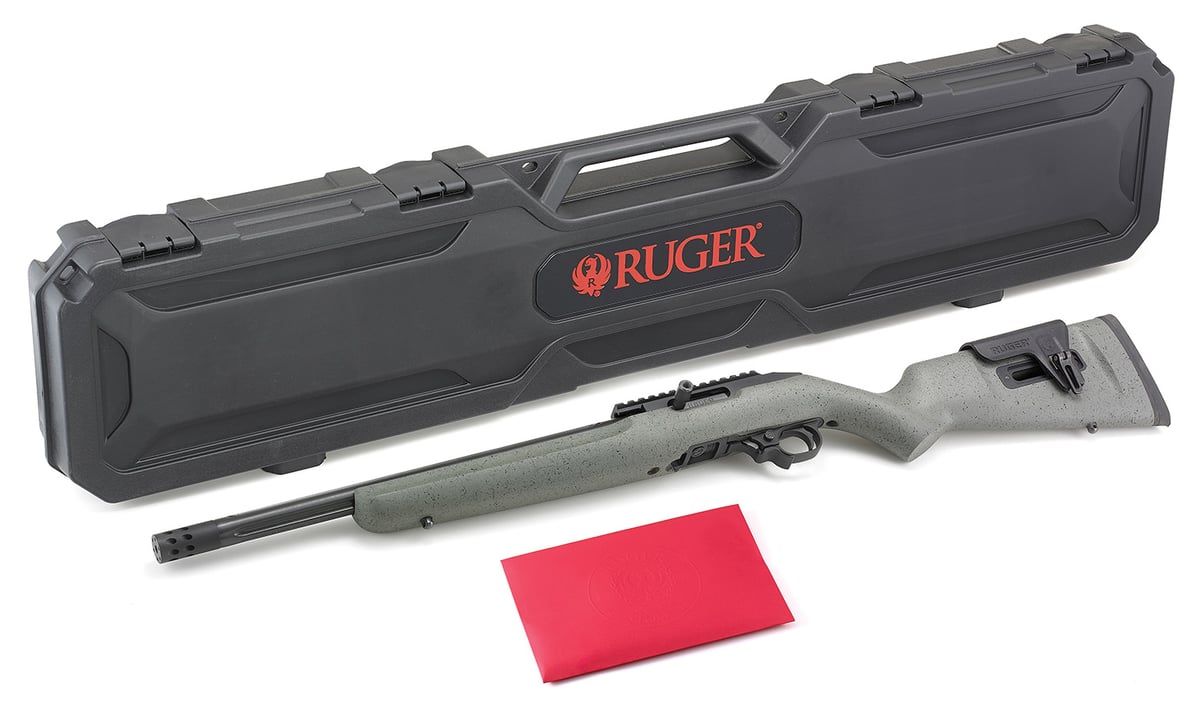
Ruger is the largest maker here by a distance, and the Ruger 10/22 alone accounts for a substantial share of every .22 rifle listed.
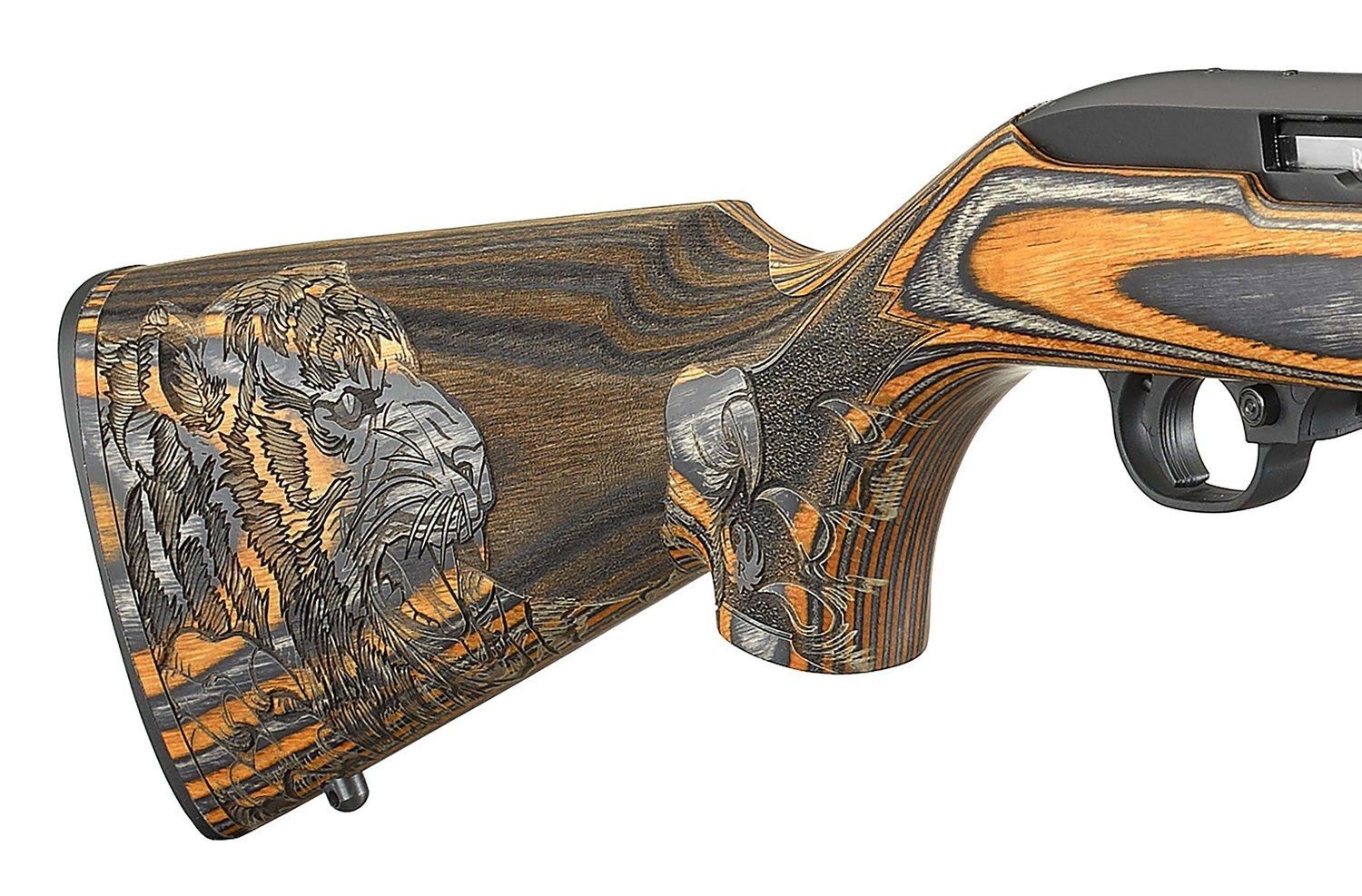
That matters less because the rifle is exceptional than because of what grew up around it. The 10/22 has been in continuous production since 1964, more than seven million of them, with a flush-fitting rotary magazine and a receiver that almost nothing else uses, and the aftermarket for it is larger than the aftermarket for most centrefire rifles. Barrels, triggers, stocks, bolt release upgrades, extended magazine releases and complete replacement receivers are all available, and a 10/22 can be rebuilt into something with none of its original parts left.
The practical consequence for a buyer is that a base-model 10/22 is a reasonable purchase even if it is not the most accurate rifle in its price range, because it is the one you can change your mind about later. Nothing else in rimfire has that property.
The takedown versions are worth knowing about separately. Roughly one in twenty rifles here is a takedown design, splitting at the barrel joint into two halves that pack into a bag, and Ruger's is the most common. It is the answer to a specific question about storage and transport rather than a general upgrade.
Where the accuracy actually lives
If groups matter, the answer is a bolt gun, and the market for serious rimfire bolt actions has got a lot better.
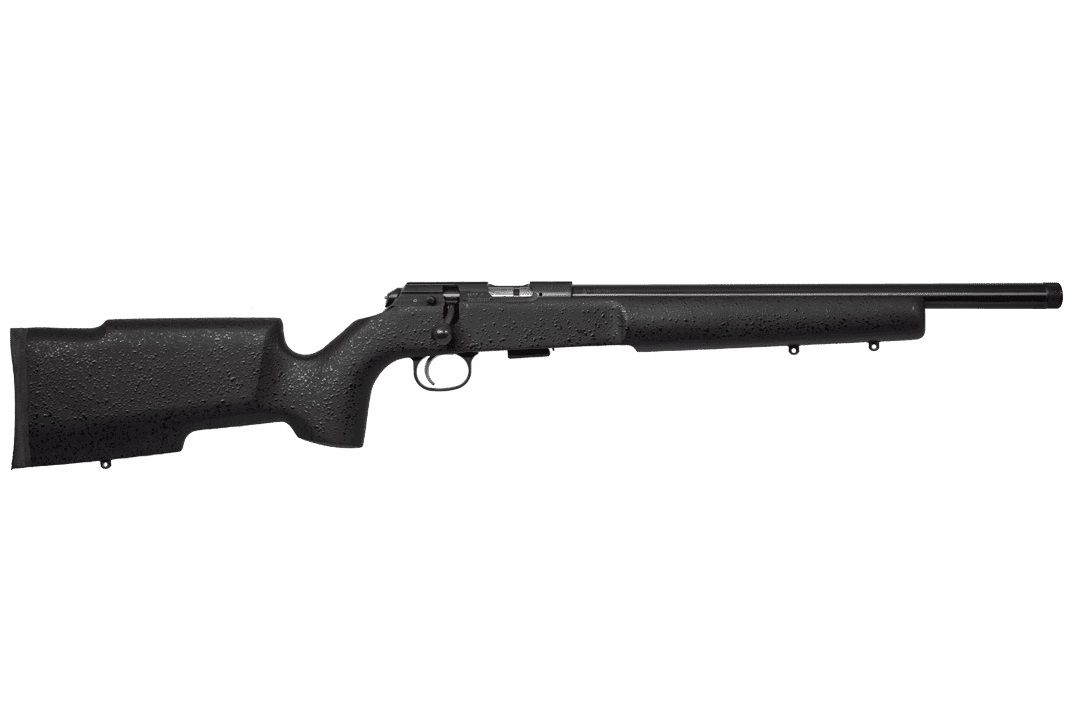
CZ's 457 is the reference point in this inventory, sold in a range of configurations from a walnut sporter to the heavy-barrelled varmint and target versions. Tikka's T1X, Savage's rimfire line, Ruger's American Rimfire, Bergara and Browning's T-Bolt all sit in the same conversation. The interesting recent development is that several of these are built deliberately to match the ergonomics of their makers' centrefire rifles, so the .22 becomes a cheap trainer with the same feel as the rifle you hunt with.
That trainer role is the strongest argument for buying a better .22 than you think you need. Practice with a rimfire costs a fraction of what centrefire practice costs, and the skills transfer if the rifle handles the same way.
Two features are worth looking for specifically on a bolt gun. A threaded muzzle, which about one rifle in forty-five here advertises, matters because .22 LR is the cartridge suppressors work best on: subsonic ammunition is standard rather than special, and a suppressed .22 is genuinely quiet rather than merely quieter. An adjustable trigger matters because rimfire triggers were historically bad and are now the main thing separating a good bolt gun from an ordinary one.
Barrel length tells you less than you think
The lengths cluster tightly, and almost everything is between sixteen and twenty inches.
Barrel
What it usually is
16 to 16.5 inches
Carbines and compact rifles, including most takedowns
18 to 18.5 inches
The largest group, the standard sporter length
20 to 22 inches
Target and varmint builds, plus older sporters
Unlike centrefire cartridges, .22 LR gets very little from extra barrel. The powder charge is small and burns quickly, and past about sixteen inches you are adding sight radius and weight rather than velocity. Some loads actually lose velocity in a very long barrel because friction outweighs what little pressure is left.
So barrel length on a .22 is a handling decision. Longer is steadier and quieter at the muzzle, shorter is handier in brush and in a vehicle. Neither is meaningfully faster.
The youth segment is bigger than the enthusiast one
Two of the larger makers in this inventory, Crickett and Keystone, build almost nothing except youth rifles, and together with the compact and youth variants of other lines they account for a large slice of the whole category.
These are single-shot bolt actions, sized down, usually with a manually cocked striker so that loading and cocking are separate deliberate actions. That design is not about cost. It is about making every shot require two conscious steps in a rifle intended for a beginner.
If you are buying for a child, the variables are stock length and weight, not action type or brand. A rifle the shooter cannot hold up teaches nothing.
Ammunition matters more than the rifle
This is the part most buyers discover late. Rimfire ammunition varies enormously between brands and lots, and a given rifle will shoot some of it well and some of it badly for reasons nobody can fully predict from the box.
A bolt gun that groups poorly with bulk-pack ammunition can transform with match ammunition, and two rifles of the same model can prefer different loads. Semi-autos add a second constraint, because they need enough power to cycle reliably, which rules out some of the quietest subsonic loads.
The practical advice is to buy several different types in small quantities and test them before committing to a case of anything. The differences are much larger than the differences between rifles at the same price.
The .21 Sharp, and why it exists
Winchester introduced a new rimfire cartridge in September 2024 called the 21 Sharp, and it is worth understanding because it will start appearing on spec sheets.
It uses a .22 LR case with a .2105-inch non-heeled bullet instead of the .22 LR's heeled design, in weights from 25 to 42 grains at 1,300 to 1,750 feet per second. It feeds from .22 LR magazines, and converting a .22 LR rifle requires a barrel change and nothing else. Savage announced rifles chambered for it at launch.
The design reason is lead-free projectiles. A traditional .22 LR bullet sits partly inside the case with an exposed heel, which constrains what the bullet can be made of and how it can be shaped. Moving to a conventional non-heeled bullet inside a jacketed design gives the cartridge room to use materials other than lead while keeping the case and the magazine.
Whether it displaces .22 LR is a separate question, and history is unkind to new rimfire cartridges. But it is not a gimmick, and a rifle chambered for it is not a rifle chambered for .22 LR.
Reading a listing without being misled
The most common problem with .22 rifle listings is not a wrong number, it is a wrong category.
We found nineteen pistols filed inside the .22 rifle tags here while preparing this article. CMMG Banshee pistols, HK MP5 .22 pistols, Tippmann M4-22 pistols and a Kriss Victor, all of them correctly described in their own records as pistols, all of them sitting in tags that say rifle. One tag, for .22 pistol-calibre carbines, was almost half pistols. All nineteen have been removed.
The reason it happens is that a .22 pistol and a .22 rifle share a maker, a model family and a cartridge, and differ only in a dimension nobody filters on. If a listing's barrel length is under about ten inches and it has no stock, it is a pistol regardless of what the category says.
The other recurring defect is a weight that has lost its pounds, showing five or seven where the real figure is five pounds three ounces. A .22 rifle weighs between about three and a half and nine pounds. Anything under two is a units error, and we corrected forty-four of them here.
What to actually buy
For a first rifle, or a rifle for a new shooter, buy a basic bolt action or a base-model 10/22 and spend the difference on ammunition and range time. Both are forgiving and neither will be the reason you miss.
For small game and pest control, buy a bolt gun with a threaded barrel, even if the suppressor is a later purchase. Retrofitting threads costs more than buying them.
For training toward a centrefire rifle, buy the rimfire that most closely matches the rifle you are training for, and accept that this is the one case where spending more is straightforwardly worth it.
For plinking and volume, the 10/22 is the default for good reasons, and the aftermarket means the decision is reversible.
And for a child, go to a shop and have them hold several. Length of pull is the whole decision and it cannot be judged from a listing.
Nick Sawinyh - Nick Sawinyh is a father, husband, hobby farmer, and gun enthusiast from Kentucky. He founded GunsNation and writes most of what appears on this blog.