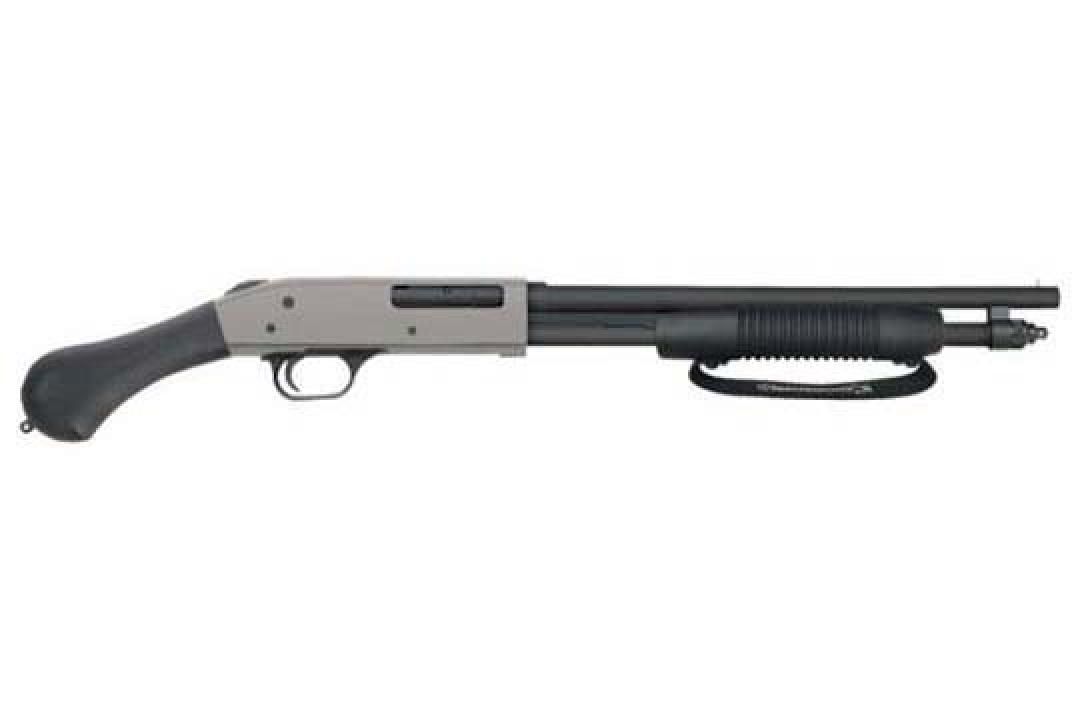
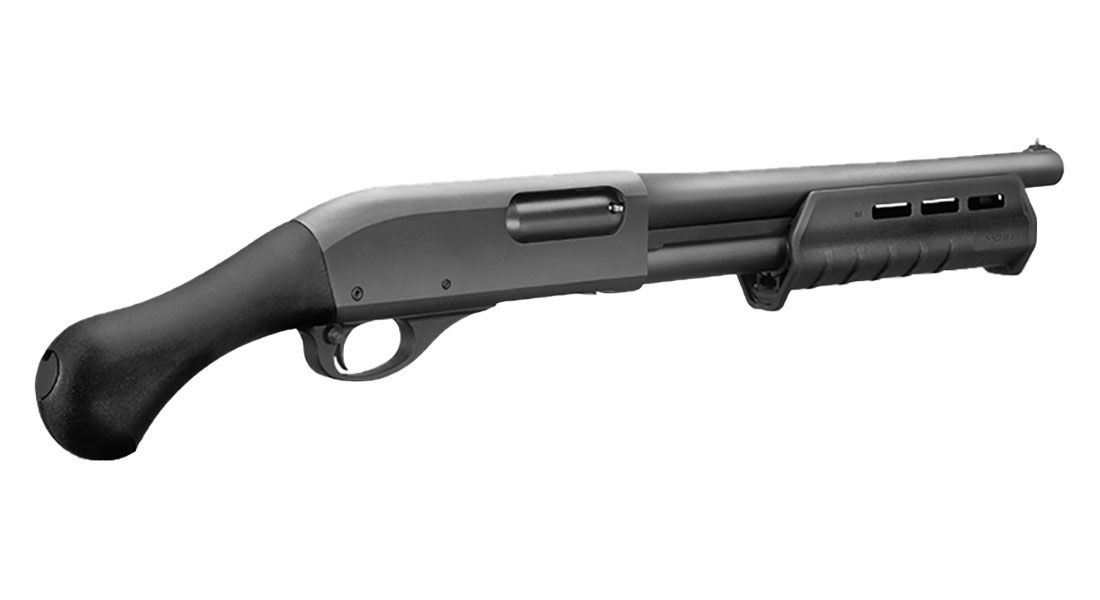
Put three listings next to each other. A Mossberg with a 14 inch barrel. A Mossberg with a 14 inch barrel. A Remington with a 14 inch barrel. Same gauge, same action, same length of tube hanging off the front, and they belong to three categories that are not interchangeable in any way that matters.
Barrel length is the number everybody looks at, and it is the wrong one. What sorts these guns is whether the thing was ever built with a stock, and how long it is end to end. Get those two questions right and every confusing product name in this corner of the catalogue resolves.
The two numbers, and which one people forget
A shotgun, in the sense the categories use, is a gun built with a stock, a barrel of at least 18 inches, and an overall length of at least 26 inches. Cut below either threshold and it becomes a short-barrelled shotgun, which is a registered item.
The forgotten case is the gun that never had a stock at all. It was not a shotgun to begin with, so the 18 inch rule never attached to it, and only the overall length decides what it is.
Built with a stock?
Barrel
Overall length
What it is
Yes
18 in or more
Invalid Date
More Articles
26 in or more
a shotgun
Yes
under 18 in
any
short-barrelled shotgun, registered
Yes
any
under 26 in
short-barrelled shotgun, registered
No, never
under 18 in
26 in or more
a "firearm", no registration
No, never
under 18 in
under 26 in
any other weapon, registered
That fourth row is the entire Shockwave and TAC-14 product category. Those guns carry a 14 inch barrel and no paperwork, not through a loophole in the barrel rule but because the barrel rule was never pointed at them. They have never had a stock, so they were never shotguns, so the only number that constrains them is the 26.
The grip is the tell, and it comes from neither maker
That grip curves back and down and gives you nothing to put a shoulder against, which is the physical expression of "not built to be fired from the shoulder". It is called a Raptor, and Shockwave Technologies makes it, a company that is neither Mossberg nor Remington. Mossberg's gun is named after the grip's maker. Remington's competitor uses the same part.
Both of the biggest names in American shotguns launched competing products in this category, and the component that defines them, the part that decides which side of the line the gun falls on, is bought in from a third party neither of them owns.
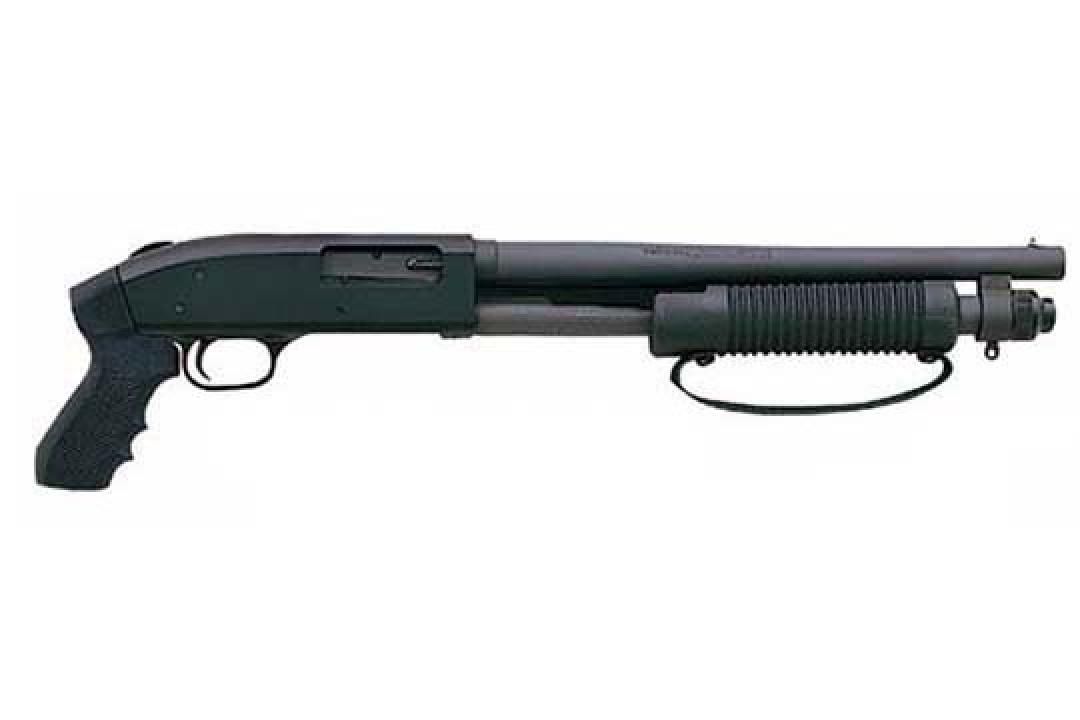
Compare that curve to a conventional vertical pistol grip.
Same maker, similar barrel, completely different category. That one measures 23.25 inches overall, under the line, so it is an any other weapon and it transfers with a stamp. It sits in the catalogue with nothing in its product name to say so.
What the barrel lengths actually look like
Pull every barrel length off the short and pistol-grip shotgun surfaces and the distribution is not smooth. It clusters hard, and the clusters sit where the thresholds are.
Barrel length
Records
14 to 15 in
29
18 to 18.3 in
10
18.5 in
94
19 to 20 in
33
22 in and over
13
The 18.5 inch spike is the finding. It is by far the most common barrel length in the set, and it sits exactly half an inch above a threshold. Manufacturers are not building to 18.0 and trusting their tolerances. They leave margin, then standardise on the margin. The set holds ten records between 18 and 18.3 inches, and the rest of the market went to 18.5 and stayed there.
Below that the distribution nearly empties. A single record in the whole set falls between 15 and 18 inches, a .410 break-action at 16, and no pump or semi-auto goes there at all. Gaining two inches of handiness there would cost the entire unregistered category.
The 26-inch cluster
Every sub-18-inch gun in the catalogue that ships without paperwork measures just over 26 inches, and the margins are thin.
Gun
Barrel
Overall length
Remington 870 TAC-14
14 in
26.3 in
Mossberg 590 Shockwave
14 to 14.38 in
26.37 in
Mossberg 590 Shockwave, some SKUs
14 in
26.5 in
Mossberg 590M Shockwave
15 in
27.5 in
Charles Daly and Chiappa Honcho
14 in
27 in
Mossberg 590A1 Cruiser, AOW
14 in
23.25 in
Read the overall length column top to bottom. Every gun in the unregistered group clears 26 by somewhere between three tenths of an inch and an inch. You are watching a design constraint work in public: the maker cut the barrel as short as it wanted, then sized the rest of the gun to land just over the line. The last row is the one that did not, and it is a different category as a result.
Three makers, one idea, three lengths
Product
Maker
Note
590 Shockwave
Mossberg
first to market, named after the grip's maker
870 TAC-14
Remington
same grip, the 870 action underneath
Honcho
Charles Daly and Chiappa
the same gun reaches the catalogue under both names
That last note is worth a second look. Search the catalogue for the Honcho and you get Charles Daly Honchos and Chiappa Honchos with matching barrel lengths, matching overall lengths and matching configurations, which is the badge-engineering pattern that runs through the imported shotgun trade generally. Buyers comparing the two names are frequently comparing one gun.
Honchos also come in an 18.5 inch version, which is not in this category at all despite carrying the same name and the same bird's head grip. The name tells you the product family. The barrel length tells you the category.
The semi-autos, which are a different market entirely
The largest tag in this group is not about short barrels. It collects the tactical semi-automatic shotguns: the Kalashnikov KS-12 and its variants, Beretta's 1301 Tactical, and a long tail of Turkish-built guns from Citadel, Dickinson, Garaysar and others, most of them on 18.5 or 20 inch barrels with a stock and a pistol grip.
They belong in the same conversation because of the grip, not the barrel. A vertical pistol grip below a full-length stock changes nothing about the category, which costs the buyer nothing and is most of the reason it is everywhere.
The exception in that group is the Garaysar FEAR series, which runs a 14.5 inch barrel on a semi-auto action. Those records carry no overall length in the catalogue, which for this category is the one field that would tell you what you are looking at.
Folding is a different answer to the same problem
A folding shotgun keeps its full barrel and its stock and gets short by hinging in the middle. That leaves it a shotgun throughout, with none of the category questions above, and it is why the folding surface in the catalogue is a genuinely separate group rather than a variant of the short-barrel one.
Approach
Barrel
Stock
Category effect
Short barrel, no stock
cut to 14 in
never had one
leaves the shotgun category entirely
Registered short-barrel
cut below 18 in
keeps it
stays a shotgun, becomes a registered one
Folding stock
full length
folds
no category change
Folding combination gun
full length
folds
no category change
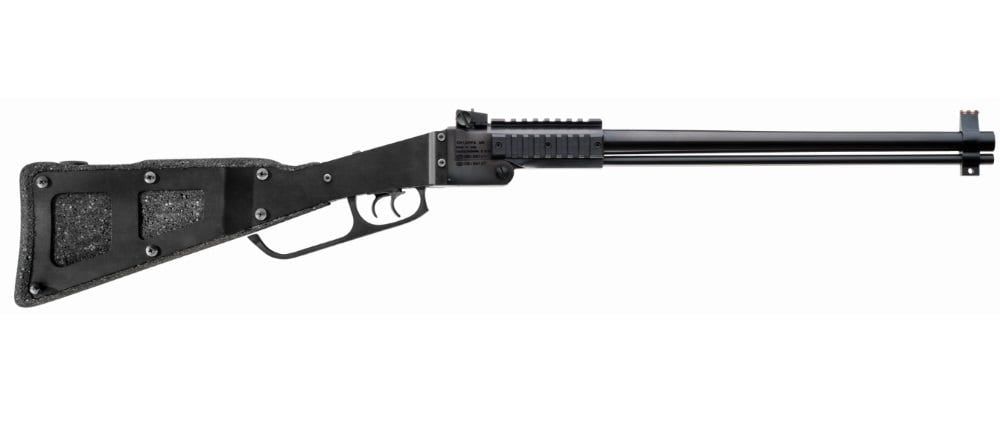
The Chiappa M6 sits at the far end of that: a break-action combination gun with a shotgun barrel over a rimfire or centrefire rifle barrel, folding flat, in .410 over .243 and 12 or 20 gauge over .22 Magnum. It is a survival-gun concept rather than a defensive one, and it is the reason the folding tag contains guns that read as rifles in a name search.
Reading the listing
Step
What to read
What it tells you
1
Grip shape in the photo
bird's head means never had a stock; vertical grip could be either
2
Overall length
the number that decides the category, not the barrel
3
Barrel length
14 to 15 is the unregistered group, 18.5 is the ordinary one
4
Product family name
Shockwave, TAC-14 and Honcho all also exist in longer versions
5
The word Cruiser, AOW or SBS
a different category from the one next to it on the shelf
The product name is the trap in the middle of that list. Shockwave, TAC-14 and Honcho are families rather than configurations, and every one of them also appears with an 18.5 inch barrel or a stock or both. A listing that gives you the family and the gauge but not the overall length has told you almost nothing, and the overall length is the field most likely to be missing: forty of the records behind this article have none recorded at all.
Check the photograph for the grip, then check the overall length against 26. Those two together settle it, and the barrel length on its own never does.
Nick Sawinyh - Nick Sawinyh is a father, husband, hobby farmer, and gun enthusiast from Kentucky. He founded GunsNation and writes most of what appears on this blog.