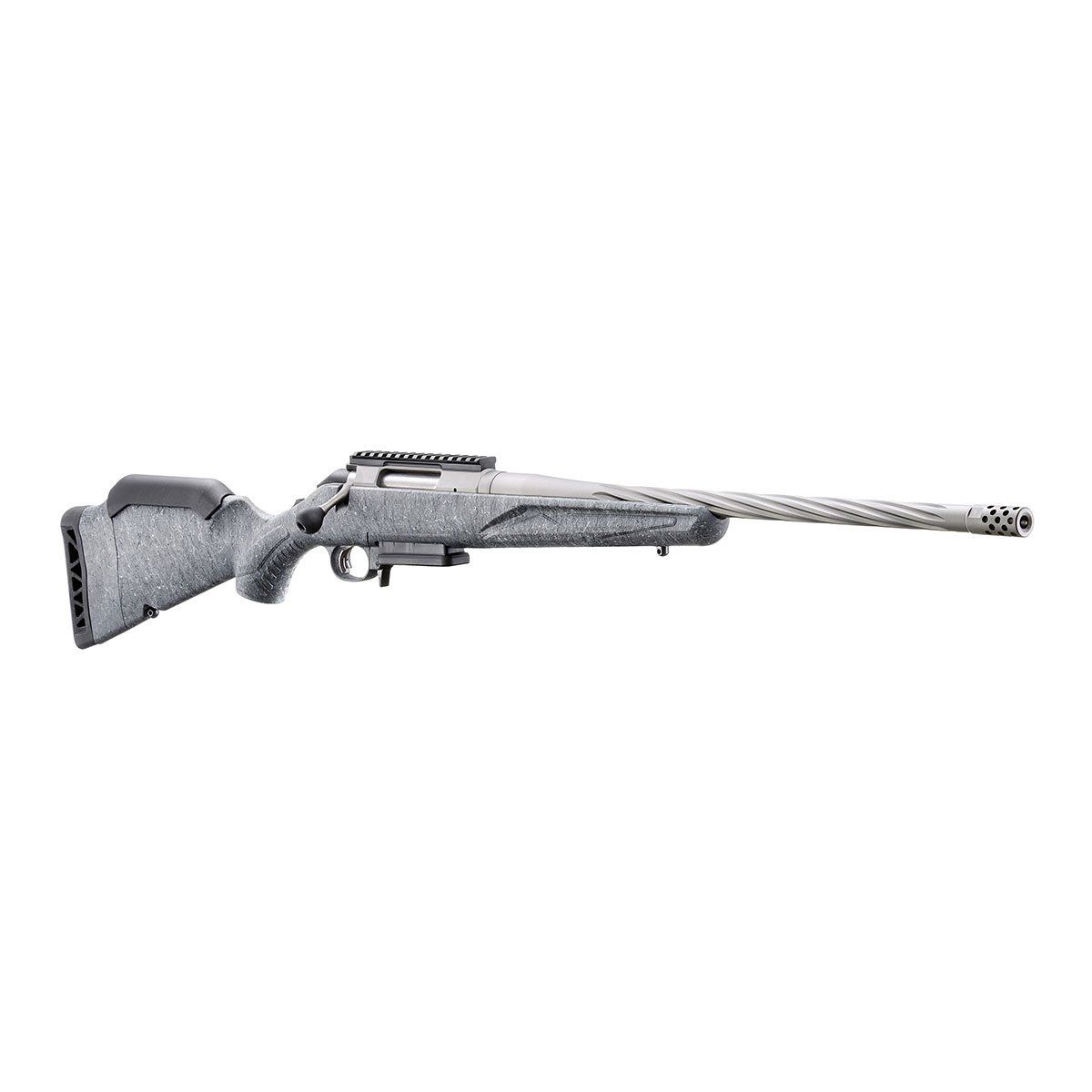
Winchester introduced the .243 in 1955 by taking the .308 Winchester case and necking it down to accept a .243in bullet. The point was to build one cartridge that did two different things: throw a light 80-grain bullet fast enough for varmints, and a 100-grain bullet hard enough for deer and pronghorn. Factory ammunition shipped in exactly those two weights, and the whole design argument was that a farmer or a rancher should not need two rifles.
Remington launched the .244 Remington the same year, based on the .257 Roberts, and it lost. The reason was rifling twist. Remington's barrels were cut to stabilise 90-grain bullets and no heavier, which locked the .244 out of the deer-hunting half of the job; Winchester's twist handled the 100-grain load. A single dimension inside the barrel decided which of the two cartridges is still on shelves seventy years later.
Twist rate still decides what the rifle can do
The standard .243 twist is one turn in ten inches, which stabilises bullets up to about 100 grains. Modern low-drag bullets heavier than that need a faster twist, usually one in eight or one in seven.
This matters when buying, because a rifle bought for deer with heavier modern projectiles in mind is a different rifle from one bought for prairie dogs, and the difference is a number that listings frequently omit. Ammunition today runs from 55 to 115 grains, a range no single barrel covers well.
Invalid Date
More Articles
Bullet weight
Twist needed
Job
55 to 80 grains
1 in 10
Varmints, small predators
90 to 100 grains
1 in 10
Deer, antelope
Over 100 grains, low drag
1 in 8 or 1 in 7
Longer range, heavier game
What the catalog holds
The .243 tag pages here carry 652 records from 40 makers, and the action breakdown says what kind of cartridge this is in practice.
Action
Records
Bolt action
593
Semi-automatic
30
Lever action
6
Break action
2
Not stated
18
The .243 is a bolt-action cartridge with a rounding error attached, which follows from its being a .308 case. Barrel length is where it starts to differ from its relatives.
The .243 has the shortest barrels of the classic hunting cartridges
Of the 608 .243 records that state a barrel length, the distribution leans short in a way its contemporaries do not.
Barrel
Records
22in
315
20in
171
24in
41
25in
22
22.4in
12
26in
9
18in
7
Grouped, 25 records sit under 20in, 508 fall between 20in and 24in, and 75 reach 24in or more. The shortest is 16in and the longest is 28in.
The 171 records at 20in are the compact and youth models. The .243 is the standard first centerfire rifle in America, because it kicks little enough for a new or smaller-framed shooter and still kills a deer cleanly, so a large share of the guns chambered for it are built short and light on purpose. The .270 Winchester has a single record in the entire catalog with a barrel under 20in.
The compact configuration is not a niche here
Counting names, 97 of the 652 records describe themselves as compact, youth, micro or lightweight. That is close to one rifle in six, and it is a far higher share than the .30-06 or the .270 carries. Another 79 records are rifle-and-scope packages sold as one item, which is the same buyer being served from the other direction: somebody equipping a first rifle in one purchase rather than assembling one.
It produces meaningfully less recoil than a .308 from the same rifle, being the same case throwing a lighter bullet, and recoil is what teaches a new shooter to flinch. Avoiding that is worth more to a beginner than any amount of extra energy at the target.
The semi-automatic corner
Thirty .243 records are semi-automatic, and they split into two clear groups. Browning's BAR accounts for most of them, a traditional gas-operated sporting rifle in a wooden or synthetic hunting stock. The rest are AR-10 pattern rifles from Armalite, Rock River and smaller shops, chambering the .243 on a short-action AR platform for predator and varmint work where fast follow-up shots matter.
The audit for this article also found three bolt-action rifles filed as semi-automatics, and a Mossberg Patriot whose own title called it a semi-auto when the Patriot has only ever been a bolt gun. Those are corrected.
Who builds them
Maker
Records
Savage
157
Browning
81
Winchester
77
Weatherby
59
Remington
52
Howa
46
Ruger
34
Tikka
23
Mossberg
16
Christensen Arms
12
Savage's lead is the Axis and 110 lines, which are also where the compact and youth configurations concentrate. This is the value end of the bolt-rifle market, and the .243 lives there.
Where it sits among the four big hunting cartridges
Cartridge
Introduced
Parent case
Bullet
Records here
Makers
.30-06 Springfield
1906
Replaced the .30-03
.308in
554
39
.270 Winchester
1925
.30-03 Springfield
.277in
559
30
.243 Winchester
1955
.308 Winchester
.243in
652
40
6.5 Creedmoor
2007
.30 Thompson Center
.264in
1,398
114
The .243 has more records than either of the older two despite being the smallest of them, which is the dual-purpose argument still doing its work. A .270 is a deer rifle; a .243 is a deer rifle that also shoots groundhogs, which is why a household is likelier to own two of them.
Buying one
Check
Why
Twist rate
Decides whether heavy modern bullets will stabilise
Barrel length
The 20in guns are compact and youth models, not an accident
Whether it is a combo
Many .243 listings here are rifle and scope packages
Stock length of pull
Follows from the compact configuration and is easy to overlook
One catalog note from the audit behind this article. Cleaning the four hunting-cartridge tag sets removed 217 records carrying invented model designations in their titles, most often "Precision Hunter", which is a Hornady ammunition line rather than any rifle model, and which had also worked its way into descriptions and review text on those same records. A Savage Axis is a Savage Axis.
Nick Sawinyh - Nick Sawinyh is a father, husband, hobby farmer, and gun enthusiast from Kentucky. He founded GunsNation and writes most of what appears on this blog.