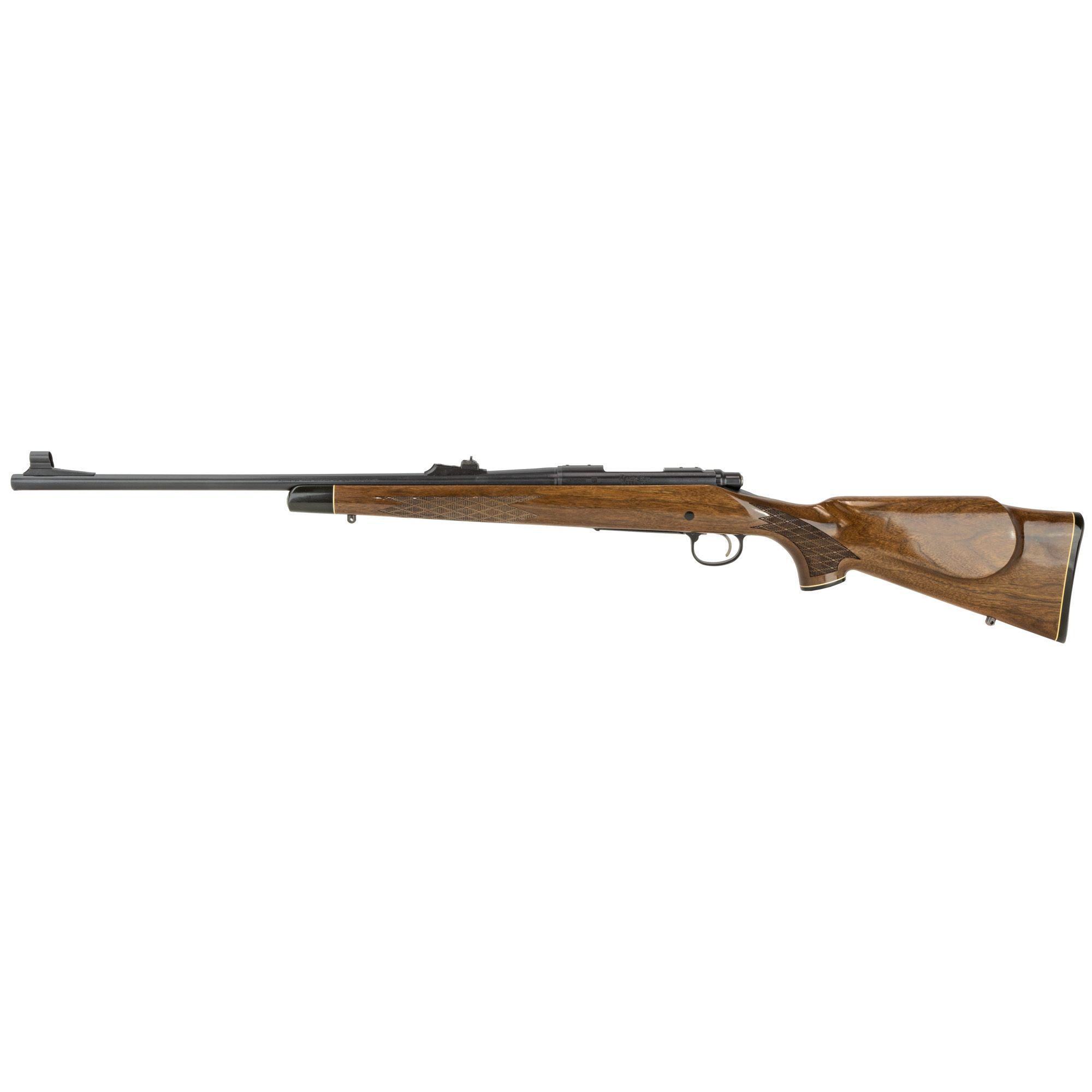
You are standing at a used rack looking at a bolt rifle stamped "Model 700" on the barrel, and the tag says BDL. The rifle next to it is also a Model 700, also walnut, and the tag on that one says ADL. They cost different money, and nothing on either rifle spells out why.
The letters are not model names and they are not generations. They are trim grades, and they describe what Remington bolted to a receiver that is the same receiver in every case. Once you know which parts each grade carries, you can identify one across a room, and you can tell when a listing has the grade wrong.
Turn the rifle over and look at the bottom of the magazine
A BDL has a hinged floorplate: a steel plate under the magazine, held by a latch inside the trigger guard, that swings down and dumps the cartridges into your hand. An ADL does not have one. Its magazine is blind, meaning it is a box milled into the stock with no opening at the bottom at all. To unload an ADL you work every round up through the action with the bolt.
That difference is functional rather than cosmetic. Unloading a rifle at the end of a hunt means cycling live cartridges past the extractor and out of the ejection port, one at a time, on a loaded gun. The floorplate lets you drop them straight down instead, with the bolt closed. Hunters who have carried both tend to have strong feelings about it.
Invalid Date
More Articles
Everything else that separates the grades follows from the same idea, which is that BDL is the dressed version and ADL is the plain one.
The one BDL that fails the floorplate test
Remington built a detachable magazine version, catalogued as the BDL DM, from the mid 1990s until 2004. It carries a removable box magazine holding three or four rounds depending on chambering, so it has neither a hinged floorplate nor a blind magazine. It was offered across a wide spread of chamberings, including .243 Winchester, 6mm Remington, .260 Remington, .270 Winchester, .280 Remington, 7mm-08, .30-06, .308 Winchester, .25-06, and the 7mm Remington, .300 Winchester, .300 Weatherby and .338 Winchester magnums. A stainless version with a synthetic stock, the BDL SS DM, ran alongside it.
If the rifle in front of you is a walnut Model 700 with a magazine that drops out of the bottom, the tag reading BDL is not wrong. Look for the magazine release ahead of the trigger guard. Owners still turn up with these on the used market, and they are frequently listed simply as a BDL with no note of the magazine at all.
What the three letters change
Remington has never published an expansion of the suffixes. They function as grade codes, and the practical meaning is what is bolted to the rifle. Three grades share the Model 700 action, and the differences are consistent enough to read off a photograph.
ADL
BDL
CDL
Magazine
Blind, no floorplate
Hinged floorplate
Hinged floorplate
Stock
Black synthetic
Gloss American walnut
Satin American walnut
Comb
Straight
Monte Carlo, raised cheekpiece
Straight
Fore-end cap
None
Black
Black
Checkering
None
Cut
Cut
Iron sights
None
Hooded ramp front, adjustable rear
None, drilled and tapped only
Barrel lengths
20, 24, 26 inches
22 and 24 inches
24 and 26 inches
The ADL in Remington's catalog is a synthetic-stocked rifle, which surprises people who remember the walnut ADL of earlier decades. If you are looking at a walnut rifle with no floorplate, you are looking at an older ADL, not a current one.
The CDL is the grade most often confused with the BDL, because both are walnut with a floorplate and a black fore-end cap. The comb is what separates them.
The Monte Carlo comb, and why a BDL is not a "700 Classic"
The BDL stock has a Monte Carlo comb: the top line of the buttstock steps up as it runs back from the grip, raising a cheekpiece so your eye lands in line with a mounted scope rather than with the iron sights. The CDL comb is straight, running in an unbroken line from grip to heel in the older English pattern.
Remington's own dimensions make the difference measurable rather than a matter of impression. The BDL drops 1 inch at the comb and 1 5/8 inches at the heel. The CDL drops 1 1/8 inches at the comb and 1 3/8 inches at the heel. The BDL comb sits higher relative to the heel, which is exactly what a Monte Carlo does.
This matters because of a naming collision that turns up constantly in listings. The Remington 700 Classic is a real and separate rifle, not a BDL variant. It entered regular production in the late 1970s in seven chamberings, then ran from 1981 to 2005 as an annual limited edition, one chambering per year: 7mm Mauser in 1981, .257 Roberts in 1982, .35 Whelen in 1988, .220 Swift in 1992, .300 Savage in 2003, .308 Winchester to close the series in 2005. Its stock has a straight comb.
So a listing headed "700 BDL Classic" is describing two different rifles at once. If the gun in the photograph has a Monte Carlo comb, it is a BDL and the word Classic is decoration. If it has a straight comb and an unusual chambering for its era, you may be looking at an actual Classic, and the chambering plus the year tells you which one.
Every chambering the BDL is catalogued in
The figures below are Remington's own published specifications rather than a dealer's summary, which matters because dealer listings copy each other and a wrong number propagates across a dozen sites in a week.
Chambering
Order no.
Capacity
Barrel
Overall length
Weight
Twist
.243 Win
R25787
4
22 in
41 5/8 in
7 1/4 lb
1:8
.270 Win
R25791
4
22 in
42 1/2 in
7 3/8 lb
1:10
.30-06 Springfield
R25793
4
22 in
42 1/2 in
7 3/8 lb
1:10
.308 Win
R25805
4
22 in
44 1/2 in
7 1/4 lb
1:10
6.5 Creedmoor
R25804
4
22 in
44 1/2 in
7 1/4 lb
1:8
7mm Rem Mag
R25803
3
24 in
44 1/2 in
7 1/2 lb
1:8
.300 Win Mag
R25806
3
24 in
44 1/2 in
7 1/2 lb
1:10
Two patterns in that table are worth remembering. The belted magnums hold three rounds and everything else holds four, so a listing claiming a four-round .300 Winchester Magnum BDL has copied the standard-caliber figure. The magnums are also the only chamberings with a 24 inch barrel, so "BDL, .270, 24 inch" is either a misprint or a rifle that has been rebarrelled.
Length of pull is 13 3/8 inches across all seven. Every one of them is gloss American walnut over polished blue, with the hooded ramp front sight and adjustable rear that the grade has carried throughout.
That list is narrower than the rifle's history. The BDL has been chambered in a good deal more over the decades, including .22-250 Remington, which ran from the late 1960s into the mid 1990s, and 6mm Remington, which owners still shoot and handload for. Those turn up used and are worth knowing on sight, because a chambering that is no longer catalogued is one a seller is more likely to describe loosely. The .22-250 in particular was offered with a heavy barrel, so a .22-250 BDL with a thick muzzle is not necessarily rebarrelled.
The barcode tells you the order number
Remington's older barcodes are built from the company prefix 047700, followed by the five digit order number, followed by a check digit. The order number sits in the middle of the barcode in plain digits.
Barcode
Order number
Rifle
047700257877
25787
.243 Win
047700257914
25791
.270 Win
047700257938
25793
.30-06 Springfield
047700258034
25803
7mm Rem Mag
047700257495
25749
.22-250 Rem
Read the middle five digits and you have the exact SKU, which pins down the chambering and grade without trusting the seller's title. That is worth a great deal on a listing with poor photographs and a description written by somebody who does not know what a floorplate is.
Barcodes beginning 810070 are the later prefix and do not carry the order number in the same readable way, so this only works on the older ones.
Two production eras wearing the same name
Remington Arms went through bankruptcy and its long gun lines were bought out of it, with the Model 700, the 870, the 1100 and the Model Seven continuing under RemArms in Ilion, New York. The rifle kept its name and its part numbers while the company behind it changed.
The barcode prefix is the cleanest marker of which era a particular listing belongs to. A 047700 prefix is the older Remington Arms numbering. An 810070 prefix is the later one. Both appear side by side in dealer inventory for the same chambering, because stock from before the transition is still working its way through the channel alongside new production.
The receiver did not change across that line. It is machined from bar stock and cylindrical, so it beds evenly in the stock, and the extractor is still integral, set in the rim of the bolt face. Aftermarket triggers, stocks, bases and barrels that fit one fit the other, which is why the Model 700 footprint became the reference dimension other manufacturers copy.
Labels Remington never used
Listings for these rifles carry a layer of invented product names, mostly generated to make a title look more specific than the seller's information actually is. None of the following are Remington designations for the 700 BDL:
"Gen 1" and "Gen 2". The Model 700 has run continuously since 1962 without generation numbering. A rifle described as a BDL Gen 1 is just a BDL, and the label tells you nothing about its age.
"Precision Hunter", which is a Hornady ammunition line rather than a Remington rifle grade.
"Precision Black", or any black stock description attached to a BDL. BDL means gloss walnut. A black-stocked Model 700 is an ADL, an SPS, or something rebuilt aftermarket.
"Classic Series" used as decoration on a Monte Carlo rifle, for the reason covered above.
When a title carries one of these and the specification block carries another, trust the barcode and the photographs.
Checking a used one
The Model 700 is among the most modified rifles in existence, which is a strength when you want to modify one and a hazard when you want an original.
Check
What you are looking for
Floorplate
Present and latching firmly. A sprung latch dumps cartridges when it is bumped.
Comb
Monte Carlo step present, confirming BDL rather than CDL or Classic.
Barrel stamping
Chambering matches the listing. Rebarrelled 700s are common and often unmarked.
Trigger
Older rifles may carry the original Walker trigger rather than the later X-Mark Pro. Check which, and check the recall history for the serial.
Stock fit
Gloss finish cracks at the wrist and behind the tang on rifles that were stored badly.
Bore
Throat erosion at the chamber end, worst on the magnums and on .22-250 varmint rifles that saw volume.
Fore-end cap
Present, and the checkering unsanded. Refinished stocks lose checkering definition first.
A rifle whose stock has been swapped for synthetic is no longer a BDL in any meaningful sense, whatever the tag says. The action underneath is unchanged, so it may still be exactly the rifle you want, but it is not the grade being advertised.
Nick Sawinyh - Nick Sawinyh is a father, husband, hobby farmer, and gun enthusiast from Kentucky. He founded GunsNation and writes most of what appears on this blog.