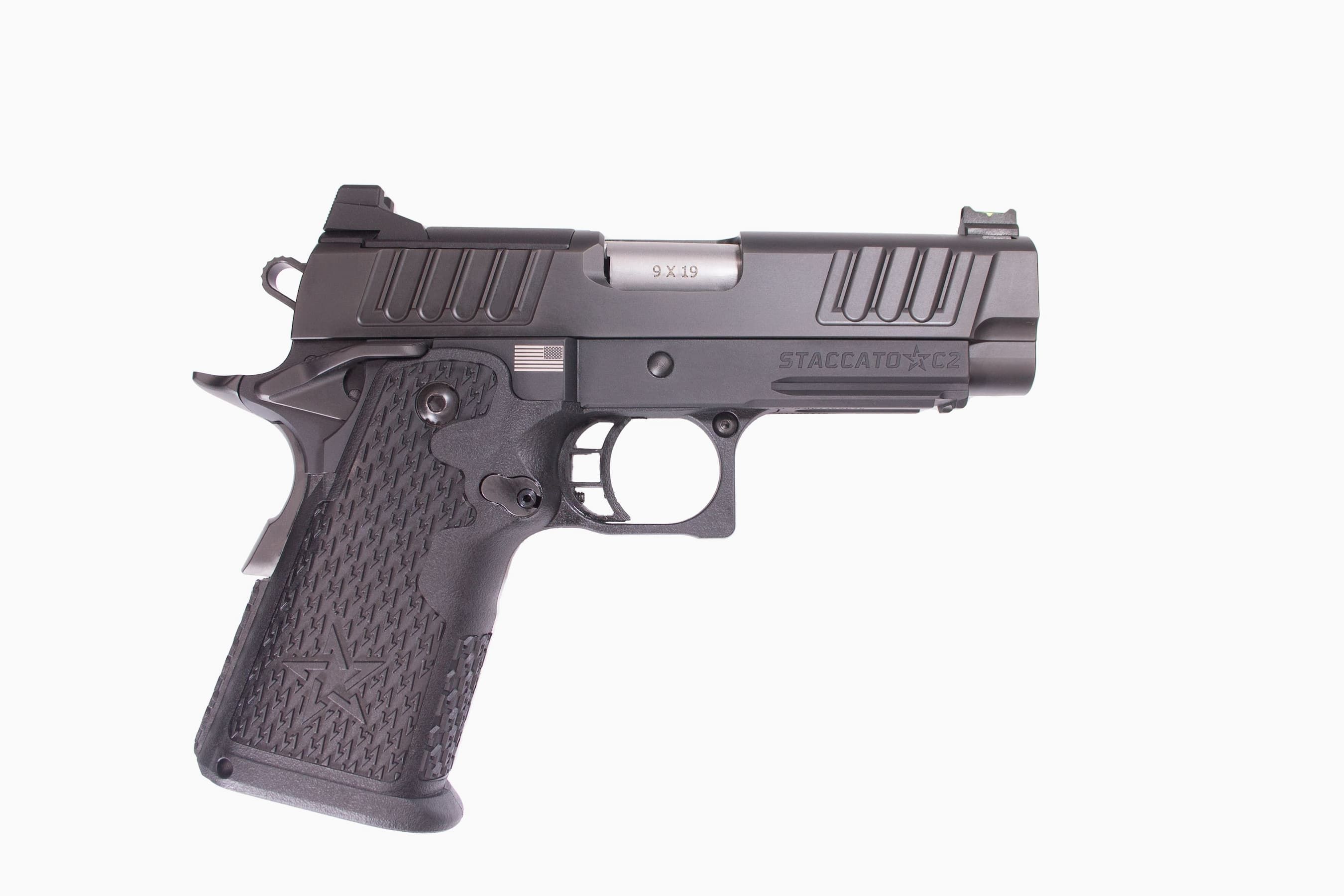
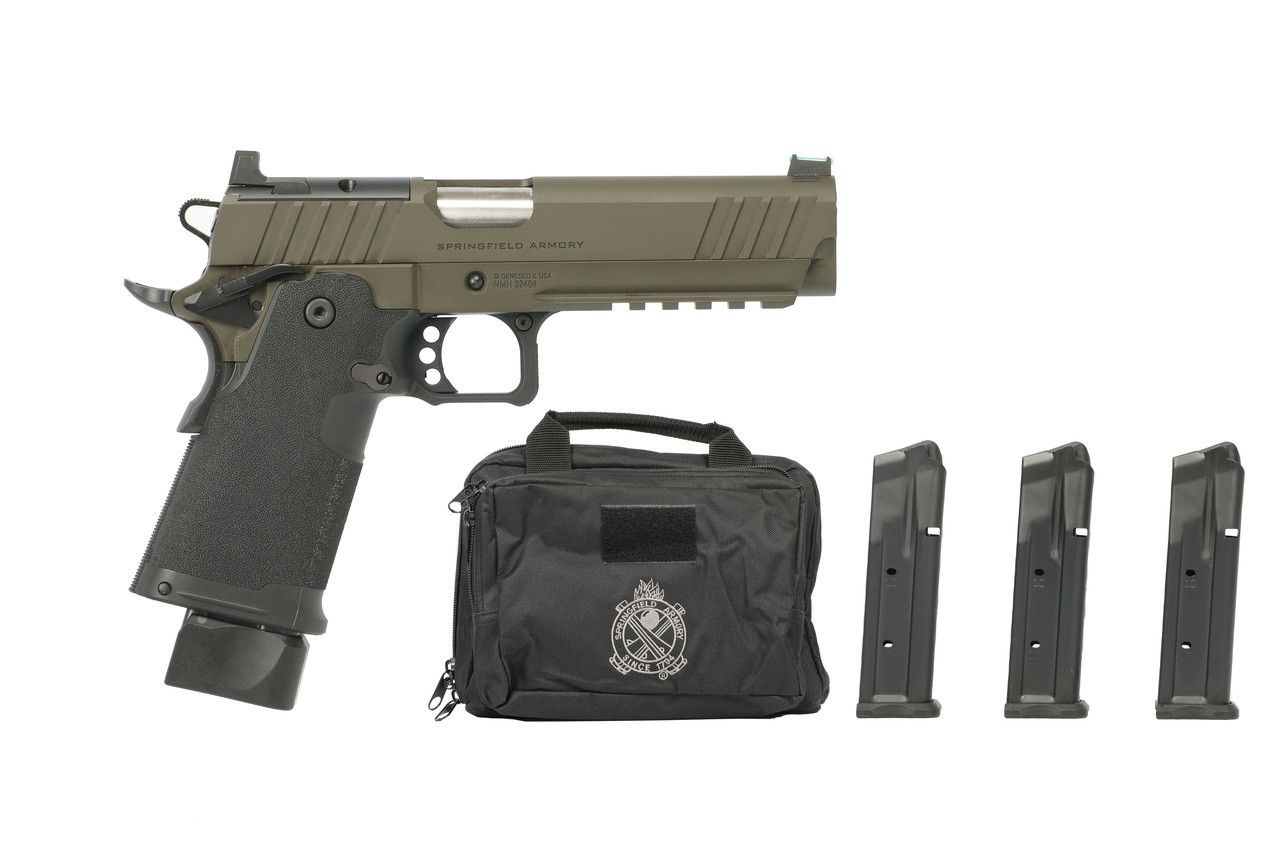
Pick one up and the first thing you notice is that it feels like a 1911 that ate something. Same slide profile, same grip angle, same thumb safety under your thumb and grip safety against your palm. Then you look at the magazine and it holds seventeen rounds instead of eight.
A 2011 is a double-stack 1911, and the interesting part is how it gets there. Not by making the frame wider, which is what earlier attempts did, but by cutting the frame in two.
The frame is the whole answer
A 1911 frame is one piece of steel. It holds the slide rails at the top, the trigger and hammer mechanism in the middle, and the grip and magazine well at the bottom. Everything is machined from the same block.
Widening that to fit a staggered magazine means widening the whole thing, and you end up with a heavy pistol whose grip is a solid steel club. Several makers tried it and the results were called widebody 1911s. They worked, and almost nobody wanted to carry one.
The 2011 splits the frame at the trigger guard. The top section stays steel and keeps the slide rails, the barrel fit and the fire control. The bottom section becomes a separate grip module, usually polymer, holding the magazine well and the grip panels, and it bolts to the steel section. Look at the photograph above and you can see the seam.
Invalid Date
More Articles
That one change does three things at once. It drops a lot of weight, because the heaviest and least useful steel is gone. It lets the grip be moulded to a comfortable shape instead of milled to a square one. And it makes the grip a replaceable part, which is why the aftermarket for these guns is mostly grip modules.
The mechanism above the seam is untouched. Single action, hammer fired, the same trigger geometry John Browning drew, a grip safety and a thumb safety. If you can run a 1911, you can run a 2011 without learning anything.
It was built to win matches, not to be carried
The design comes out of competition, and specifically out of Texas in the early 1990s, when Virgil Tripp was building custom 1911s for a growing IPSC market that wanted more rounds than eight.
In 1993 Sandy Strayer, an engineer and CAD specialist, joined Tripp at Tripp Research. The modular frame they patented together, with a fibre-reinforced plastic section carrying the trigger guard, grip and magazine well bolted to a metal upper frame, was finalised in May 1994, and the 2011 range launched the same year. Tripp gave Strayer an equal stake and co-patent rights, and Tripp Research became Strayer-Tripp International, which is where the STI name comes from.
The partnership did not last the year. Strayer left in June 1994 to form Strayer-Voigt with the competitive shooter and gunsmith Michael Voigt, and SVI has built the pattern separately ever since. STI went on to become Staccato.
Knowing that origin explains a lot about how these guns feel. Every design decision was made for a shooter standing on a range with a timer running: the flat single-action trigger, the high capacity, the weight sitting low in the hand to keep the muzzle down between shots. None of it was chosen for a pistol that spends fourteen hours a day under a shirt. The carry-oriented compacts are a later adaptation of a competition tool, which is why they still weigh what they do.
Why nobody else calls it a 2011
Search for these guns and the names will not line up, and there is a simple reason. Staccato, formerly STI International, owns the 2011 trademark. Everyone else builds the pattern under a name of their own.
Maker
What they call it
Staccato
2011, in the P, C2, XC, XL and CS models
Springfield Armory
1911 DS, sold as the Prodigy
Kimber
2K11
EAA
Witness 2311
Bul Armory
SAS II
Most others
"double-stack 1911"
This matters when you shop, because a search for "2011" returns Staccato and very little else, while the pattern you actually want is sitting under four other names. It also means "double-stack 1911" and "2011" get used interchangeably in conversation while meaning slightly different things in a catalog. In common use they are the same gun.
The grip is the real buying decision
The complaint that comes up more than any other is that the grip is too fat. Tom Gresham put it plainly on X in August 2026, asking who makes a double-stack 1911 with the slimmest grip, because most of them feel too thick in his hands while double-stack striker pistols do not.
That is not a manufacturing failure, it is geometry. The magazine has to hold two staggered columns of cartridges, and the grip has to hold the magazine plus walls plus panels. A striker-fired pistol can run a narrower grip because it has no hammer mechanism behind the magazine and its frame is moulded rather than assembled.
Makers are competing on exactly this now. EAA's Witness 2311 CMX is marketed on a slimmer grip and a magazine designed for 9mm rather than adapted from a wider cartridge, which is the specific fix: a magazine built around .38 Super or 10mm dimensions wastes width when you load 9mm into it.
If your hands are small, this is the variable that decides whether you like the gun, and it is the one you cannot judge from a photograph. Hold one before buying.
Sizes, and what the barrel length tells you
The lengths in this inventory cluster into three groups, and each one is a different gun.
Barrel
What it is
5 inches
The full-size competition and duty gun, the largest single group here
4.25 to 4.4 inches
The commander-length middle, the most common carry compromise
3.5 to 4 inches
The compacts, including Staccato's CS and C2
The full-size guns are the original point of the design. These started as competition pistols, where a heavy 9mm with a light single-action trigger and a twenty-round magazine is close to ideal, and where nobody cares that it prints under a shirt.
The compacts are the newer and more interesting half of the market, because they are trying to make a competition gun into a carry gun. A 3.9-inch 2011 gives up sight radius and some magazine capacity to get down to something wearable, and the weight lands around two pounds, which is heavy for concealed carry and light for a steel-framed 1911.
What this inventory holds
The distribution is more lopsided than most catalog segments.
Dimension
What the listings show
Maker
Staccato is well over half. Springfield is most of the rest
Chambering
Overwhelmingly 9mm. A handful of .45 ACP, 10mm and .40
Capacity
16, 17 and 20 rounds are the common figures
Weight
Around two pounds is typical
That 9mm concentration is worth pausing on. The 1911 is a .45 ACP design by origin, and the 2011 pattern has almost entirely abandoned the cartridge that made the platform famous. The reason is the same reason competition shooters moved: 9mm gives you more rounds in the same grip, less recoil to track through, and cheaper practice.
Staccato's dominance of the listings reflects the trademark as much as the market. They own the term everyone searches for, so their guns are the ones tagged with it.
Reading a listing without being fooled
Two traps caught us while building this catalog surface, and both are the kind that survive a casual glance.
The first is a maker who builds both patterns. Bul Armory makes the SAS II, which is a genuine double-stack 1911, and also the Axe series, sold as the Cleaver, Hatchet and Tomahawk. The Axe guns are striker-fired polymer pistols with no 1911 mechanism in them at all. Filtering on the Axe name put six of them into this tag before they were caught and removed. The tell was sitting in the records themselves: the names said "Striker-Fired" and the action field said Striker.
The second is that 2011 is also a year. A search for the pattern returns a Browning A-Bolt bolt-action rifle sold as a "2011 Edition", which is a rifle in every respect. Any model name that looks like a year will collect this kind of match.
The general rule that falls out of both is worth keeping. When a listing's own action field contradicts the category it has been filed under, the action field is usually right, because it came from the product data rather than from someone matching on a word.
Which one to buy
If the gun is for competition or the range, buy the five-inch full-size version of whichever brand you can afford, and spend the difference on ammunition. At this size the guns are more alike than the marketing suggests, and the trigger is the thing you are paying for.
If the gun is for carry, go to the compacts and accept the tradeoff honestly. You are carrying a heavy pistol because you want a single-action trigger and a lot of rounds, and lighter options exist that give up one or both. That is a real preference and not an irrational one.
If your hands are on the smaller side, make grip circumference your first filter rather than your last. The slimmer designs exist specifically because enough people found the standard ones uncomfortable.
And if you already shoot a 1911 well, this is the shortest path to doubling your capacity without relearning a manual of arms. That, more than the competition pedigree, is why the pattern keeps growing.
The full inventory is on the 2011 pistols tag page, with Staccato's own guns broken out under Staccato 2011.
Related reading
1911 pistols, the single-stack ancestor every gun above is built from
Nick Sawinyh - Nick Sawinyh is a father, husband, hobby farmer, and gun enthusiast from Kentucky. He founded GunsNation and writes most of what appears on this blog.