Someone hands you two rifles that look almost identical. Same receiver set, same magazine, same trigger, same optic. One of them is a rifle. The other is a pistol, and the only visible difference is what is bolted to the back of the receiver extension.
An AR pistol is an AR built with a barrel shorter than sixteen inches and no shoulder stock. Everything else follows from those two decisions. Same action, same cartridges, often the same factory. What a buyer needs to understand is what changes when the stock comes off, and what does not change at all.
The receiver extension is the whole argument
On a standard AR-15, the buffer and recoil spring live in a tube that threads into the back of the lower receiver. The stock slides over that tube. The tube is structural and the stock is a passenger, which is why an AR is so easy to reconfigure: the part that makes it a rifle is a sleeve, and the tube underneath stays put.
Strip the stock off and the tube remains, still holding the buffer and still cycling the bolt carrier. What it no longer does is give you somewhere to put your shoulder. That is the mechanical definition of an AR pistol.
Two things follow, and they account for most of what people notice the first time they shoot one.
Invalid Date
More Articles
You lose your third contact point. Rifle marksmanship is built on shoulder, cheek and firing hand working together. Take one away and the gun moves more under recoil, tracks slower between targets, and rewards a much more deliberate grip on the handguard. This is not a small effect, and it is the honest reason a rifle is easier to shoot well.
Then there is the blast. A 5.56 case is designed around burning its powder charge in roughly twenty inches of barrel. Cut that to seven and a half and a large fraction of the propellant is still burning when it leaves the muzzle. The noise and flash are worse for the people standing beside you than for the person shooting, which is the part nobody warns you about.
Brace or bare tube
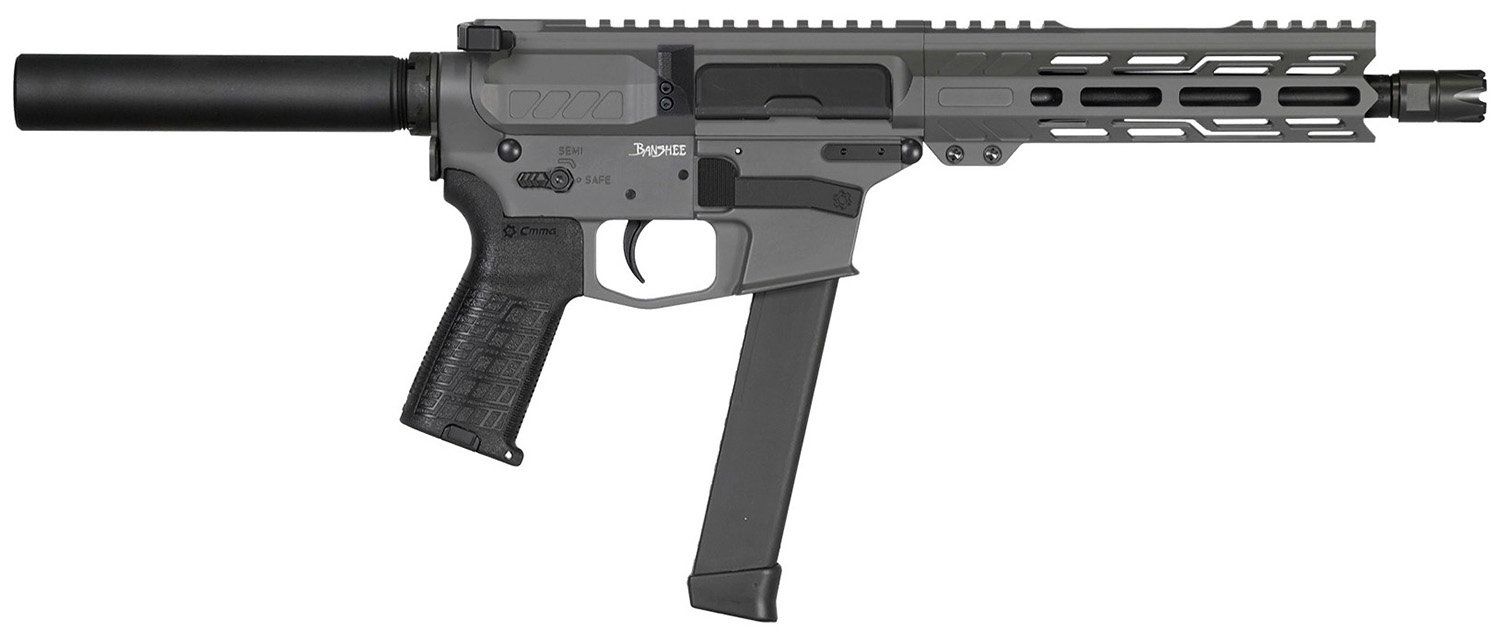
A bare receiver extension is exactly what it sounds like: the tube with a foam cover, or with nothing at all. CMMG's Banshee line ships this way, and once you know to look for it the bare tube is unmistakable.
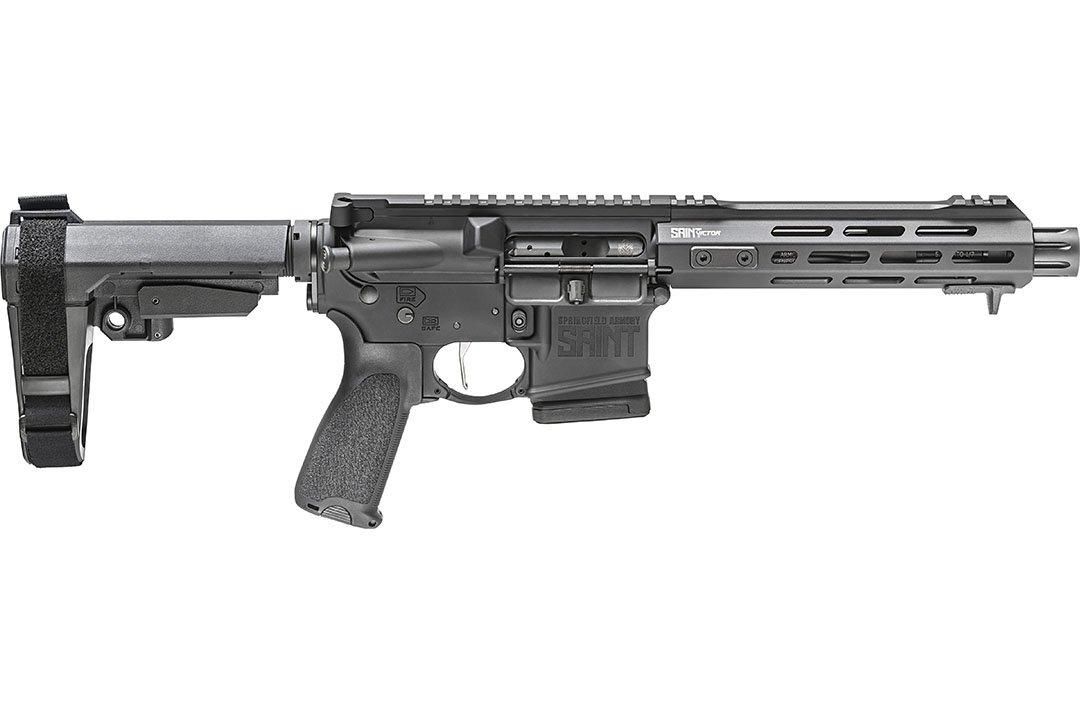
A stabilizing brace is a moulded attachment on that same tube, with a strap. SB Tactical developed the first one around 2012, and the design intent was to let a shooter with limited use of one arm strap the firearm to the forearm and fire it one-handed. The strap is not decoration. It is the feature the original design was built around, and it is clearly visible on the Springfield Saint Victor at the top of this page.
The brace has since become a product line rather than a single item. SB Tactical's numbered series runs SBA3, SBA4, SBA5 and now SBA6, with the differences amounting to adjustment range, the shape of the rear surface, and how the strap anchors. Buying an AR pistol usually means buying whatever brace the manufacturer had a supply contract for, which is worth knowing when two otherwise identical guns differ by several ounces.
Weight is where the choice shows up on a spec sheet. A bare tube saves several ounces over a moulded brace, and on a firearm that already sits nose-heavy from a short handguard full of rail, ounces at the back count for more than ounces at the front.
A rule that came, went, and left the hardware behind
The brace has a regulatory history, and it explains why the market looks the way it does.
Braces sold for roughly a decade under agency guidance that treated them as accessories rather than as stocks. A Congressional Research Service report estimated between ten and forty million of them in circulation as of 2021, which makes it one of the most widely adopted firearm parts in modern American shooting.
In 2023 the ATF published a rule, "Factoring Criteria for Firearms with an Attached Stabilizing Brace", which reclassified most braced pistols and opened a registration window of a hundred and twenty days. Estimates of compliance during that window run between roughly half a percent and eight percent of the braced pistols believed to exist. A number that low in either direction tells you how thoroughly the category had already been absorbed into ordinary ownership.
The rule was vacated in August 2024 following rulings in the Fifth and Eighth Circuits, on procedural grounds rather than on the underlying question, and the Department of Justice later dropped its appeal. Litigation over the interpretation behind the rule has continued since.
The durable part of this for a buyer is narrower than the argument. The hardware in front of you was designed across that whole period, so the market holds braces designed before the rule, braces redesigned during it, folding stocks marketed as alternatives to it, and bare tubes that sidestepped the question entirely. Two guns from the same maker in the same caliber can have four different things attached to the back, and that is why.
Barrel length is a velocity decision
How far under sixteen inches to go is a ballistics question. Here is where the market has actually settled, counting only the records that publish a barrel length:
Barrel length
Share of published lengths
What lives there
Under 7 inches
About a quarter
Rattler-class 5.5in guns, blowback .45 ACP
7 to 9.9 inches
More than half
The 7.5in 5.56 mainstream, 8in blowback Banshees
10 to 11.9 inches
About an eighth
10.5in and 11.5in 5.56
12 to 15.9 inches
Under a tenth
12.5in .300 Blackout, .308 builds
The 7.5-inch 5.56 build dominates because it is the shortest length at which a pistol-gas AR cycles reliably without heroics, not because it performs best. Move up to 10.5 or 11.5 inches and 5.56 recovers a meaningful fraction of its velocity for a few inches of extra length. The 11.5-inch length has a long service history behind it and is the one most often recommended by people who shoot short 5.56 seriously.
.300 Blackout sits differently, and this is the cartridge's reason for existing. It was designed to burn its charge in a short barrel, so an 8.5-inch .300 Blackout is working as intended rather than working compromised. If a suppressor is part of the plan, the case for it over 5.56 gets stronger, for reasons covered in our piece on what suppressor-ready actually means.
The blowback branch
A large part of this category is not gas-operated at all. Chamber an AR-pattern receiver in a pistol cartridge and the gas system becomes unnecessary: a heavy bolt and a stiff spring do the work, with no gas tube, gas block or gas key anywhere in the design. CMMG's Banshee is the volume seller here, and the same platform appears in 9mm, .40 S&W, .45 ACP, 10mm, 5.7x28 and .22 LR.
The magazine tells you which branch you are looking at. A blowback AR pistol usually feeds from a Glock-pattern or Colt-pattern magazine through a modified magwell, sitting proud of the receiver rather than flush inside it. You can see that in the Banshee photograph above.
Chambering
Share of the catalog's AR pistols
Operating system
5.56 NATO and .223
About a third
Direct impingement gas
9mm
Roughly a sixth
Blowback
.300 Blackout
Roughly an eighth
Direct impingement gas
5.7x28
Small but distinct group
Blowback
.45 ACP
Small but distinct group
Blowback
10mm, 7.62x39, .22 LR, .40 S&W
Smaller groups each
Mixed
Only about a third of these guns are chambered in 5.56 or .223, which is the fact most likely to surprise anyone who thinks of the category as short AR-15s. If the pistol-caliber side is the interesting one, the mechanics are the same ones covered in how 9mm carbines actually work.
Not everything called an AR pistol is an AR-15
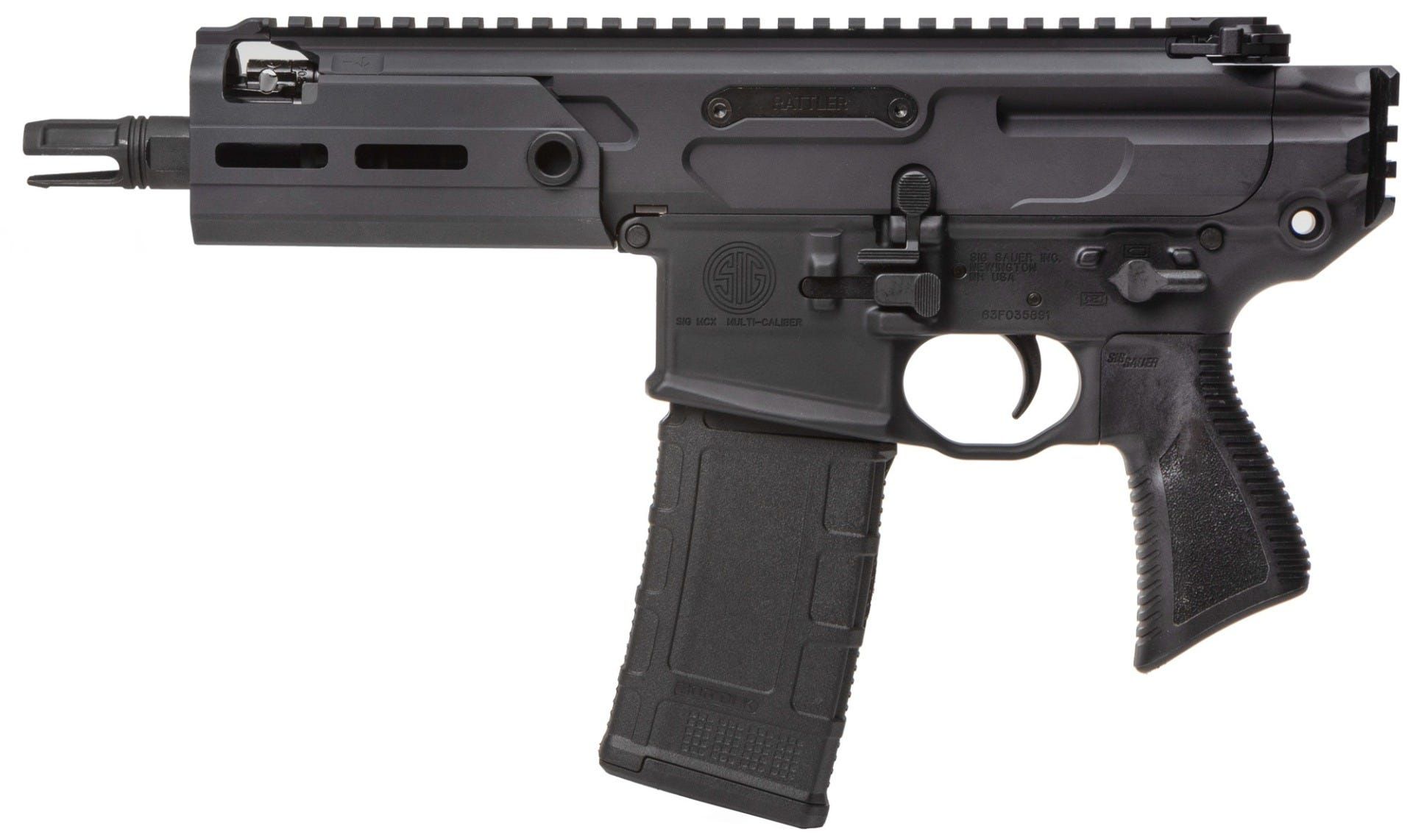
Sig's MCX is the clearest example. It takes AR-pattern magazines and uses AR-style controls, so it gets shelved and searched alongside AR pistols, but internally it is a short-stroke gas piston design with the recoil springs moved into the upper receiver.
Moving them is what makes the folding brace possible. With nothing in the receiver extension, the rear of the gun has no functional reason to stay rigid.
The numbers show what that buys. A Rattler in .300 Blackout with a 5.5-inch barrel folds to 15.4 inches. A conventional 7.5-inch AR pistol on a buffer tube cannot fold at all and measures 23.5 inches at its shortest.
The tradeoff is the aftermarket. AR handguards, buffers, springs and stocks are a commodity market with decades of competition behind it. MCX parts come from Sig.
What a spec sheet gets wrong
Published dimensions on short-barrelled ARs are unreliable, and the failure is systematic enough to be worth catching yourself.
The arithmetic is fixed. Overall length is the barrel plus the receiver set plus the receiver extension, and the middle two terms barely vary. A 7.5-inch barrel puts a braced AR pistol somewhere around 23 to 25 inches. A 9.6-inch barrel puts it around 26. A listing showing a 7.5-inch barrel and a 33-inch overall length has taken its number from a rifle, because 33 inches is roughly what a 16-inch carbine measures.
We found exactly that while preparing this article. Two records for the same Great Lakes Firearms 7.5-inch .223 Wylde pistol carried an overall length of 33.25 inches and a weight of 6.8 pounds, where the manufacturer's own page lists 23.5 inches and 5.0 pounds. Two American Tactical records carried 40.25 inches, longer than most 16-inch rifles. All four have been corrected.
Weight fails a different way, through unit collapse. One Springfield Saint listing gave the weight as 5.8 pounds and then, in the same sentence, as 8 ounces. A CMMG Banshee was published at 5.1 ounces, which is a mangled rendering of five pounds one ounce. No firearm weighs eight ounces.
Three checks catch nearly all of it:
Overall length should exceed barrel length by roughly 16 inches on a braced AR with a buffer tube. Much more than that and you are reading rifle data.
A complete AR pistol weighs between about 4 and 7.5 pounds. Anything under a pound is a units error.
A folding gun often publishes its folded length, which legitimately breaks the first check. Work out whether the design can fold before treating a short number as a mistake.
Model
Barrel
Overall length
Weight
Springfield Saint Victor 5.56
7.5 in
24 in
5.5 lb
Great Lakes .223 Wylde
7.5 in
23.5 in
5.0 lb
Del-Ton Lima 5.56
7.5 in
23.1 in
4.8 lb
Springfield Saint 5.56
9.6 in
25.8 in
5.8 lb
CMMG Banshee MkGs 9mm
8 in
26.6 in
5.2 lb
CMMG Banshee MKG .45 ACP
8 in
23.8 in
5.2 lb
Wilson Combat 5.56
11 in
27.5 in
7.3 lb
Sig MCX Rattler .300 BLK
5.5 in
15.4 in folded
5.1 lb
Choosing one
Most of the variables collapse into two questions.
The first is what you are feeding it. If the answer is the same ammunition as your rifle, stay in 5.56 and pick barrel length by how much velocity you will trade for how much length. If the answer is short and quiet, .300 Blackout was designed for that job. If you already own a pile of 9mm and a stack of Glock magazines, the blowback branch removes the gas system as a failure point entirely.
The second is how short it actually needs to be, and this is the one people answer badly. A 7.5-inch barrel saves four inches over an 11.5-inch barrel and costs a substantial amount of velocity along with a great deal of noise. Four inches matters if the gun has to live in a particular container. If it does not, the longer barrel is the better firearm nearly every time.
Everything after that is preference. Brace against bare tube is comfort and a few ounces. Piston against direct impingement is a question of whether the folding option is worth giving up the AR aftermarket for.
The full inventory is on the AR pistols tag page, and the 5.56 and .223 subset is broken out under AR-15 pistols if you want to skip the blowback guns.
Nick Sawinyh - Nick Sawinyh is a father, husband, hobby farmer, and gun enthusiast from Kentucky. He founded GunsNation and writes most of what appears on this blog.