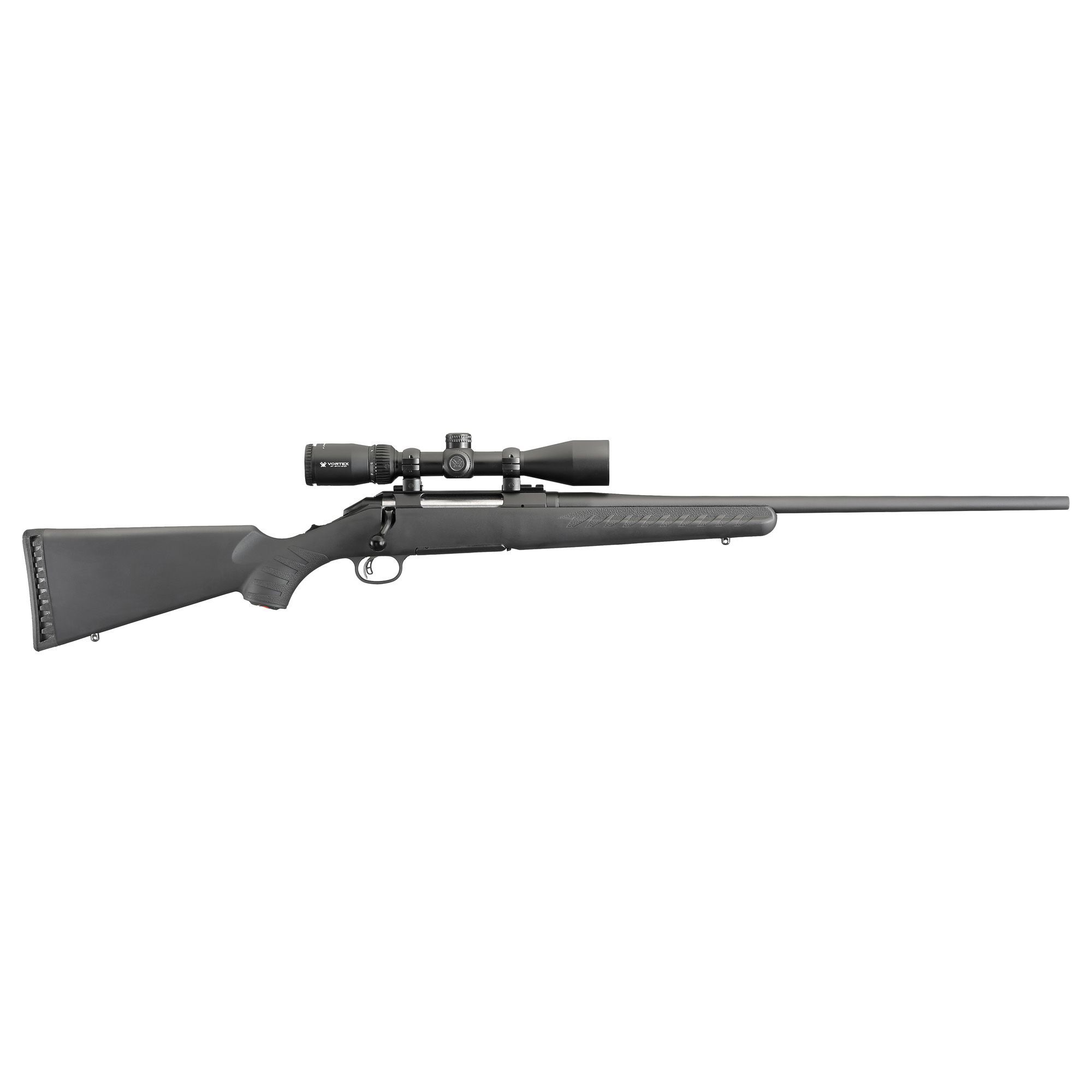
The name is a date. The .30 is the nominal bullet diameter in inches, and the 06 is 1906, the year the US Army adopted it. It replaced the .30-03 Springfield, the 6mm Lee Navy and the .30-40 Krag in one stroke, and it then stayed the Army's primary rifle and machine gun cartridge for close to fifty years, through the M1903 Springfield, the M1917 Enfield and the M1 Garand, and through two world wars, Korea and into Vietnam. It was replaced in service in 1957.
The original M1906 load pushed a 150-grain flat-based spitzer at 2,700 fps. The M2 ball load of 1938 raised that to 2,805 fps. Those numbers still describe a perfectly ordinary modern hunting load, which is most of why the cartridge never had to be replaced in the field.
What the catalog says about its second life
The .30-06 tag pages here hold 554 records from 39 makers. Not one of them is a service rifle.
There are no M1 Garands, no 1903 Springfields and no M1917s in this catalog under the .30-06 heading, because those guns move through the surplus and collector market rather than through new-gun dealers. What is left, in a catalog of new firearms on dealer shelves, is a pure hunting cartridge with an unusually varied set of actions attached to it.
Invalid Date
More Articles
Action
Records
Bolt action
489
Semi-automatic
30
Lever action
9
Pump action
7
Break or single shot
2
Not stated
17
The catalog holds 48 .30-06 records that are something other than a bolt gun. That is the widest spread of the four big American hunting cartridges, and each group has a reason.
The pumps are all the Remington 7600, a slide-action centerfire rifle that survives because several states and a great many deer camps prefer a repeater that is not a semi-automatic. The levers are the Browning BLR, which uses a rotating bolt head and a detachable box magazine so it can safely chamber a pointed bullet, and the Winchester 1895, whose original box magazine did the same thing a century earlier. Both exist because a traditional tubular-magazine lever gun cannot handle a spitzer bullet safely.
The semi-automatics divide into hunting rifles, mostly Browning's BAR, Benelli's R1 and Winchester's SXR2, and a small number of reproductions from Ohio Ordnance, including a semi-automatic 1918 BAR and the HCAR. Nothing else in this catalog covers that range.
The cartridge that would not be replaced
The Army spent decades trying to move on. The .30-06 was already considered overlong for a self-loading rifle when the M1 Garand was designed, and the shorter .308 Winchester, adopted as 7.62x51mm NATO in the 1950s, was the eventual answer. On paper the .308 does nearly everything the .30-06 does in a shorter case.
In the hunting market the replacement never happened. The longer case leaves room for slow powders and heavy bullets, so the .30-06 holds an advantage at the top of the weight range, which matters to anyone hunting elk or moose. It also has the largest and cheapest ammunition supply of any centerfire rifle cartridge in North America, and a practical argument of that kind usually beats a ballistic one.
Barrels: the longest of the four
Of the 507 .30-06 records that state a barrel length, only five are under 20in and 144 reach 24in or more.
Barrel
Records
22in
293
24in
84
25in
43
20in
40
22.4in
19
26in
11
The shortest record is 18in and the longest is 28in. Compare that with the .243 Winchester, where 171 records sit at 20in and the compact configuration is a substantial part of the market. The .30-06 has 19 records describing themselves as compact, youth or lightweight, against 97 for the .243.
The .30-06 burns a large charge and cutting the barrel wastes it. It also recoils enough that a lightweight rifle becomes unpleasant to shoot rather than convenient to carry, so the market never pushed it toward the compact configurations that suit smaller cartridges.
Who builds them
Maker
Records
Savage
108
Browning
91
Winchester
57
Remington
55
Weatherby
44
Tikka
28
Ruger
21
Springfield
18
Howa
16
Sako
14
Browning's second place comes from the BAR and BLR rather than from a bolt-rifle lead, which is what happens when one maker keeps three different actions chambered in the same cartridge.
Where it sits among the four big hunting cartridges
Cartridge
Introduced
Bullet
Records here
Makers
Under 20in
.30-06 Springfield
1906
.308in
554
39
5
.270 Winchester
1925
.277in
559
30
1
.243 Winchester
1955
.243in
652
40
25
6.5 Creedmoor
2007
.264in
1,398
114
126
The .270 Winchester is the .30-06's own child, built in 1925 on the .30-03 case with a .277in bullet, and the two sit within five records of each other here. Between them they define what the American hunting rifle was for most of the twentieth century, and the 6.5 Creedmoor entry in that table is what happened to the argument afterwards.
What to look for
Check
Why
Action type
This is the one classic cartridge where pump and lever are real options
Barrel length
Under 22in gives up velocity a large case is there to produce
Magazine type
A BLR or 7600 takes a box magazine; a tube gun will not chamber spitzers
Whether it is surplus
Service rifles in this chambering trade elsewhere, not on new-gun listings
The audit behind this article corrected four .30-06 records whose action fields or titles contradicted the guns themselves, including a Browning X-Bolt described as a semi-automatic and two Browning BLR lever rifles filed the same way. A further 217 records across this cartridge and its three neighbours were carrying invented model names, most often "Precision Hunter", a Hornady ammunition line that had been pasted into rifle titles.
Nick Sawinyh - Nick Sawinyh is a father, husband, hobby farmer, and gun enthusiast from Kentucky. He founded GunsNation and writes most of what appears on this blog.