Anyone looking at a 5.7 pistol has usually already read that the round is fast, flat and light on recoil, and that the ammunition costs more than 9mm. All of that is true, and it skips the part that decides between two guns on a shelf. The 5.7x28mm is a bottlenecked centerfire rifle cartridge running at rifle pressure, designed for a submachine gun. Putting it in a handgun is awkward, and every company that has tried has worked around the awkwardness differently.
The Five-seveN, the Ruger, the Smith & Wesson, the CMMG and the two odd Kel-Tecs are five separate mechanical answers to one question: how do you keep a breech shut long enough for a fast, high-pressure round to leave a short barrel?
Where the round came from, and what it was built around
FN Herstal introduced the P90 in 1990 as a personal defence weapon: something for vehicle crews and support troops who needed more reach than a pistol without carrying a rifle. The cartridge came first and the gun was built to it. The P90 is a straight-blowback, closed-bolt bullpup with a 10.4in barrel, 19.9in overall, 5.8lb, feeding from a 50-round magazine that lies flat along the top of the receiver. The SS190 load leaves that barrel at about 2,350 fps.
The barrel figure is worth keeping in mind, because the published claims about what 5.7x28mm does were measured from a barrel about that long or longer. The Five-seveN pistol arrived as the P90's companion sidearm, sharing the cartridge and the feed geometry but not the barrel length, and it has been the smaller half of that pair ever since.
Invalid Date
More Articles
The civilian PS90 exists for a regulatory reason rather than a ballistic one. Selling a semi-automatic P90 in the United States without a short-barrelled rifle tax stamp meant lengthening the barrel to clear the 16in threshold, so the carbine carries a 16.04in barrel and runs 26.23in overall at 6.28lb. The gun grew six inches at the front to satisfy a legal definition.
Gun
Barrel
Overall
Weight
Feed
FN P90
10.4in
19.9in
5.8lb
50rd top-mounted
FN PS90
16.04in
26.23in
6.28lb
50rd top-mounted
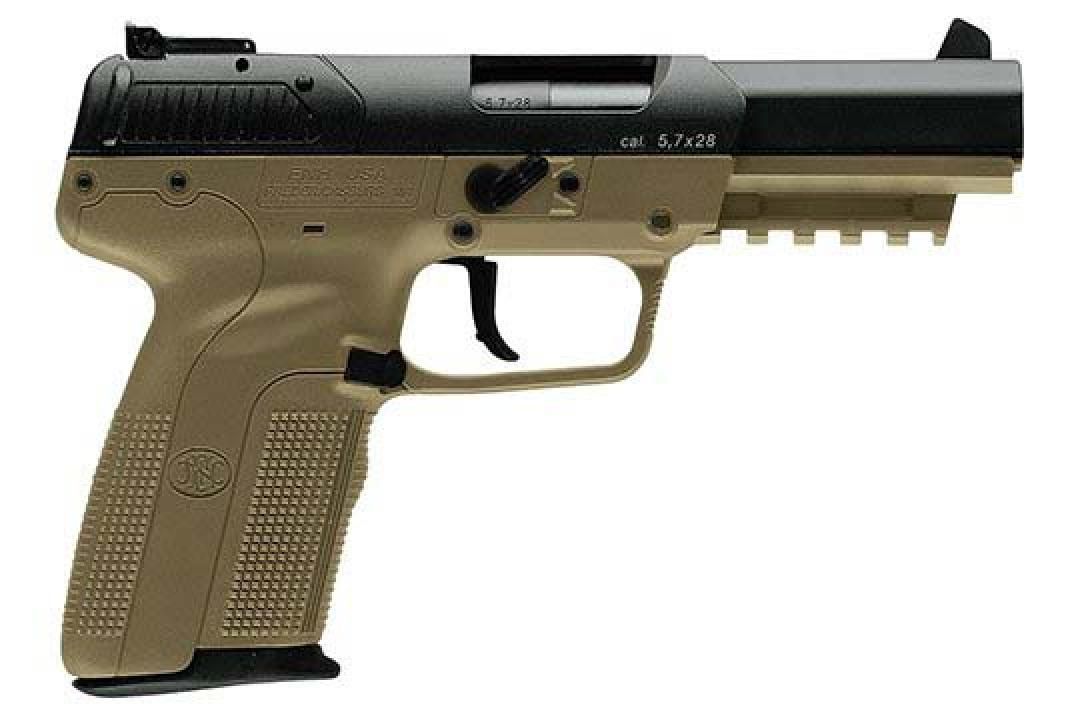
FN Five-seveN
4.8in
8.2in
25.2oz
20rd box
What the catalog actually holds
Across the six 5.7x28mm tag pages here, 210 records from 11 manufacturers. Of those, 176 state a barrel length, and the distribution is not what the cartridge was designed around.
Barrel length
Records
Under 6in
80
6in to under 12in
47
12in and over
49
The shortest is 4.0in and the longest is 18.0in. Fully 77 records sit at 5in or under, which is less than half the barrel the round's own reference figures were taken from. The records at 12in or more number 49, and every one of them is a carbine or a bullpup rather than a handgun.
The market went the opposite direction from the design. A cartridge specified around a 10.4in barrel is now being asked to work out of five inches in most of the guns you can buy it in. Some of the powder finishes burning past the muzzle, and a velocity figure taken from a PS90 does not survive the trip to a pocket pistol, so a quoted number is worth chasing back to the gun it came from.
A short barrel also means less time for pressure to fall before the case has to leave the chamber, which is the condition a blowback action handles worst.
FN's answer: delay the blowback and accept the size
The Five-seveN is a delayed blowback pistol, hammer-fired, and the current guns run a single-action-only trigger. There is no rotating barrel and no gas port. The slide is held closed by the friction of the case in a chamber shaped to resist extraction until pressure drops, and the recoil spring and slide mass do the rest.
That produces a pistol which is large for its calibre and light for its size, because the frame is polymer and the slide does not have to be heavy when the delay is doing the work. It is also why the gun feels mild in the hand: little of the cartridge's energy arrives as a sharp impulse.
The catalog's records for these guns agree with FN about the trigger. The rest of the category is where the disagreements start.
Ruger's answer: the same principle, a shorter travel
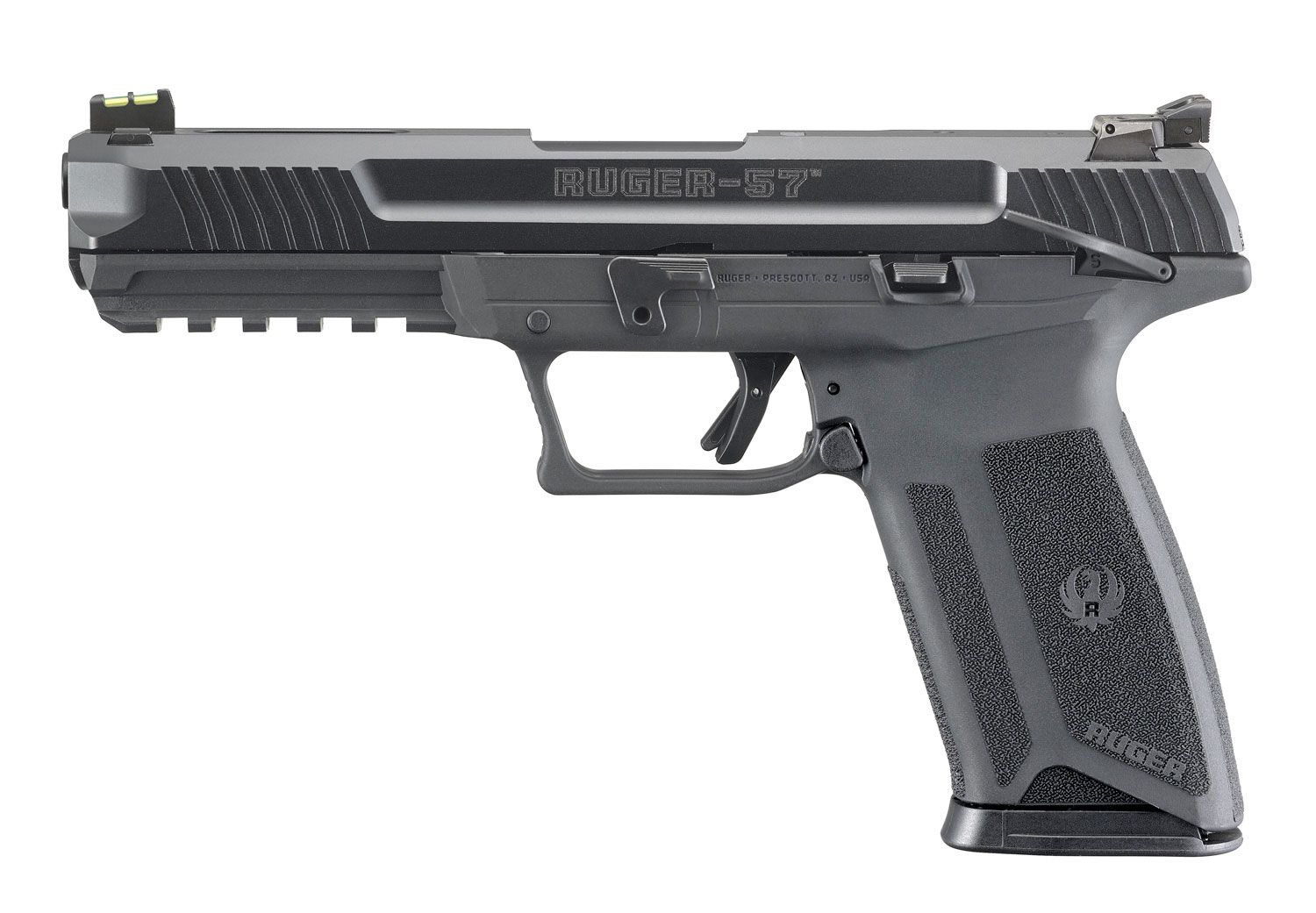
Ruger's 5.7 pistol also uses delayed blowback, with the barrel travelling rearward with the slide by roughly a quarter of an inch, enough for the bullet to clear and pressure to drop. The fire control is Ruger's Secure Action: a protected internal hammer with a bladed-safety trigger, giving a short pull, a clean break and a positive reset.
The published specification for model 16401 is a 4.94in barrel, 8.65in overall, 24.5oz, 20+1, with a fibre optic front sight and an adjustable rear, and an ambidextrous 1911-style manual safety.
This catalog held six records describing the gun as double action or double-action-only, and one of those went on to say the trigger came without a manual safety lever to manage. Both claims contradict Ruger's own specification sheet, and they contradicted the twenty Ruger records sitting beside them. A trigger with a positive reset has already been cocked by something, which is what rules out a double action. Those records have been corrected.
Smith & Wesson's answer: put a gas system in a handgun
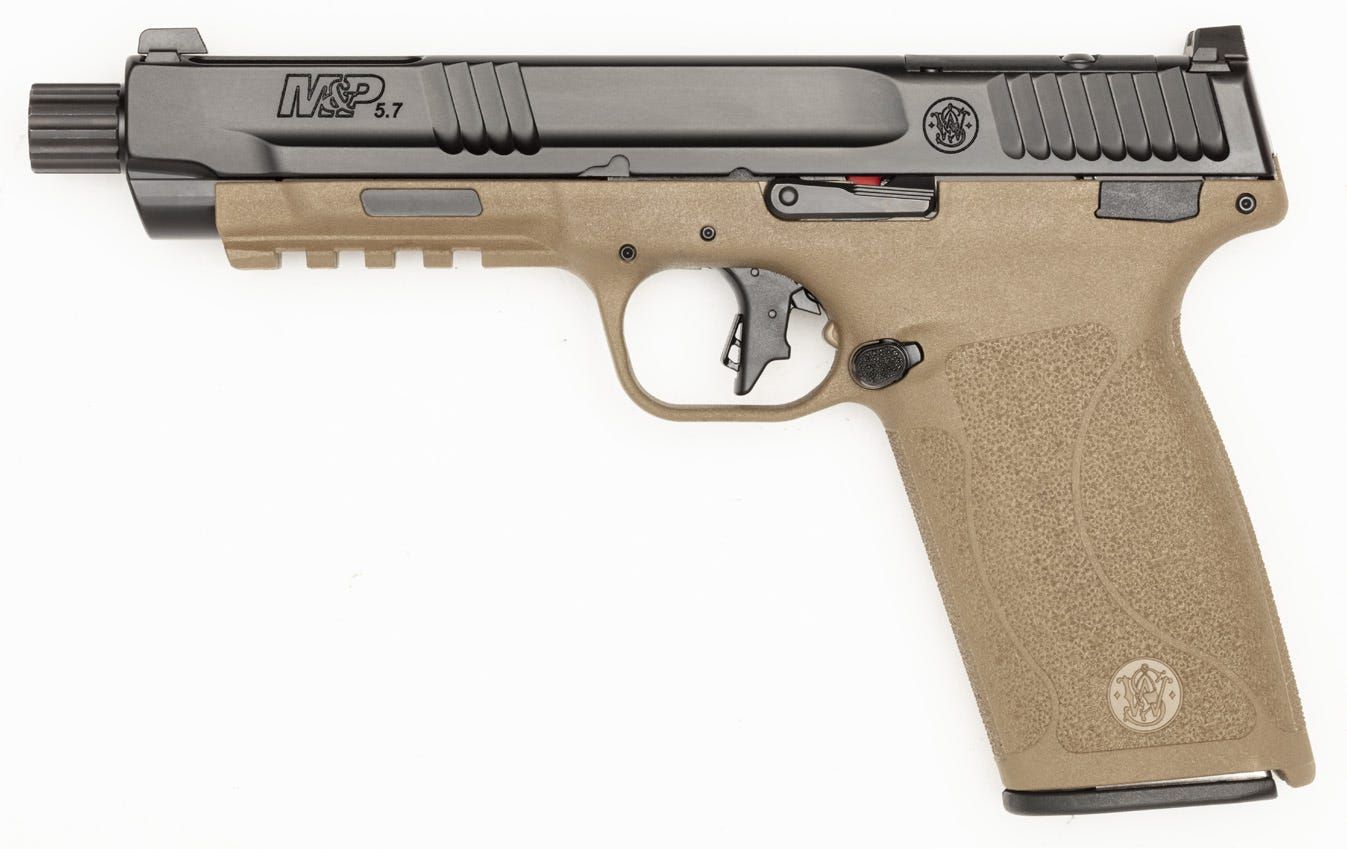
The M&P 5.7 does something no other pistol in this group does. Its Tempo barrel is a two-part, locked-breech assembly with its own gas port. The bullet travels down the inner barrel, passes the port, and gas pressure acts on the outside of that barrel like a piston, driving it rearward inside a shroud. A cam track rotates the barrel as it moves, unlocking a pair of lugs from the slide, and only then does the case get extracted.
The projectile has left the muzzle before anything unlocks. A delayed blowback offers no such guarantee, since it is always a race between falling pressure and a slide that has already begun to move. Suppressor users notice the difference, because a breech that stays shut through the pressure peak sends much less gas back through the ejection port.
Smith & Wesson also says the rotating motion turns part of the rearward force into movement perpendicular to the bore, which is their account of the gun's recoil impulse. The barrel is 5in and the magazine holds 22.
CMMG's answer: make the AR pattern take it
The Banshee Mk57 is an AR-pattern gun, and an AR-pattern gun in a pistol cartridge is normally straight blowback with a heavy bolt and a heavy buffer to compensate. CMMG's Radial Delayed Blowback replaces the mass with a mechanical delay. Backpressure pushes the bolt rearward, chamfered faces on the bolt lugs and the barrel extension force the bolt to rotate through 22.5 degrees, and that rotation accelerates the carrier through a 50-degree cam-pin slot.
Forcing the bolt to turn before the carrier can move buys the time a heavier bolt would otherwise buy with inertia, so the gun runs ordinary carbine buffers and springs. A Banshee therefore handles like an AR instead of like a blowback subgun. CMMG has the largest presence in this catalog on the back of it, 76 records of the 210.
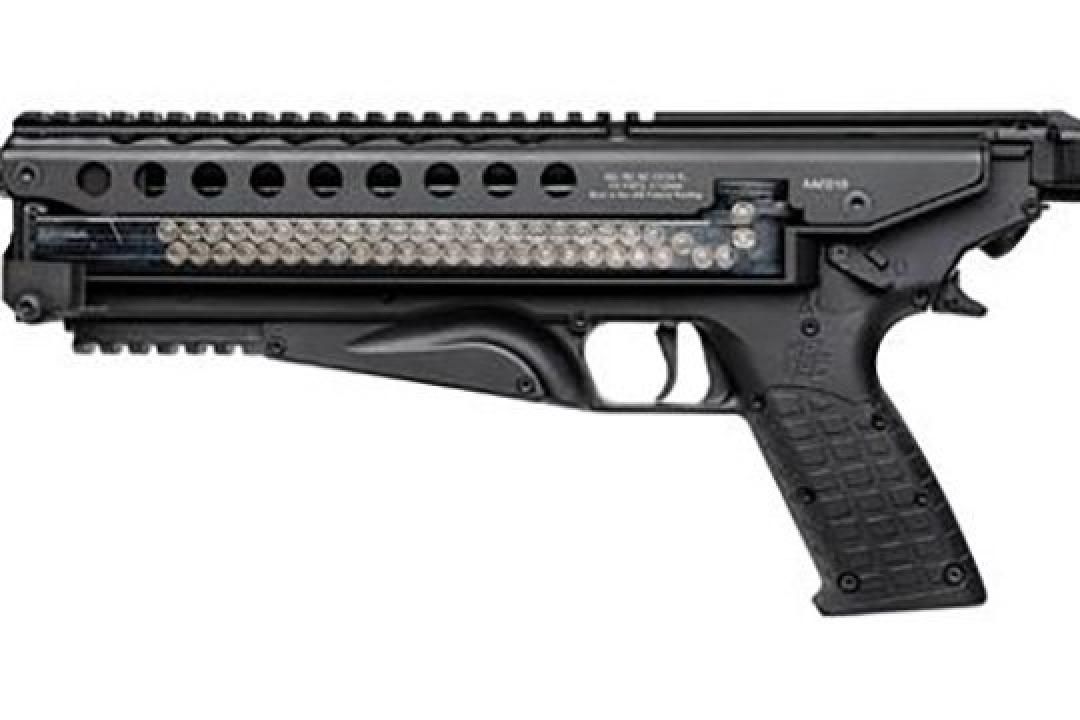
Kel-Tec has produced more distinct approaches to this cartridge than anyone. The P50 is a large 50-round pistol that feeds from P90 magazines, hinging open at the top to load them. The R50 is the carbine version of the same idea. The SUB2000 folding carbine, long a 9mm and .40 gun, arrived in a 5.7x28mm version with a 16.5in barrel, which is how a cartridge designed for a bullpup ended up in a carbine that folds in half.
The PR57 is the outlier even by Kel-Tec standards. It is a short-recoil pistol with a rotary barrel whose lugs sit near the muzzle, and it has no detachable magazine at all. Ammunition goes in through the top into a fixed 20-round internal magazine, loaded from 10-round stripper clips. Nothing else in current production loads like that.
The genuinely odd corner: bolt actions and single shots
The catalog holds three Dark Mountain Arms Stowaway rifles, which are bolt-action single shots in 5.7x28mm, offered with barrels of about 5in, 5.1in and 16in. A manually operated single shot sidesteps the entire delay problem, because nothing has to hold the breech shut except the bolt and the shooter. It also makes the cartridge behave properly out of the long barrel, and it is one of the few places where 5.7's ballistics arrive intact.
Nobody means one of these when they say "5.7 pistol", and that is the point of mentioning them: the difficulty everywhere else in this category comes from self-loading, and a single shot has none of it.
Choosing between them
The mechanism decides most of what you will notice.
Locked breech until the bullet passes the gas port
AR controls and AR parts
CMMG Banshee Mk57
Radial delayed blowback on standard buffers
Maximum capacity in one gun
Kel-Tec P50, FN PS90
50-round P90-pattern magazine
Something nobody else has
Kel-Tec PR57, Dark Mountain Stowaway
Stripper-clip feed, or a bolt action
Ammunition supply is the recurring complaint from people who shoot these guns often, and it is the most common reason one comes up for sale. Barrel length also changes this cartridge more than it changes almost any other handgun round, so a 5in pistol and a 16in carbine chambered identically are not doing the same job.
The PS90 has picked up an aftermarket of its own, including chassis systems that replace the bullpup's furniture with conventional rails and grips.
Nick Sawinyh - Nick Sawinyh is a father, husband, hobby farmer, and gun enthusiast from Kentucky. He founded GunsNation and writes most of what appears on this blog.