A biathlete comes into the range with a heart rate near its maximum, lies down or stands at the mat, and has to hit five targets 50 meters away. The prone targets are 45 millimeters across, about the size of a golf ball. The standing targets are 115 millimeters. Every miss costs a 150-meter penalty loop, or a full minute in the individual race. The rifle on the athlete's back is built around one problem: how to reload five times without moving the shooting hand, the cheek or the eye.
The straight-pull action is how the sport solved that, and it is the one part of a biathlon rifle that has reached guns an ordinary shooter can buy.
From military patrol to .22 LR
Biathlon grew out of military patrol, a ski-and-shoot event on the program at the 1924 Winter Olympics, and for decades it was shot with fullbore centerfire rifles at longer ranges than today's. The switch came in the 1970s. The governing body decided in 1976 that from January 1, 1978 championships would be shot in .22 Long Rifle, and the last major fullbore championship was held in Norway in 1977.
With the rimfire cartridge, ranges shrank to 50 meters, targets could be mechanical plates that flip from black to white when hit, and a rifle could be light enough to ski with. Because a .22 barely recoils, most of the time between shots became the time spent working the bolt, and that is what the rifle makers set out to shorten.
Invalid Date
More Articles
What the rules require
The International Biathlon Union's equipment rules are narrow, and most of what the rifle looks like follows from them.
Rule
Requirement
Cartridge
.22 Long Rifle only
Distance
50 meters
Target, prone
45 mm
Target, standing
115 mm
Rifle weight
3.5 kg (7.7 lb) minimum
Trigger pull
at least 500 g
Muzzle velocity
no more than 360 m/s
Bullet weight
2.55 to 2.75 g
Magazines
five rounds each, four carried on the rifle
Sights
non-magnifying diopter rear and globe front
Action
manually operated; semi-automatics are not allowed
Relay racers get three extra rounds per stage, loaded by hand one at a time, so a miss in a relay costs seconds at the mat before it costs a penalty loop.
The weight rule sets a floor, so nobody races with a featherweight rifle that is easy to carry and hard to hold still. The velocity cap keeps ammunition at standard velocity. With semi-automatics banned, the action has to be manual and fast, and very few designs manage both.
The Fortner action
Nearly every rifle on a World Cup range is an Anschütz 1827 Fortner. Peter Fortner designed the action around 1984, after conversations with Peter Angerer, who won Olympic gold that year. Anschütz builds its biathlon rifles around it.
The bolt does not rotate. A ring of hardened steel balls sits around the rear of the bolt body. Pushing the bolt handle forward drives a sleeve that forces the balls outward into a groove machined inside the receiver, which locks the bolt. Pulling the handle back lets the balls drop inward and the bolt comes free. The shooter flicks the handle back with the index finger and pushes it home with the thumb, and the hand never leaves the grip. Outdoor Life puts a reload at under a second.
A turn-bolt needs the hand to lift, pull, push and rotate down, and each of those movements disturbs the hold. The straight pull reduces that to two short movements along the axis of the bore, both made with the fingers.
The toggle alternative
Izhmash in Russia built the other biathlon action of note. Its Biathlon 7-series rifles use a toggle-lever action of the company's own design, cycled with a short movement of the shooting hand. The idea is the same as the Fortner: keep the rifle on the shoulder and the eye in the sight while the next round goes in.
The Volquartsen Summit, one of the civilian rifles below, also locks with a toggle.
The civilian straight-pull .22s
The biathlon rifle listings on this site carry the two straight-pull .22 LR rifles sold in the United States that borrow the biathlon idea directly.
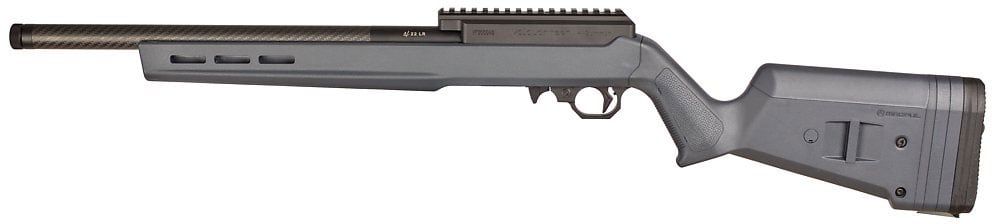
The Volquartsen Summit puts a toggle-locking straight-pull action into a receiver with the outside profile of a Ruger 10/22, so it takes 10/22 rotary magazines and many 10/22 stocks. The listings here have 16 to 16.5-inch barrels and weigh 5.6 to 5.8 lb.
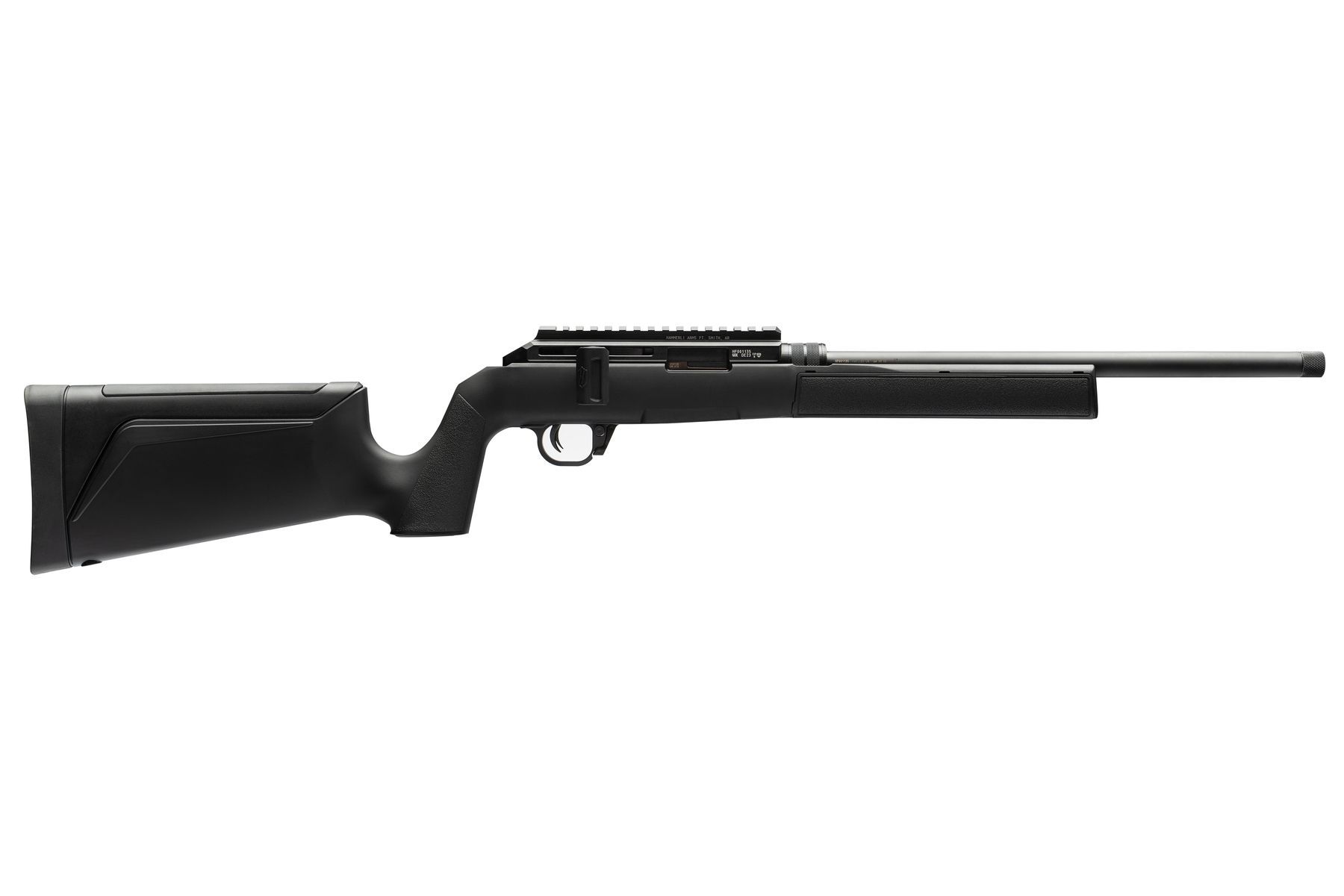
The Hämmerli Force B1 comes from a Swiss name now under the Walther group, and is a straight-pull rimfire with what American Rifleman called a "biathlon-style" bolt handle. The handle is long enough to be worked with several fingers, and there is no spring assist: the shooter pulls it back and pushes it forward. The magazine well takes Ruger 10/22 magazines, and the barrel swaps without tools between .22 LR and .22 WMR. Barrels are 16.1 inches and the rifle weighs 5.75 lb.
Neither is a biathlon rifle in the sense a race official would accept. Both are well under the 3.5 kg minimum, since 5.75 lb is about 2.6 kg, both have short barrels where a match rifle usually runs 20 to 22 inches, and neither carries a harness, a snow cover over the muzzle or a diopter sight. What they share with the Fortner is the bolt: it goes back and forward in a straight line, fast, without the hand leaving the stock, which is useful to anyone shooting a .22 from field positions.
The Browning T-Bolt is the other straight-pull .22 a shooter will come across. Browning introduced the T-Bolt in 1965, and the current version dates from 2006. Its straight-pull bolt uses its own locking system rather than a toggle or balls, and it is a sporter with no biathlon lineage, so it is not listed with these.
Where the match rifles are
Anschütz 1827 Fortner rifles and Izhmash biathlon rifles do come into the United States, mostly through specialist importers and biathlon clubs rather than general gun dealers. They carry a backpack-style harness, spare magazines held in the stock, flip-up covers for the muzzle and sights, and a hand stop under the forend for the sling. A new shooter joining a club will usually be handed a club rifle before buying one.
What the catalog had wrong
Until this article was written, the biathlon rifle listings held 16 records, and none of them was a biathlon rifle or a straight-pull. There were 14 Marlin XT-22 bolt-actions, a Savage Mark II BV and a Sako Finnfire II, all conventional turn-bolt rimfires, apparently grouped by caliber and nothing else. They were removed, and the Summit and Force B1 listings in .22 LR were attached.
Among the .22 LR Force B1 listings, two had it filed as a semi-automatic, one of them in its title and product description as well as the action field. It is a straight-pull bolt action, and a semi-automatic is not allowed in the sport it takes its handle from. Both were corrected.
Nick Sawinyh - Nick Sawinyh is a father, husband, hobby farmer, and gun enthusiast from Kentucky. He founded GunsNation and writes most of what appears on this blog.