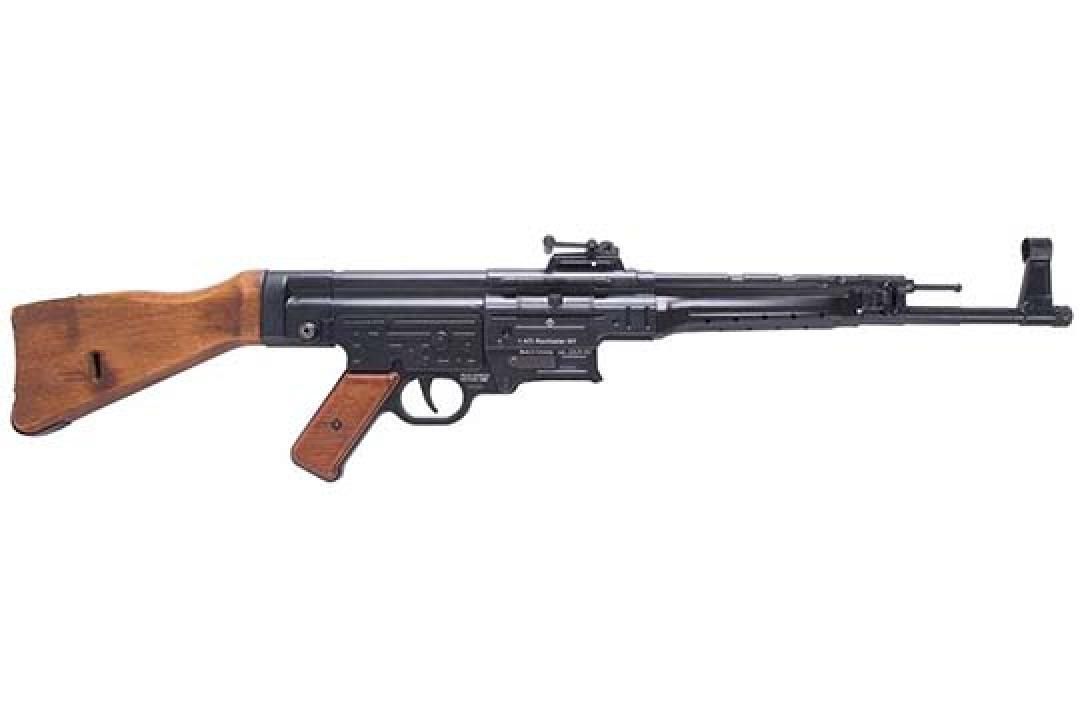
Nobody in the United States is buying a real Sturmgewehr 44. Production ran from 1943 to 1945 and stopped at 425,977 guns, they fire a cartridge nobody loads commercially in quantity, and a transferable one is a registered machine gun at a price that puts it in the same conversation as a house.
What sells instead is a .22 LR copy, and it is a closer copy than the category usually manages.
The replica is closer to the original than replicas usually are
Most rimfire copies of famous guns are approximations. They get the silhouette right, shrink the proportions to suit a .22 action, and come out noticeably lighter and a little smaller than the thing on the poster. The STG-44 replicas hold the dimensions.
StG 44 (1943)
.22 LR replica
Barrel
16.5in
16.5in
Overall length
37in
37.2in
Weight
10.1lb unloaded
9.25lb to 9.9lb
Cartridge
Invalid Date
More Articles
7.92x33mm Kurz
.22 LR
Magazine
30 rounds
10 or 25 rounds
Action
Gas-operated long-stroke piston, tilting bolt, selective fire
Blowback, semi-automatic
The barrel length matches exactly. The overall length is within a fifth of an inch. The weight is within a pound, and the reason is that the replica has a steel receiver and a solid wood stock rather than the polymer a .22 would otherwise use. Buyers get the mass and the balance of the original, which is the entire point of the exercise, and they pay for it in the one place a .22 rifle usually saves: it is a heavy gun to carry for a plinker.
The one thing that cannot carry over is the mechanism. The original is a gas-operated, long-stroke piston design with a tilting bolt and a selective-fire trigger, running at 500 to 600 rounds per minute. A .22 LR does not generate enough gas to run a piston system worth building, so every replica is straight blowback and semi-automatic only.
Why this gun and not another
The StG 44 has a claim no other World War II rifle has: it is generally treated as the first successful assault rifle, the gun that established the intermediate cartridge, controllable automatic fire and a compact package aimed at targets inside a few hundred metres. The AK-47 and the M16 both descend from that idea.
Its name is a piece of history in itself. It began as the MKb 42(H), a Haenel prototype. It was redesignated MP 43, a "machine pistol", specifically to get it past Hitler's opposition to introducing a new cartridge, and Hitler renamed it MP 44 in April 1944. The final name, Sturmgewehr 44, arrived in October 1944, credited to General Erich Jaschke and accepted for propaganda value as much as accuracy, though it does describe the job correctly and separates the gun from the submachine guns it had been hiding among.
That history is most of why the replica sells: it is a .22 copy of the gun every modern rifle is descended from, which is a different proposition from a .22 copy of an ordinary rifle.
What the catalog holds
The STG-44 tag here carries 11 records, and every one of them is the same gun under different badges.
Badge on the box
Records
Mauser (Blue Line Global)
6
ATI or American Tactical GSG
4
Blue Line Mauser
1
They are all built by German Sport Guns and reach the US market through American Tactical and through Blue Line Global, which holds the Mauser rimfire licence. The Mauser name on the receiver is a trademark arrangement rather than a manufacturing one, in exactly the way the Turkish shotgun trade works.
Configurations run to a black-and-wood version, an FDE and tan version, and a 25-round magazine option against the standard 10. Barrel lengths in the catalog read 16.5in on most records and 16.2in on one, which is the same gun measured differently rather than a different gun.
The wider rimfire replica shelf
The STG-44 sits in a category that is larger than it looks. Counting .22 LR versions of guns that exist in a centerfire chambering:
Replica
Rimfire records
Walther-branded rimfire (including P22 and Colt-licensed)
93
M4 and AR-pattern .22
63
MP5 pattern
18
Thompson
15
HK416 pattern
12
1911 pattern
12
Colt M4 branded
7
Chiappa M1-22 carbine
4
AK pattern
3
MP-40
3
This business runs through two companies. German Sport Guns builds the STG-44, the MP-40 and the GSG-16, and it also builds the .22 versions carrying Walther, Colt and other licensed names. Umarex holds the licensing arrangements that put those names on the guns.
The economics are straightforward. A .22 blowback action is cheap to make, a steel-and-wood shell around it is not much more expensive, and the licence to write "Colt" or "Mauser" on the side turns a generic plinker into something a buyer already wants. Cheap ammunition is what makes a nine-pound .22 bearable for an afternoon.
What to check before buying one
Check
Why
Magazine capacity
10-round and 25-round versions exist and the listings often omit which
Weight
Around nine and a half pounds is normal here, and it surprises people
Who imported it
ATI and Blue Line Global both sell essentially the same rifle
Sights
Fixed front, adjustable rear on the standard configuration
Whether it is the .22
The tag and the search term both attract the historical rifle
The catalog audit for this article found three records storing the rifle's weight in ounces while every comparable rifle stores it in pounds, so a nine-pound rifle was reading as 158.4. Those are corrected. The tag itself is clean of the homonym problem that catches most short model names: a search for "STG" also returns a Kimber Micro 9 STG pistol, a Timney trigger shoe and a Steyr AUG STG-77 optic, none of which had found their way in.
Nick Sawinyh - Nick Sawinyh is a father, husband, hobby farmer, and gun enthusiast from Kentucky. He founded GunsNation and writes most of what appears on this blog.