The rimfire revolver is the odd one out in its own category. Almost everything written about revolvers assumes a double-action gun with a swing-out cylinder, six chambers, and a centerfire cartridge. The .22 revolver is usually none of those things, and the reasons for that are mechanical.
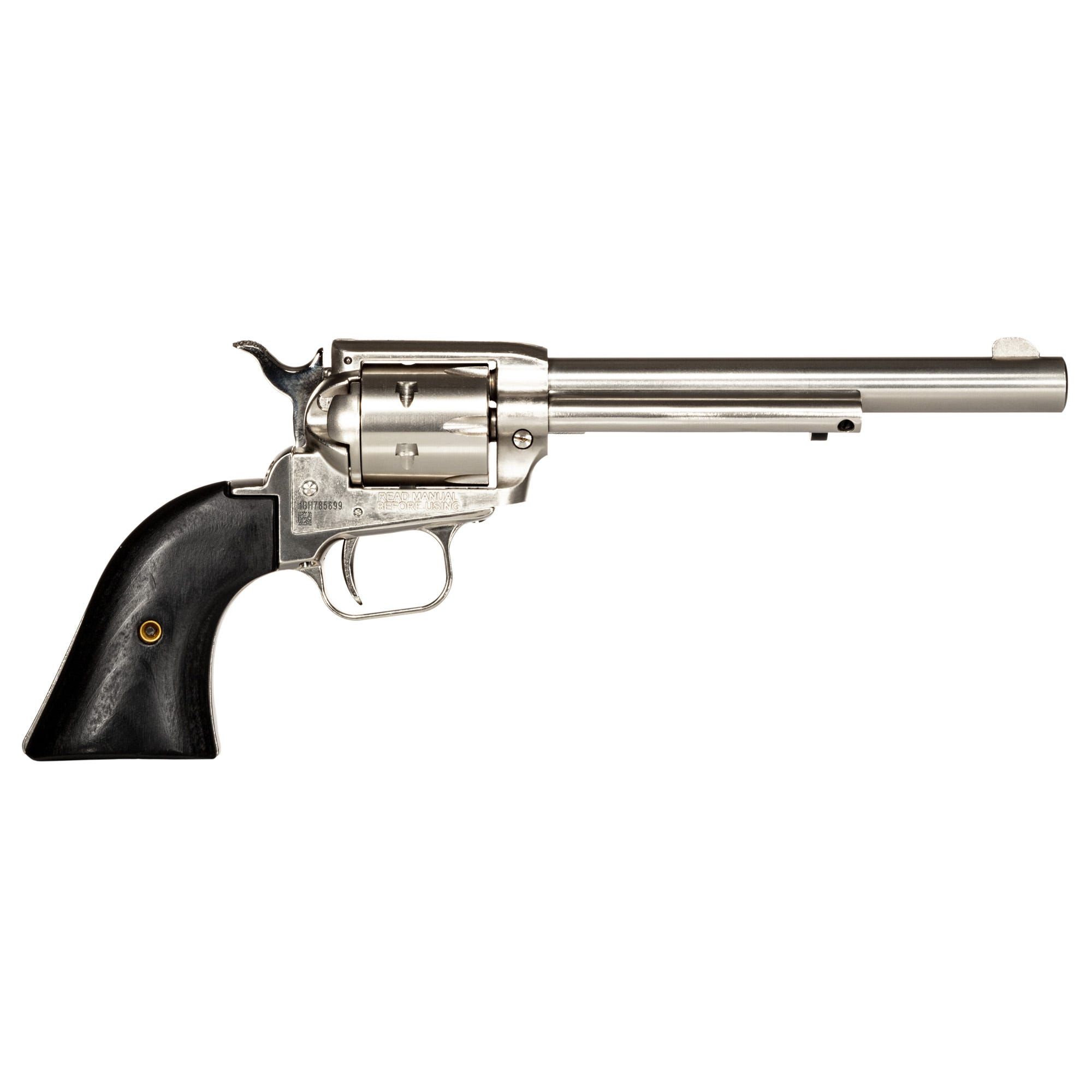
Across the ten rimfire revolver tag pages here, 622 records. Of the 572 that state an action type, 457 are single action and 19 are double action only. The remaining 96 will fire either way. So the gun a shopper is most likely to find under "22 revolver" is a single-action pattern that has to be cocked by hand between shots, which in the centerfire world means either a cowboy replica or a hunting gun.
The second cylinder is the whole trick
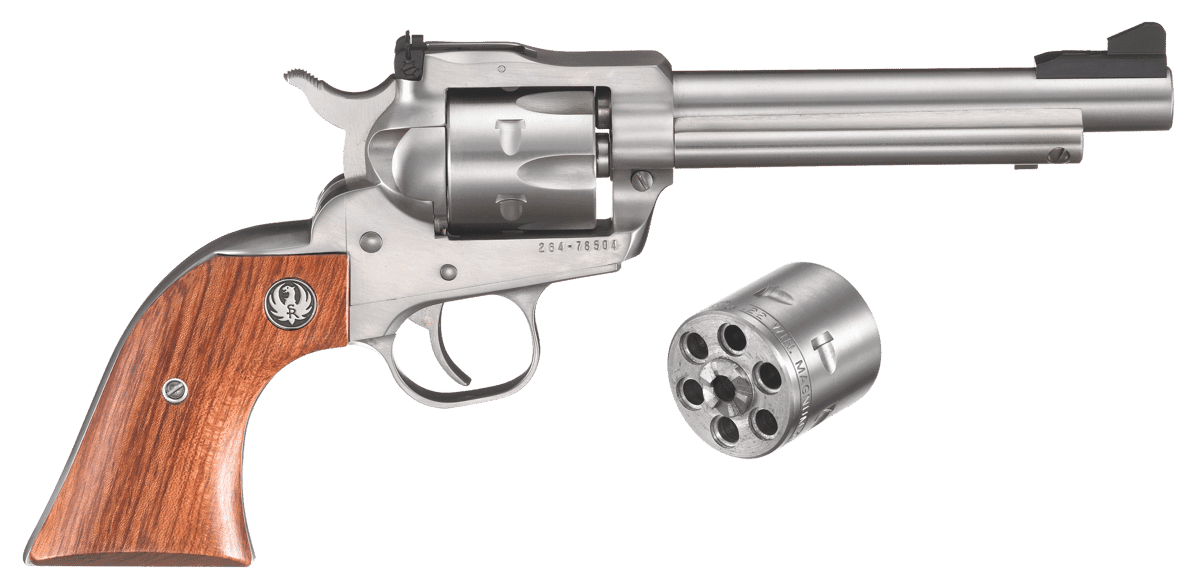
A large part of this market ships with two cylinders in the box, one for .22 LR and one for .22 WMR. Nothing else in handguns works quite like that, and the reason is a happy accident of dimensions.
Put the two cartridges side by side and the pattern is obvious.
.22 LR
.22 WMR
Bullet diameter
Invalid Date
More Articles
.223in to .2255in
.224in
Case length
.613in
1.055in
Base diameter
.226in
.2455in
Rim diameter
.278in
.300in
Muzzle velocity, 40gr
about 1,200 fps
about 1,875 fps from a rifle
The bullets are within a thousandth of an inch of each other. Everything behind the bullet is not: the Magnum case is most of half an inch longer, and it is wider at the base and at the rim.
There is a wrinkle that explains why the bullet diameters land so close. The .22 LR uses a heeled bullet, meaning the bullet is the same diameter as the case and has a narrower heel that fits down inside it. The .22 WMR uses a conventional bullet seated inside a wider case. The two construction methods arrive at nearly the same projectile diameter from opposite directions, and one barrel can serve both.
The cases cannot share anything. A .22 WMR round will not enter a .22 LR chamber because it is too long and too wide. A .22 LR fired in a .22 WMR chamber gives swollen or split cases, gas leaking backwards past the head, and a bullet hitting the chamber throat out of line, which can injure the shooter.
So the cylinder is the part that has to change, and on a revolver the cylinder is the one component that comes out without tools. Swing the base pin, drop one cylinder, drop in the other. That is the entire mechanism behind every convertible .22 on the market, and it does not transfer to a semi-automatic, where the chamber is part of the barrel and the breech face, extractor and magazine all care about case dimensions.
In this record set, 57 guns explicitly mention a second or convertible cylinder. The true figure is higher, because many listings simply write ".22 LR/WMR" in the title and leave the reader to work it out. A rebate offering a free .22 Magnum cylinder with a Rough Rider purchase is a standing feature of this market rather than a one-off promotion, which says something about how central the second cylinder is to the way these guns are sold.
Why single action dominates a category that had a choice
A double-action lockwork costs money to make, and it has to be strong enough to cock and drop a hammer with one long pull. Rimfire ignition wants a firm, well-placed hit on the rim of the case rather than on a primer in the middle of it, and a double-action trigger tuned for a pleasant pull is not the easiest way to deliver one. A single-action revolver cocks the hammer manually against a strong spring, so the hammer can be as heavy as the designer likes, and the parts count drops sharply.
That combination points the whole category toward the cheap end. It is also why the guns look the way they do: the 1873 Colt pattern is the reference design for a hand-cocked revolver, so a .22 that wants to be inexpensive ends up looking like a cowboy gun whether or not anyone set out to make one.
The double-action rimfires that do exist tend to be either serious target guns or small-frame carry-pattern revolvers, and there are 19 of them here against 457 single actions.
Action
Records
Single action
457
Single or double
96
Double action only
19
Not stated
50
Two companies own the shelf
Heritage Manufacturing accounts for 226 of the 622 records and North American Arms for 174. Between them that is 400, which leaves 31 other brands to divide what remains. Ruger is the largest of those at 80.
Maker
Records
Heritage
226
North American Arms
174
Ruger
80
Chiappa
24
Charter Arms
20
Taurus
18
Colt
14
Diamondback
12
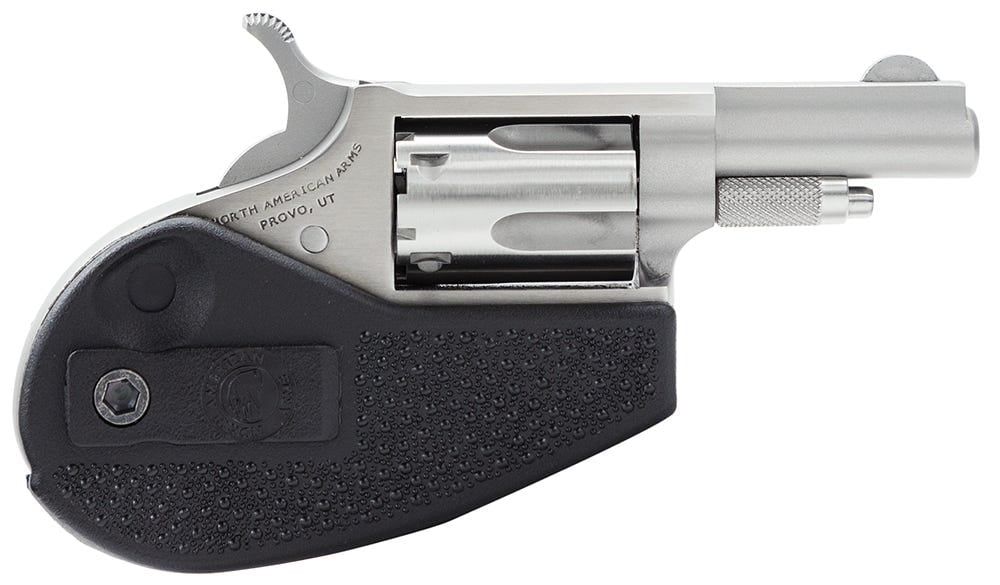
The two leaders are not competing with each other. Heritage builds full-size single actions on the cowboy pattern at the lowest price in the category. North American Arms builds mini revolvers you can close your hand around. They both sell in volume because they answer different questions, and neither answer has much to do with the other.
The very small end
Barrel lengths here run from 0.8in to 16.13in, which is a wider spread than any centerfire handgun category can offer. The short end is crowded: 142 records carry a barrel under two inches, and nearly all of them are NAA mini revolvers or their imitators.
These guns work because a rimfire cartridge does not need much of a gun around it. A five-shot cylinder at .22 LR diameter is small enough that the entire revolver fits in a closed fist, and there is no magazine, no slide and no recoil spring to lengthen it. The tradeoff is that they are slow to reload, which is what NAA's own Ranger II addresses with a top-break frame instead of the usual pin-and-loading-gate arrangement.
The shortest record in the set is a folding .22 WMR revolver with a 0.88in barrel, a gun that hinges shut into something the size of a large key fob.
The very long end
At the other extreme sit 20 records with a barrel of 16in or more. These are single-action .22 revolvers carrying a rifle's worth of barrel on a handgun frame, and nothing about the cartridge asks for it. What the length buys is sight radius and a little velocity, and the rest of the appeal is that the result looks absurd, which is most of why people buy them. The holsters sold for them are their own comedy.
A .22 does not gain much past a certain barrel length. The powder charge is small and it finishes burning early, so a 16in .22 revolver is not meaningfully more powerful than a 6.5in one. It is a longer sight line and a longer gun.
Cylinders that hold more than six
The six-shot cylinder is a centerfire convention, set by how much steel has to sit between chambers holding back thirty-odd thousand psi. A rimfire cylinder of the same outside diameter is working against a fraction of that, with a much narrower case, so it has room for more holes.
Of the 378 records here that state a capacity, 103 hold more than six rounds.
Capacity
Records
5
121
6
154
8
33
9
28
10
38
12
4
The five-shot group is almost entirely the mini revolvers, where the constraint is the size of the gun rather than the pressure. The eight, nine and ten shot cylinders are full-size guns taking advantage of the small case, and the twelve-shot examples are Uberti-pattern single actions built on a full-size frame around the smallest cartridge that fits it.
Reading a listing without getting caught
Several things in these listings go wrong regularly, and they are all checkable before you buy.
Check whether a "convertible" or "combo" gun actually ships with the second cylinder or whether the cylinder is a rebate you have to claim. Check the action field against the gun rather than trusting it: this catalog held a Ruger Wrangler filed as a semi-automatic, a Heritage Rough Rider filed as striker-fired, and two Taurus Model 94 revolvers described in their own titles as semi-automatic pistols. All four have been corrected.
Then check the barrel figure. The barrel figure is worth a glance as well. This catalog held four Ruger Wranglers and an NAA mini carrying barrel lengths of 612, 458, 334 and 158 inches, which is what happens when a vendor writes 6-1/2, 4-5/8, 3-3/4 or 1 5/8 and something downstream keeps the digits and throws away the punctuation. Those are corrected, and a sweep for the same fault across the whole catalog turned up two Glocks whose barrels had been stored in millimetres and one genuine 41in flintlock musket that was telling the truth.
What to actually pick
If you want
Look at
Why
Cheapest way into a revolver
Heritage Rough Rider
Single action, full size, the volume leader
One gun for both rimfire cartridges
Ruger Single-Six Convertible, Super Wrangler
Two cylinders, one barrel
Something genuinely pocketable
NAA mini revolvers
Under two inches of barrel, five shots
Faster reloading in a mini
NAA Ranger II
Top-break instead of a pin and gate
A double-action trigger
Taurus 942, Charter Arms, S&W
The 19-record minority
Maximum rounds per cylinder
Uberti and Chiappa pattern
Ten and twelve shot cylinders
A .22 revolver gets bought for practice, for teaching a new shooter, for pest control at short range, or for carrying something very small. None of those uses needs a double action, and most of them are better served by a gun cheap enough that the ammunition budget stays the interesting part of the decision.
Nick Sawinyh - Nick Sawinyh is a father, husband, hobby farmer, and gun enthusiast from Kentucky. He founded GunsNation and writes most of what appears on this blog.