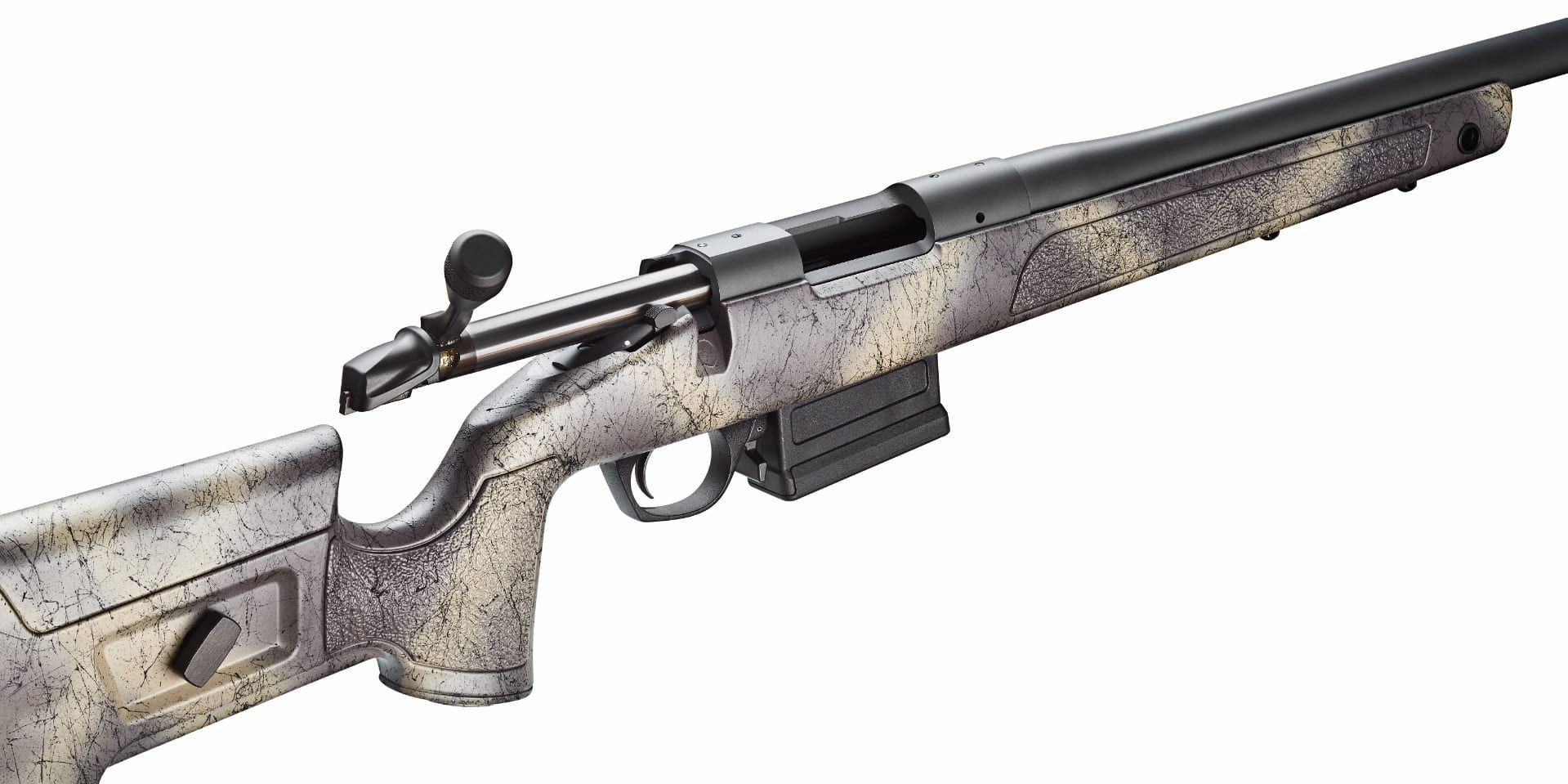
Hornady introduced the 6.5 Creedmoor in 2007, developed with Dennis DeMille of Creedmoor Sports, by necking down the .30 Thompson Center case. The brief came from competition shooters and it was narrow: build something that shoots flat and long, that recoils little enough to spot your own hits, and that fits a short action.
That last constraint is the one that did the work. A cartridge with an overall length of 2.825in runs in a short-action rifle, which means a lighter, cheaper, stiffer receiver than a magnum needs. Inside that length the 6.5 Creedmoor still has room to seat long, high-ballistic-coefficient .264in bullets without pushing them down into the powder space. Older 6.5 cartridges had to choose between the two.
The result stays supersonic past 1,200 yards where a .308 Winchester gives up around 975, and it does that with a trajectory close to a .300 Winchester Magnum's at markedly lower recoil.
The number that says how completely it won
The 6.5 Creedmoor tag pages here hold 1,398 records from 114 different manufacturers.
Cartridge
Introduced
Invalid Date
More Articles
Records here
Makers
.30-06 Springfield
1906
554
39
.270 Winchester
1925
559
30
.243 Winchester
1955
652
40
6.5 Creedmoor
2007
1,398
114
The three older cartridges are chambered by 30 to 40 makers each. The Creedmoor is chambered by 114, and 41 of those appear exactly once. That long tail is the real story: a custom shop or a small builder assembling a rifle chambers it in 6.5 Creedmoor because that is what a buyer will assume it should be, and because barrels, reamers, dies and brass are available from everyone.
At that point the chambering has stopped being a decision anyone makes deliberately, which is what a default looks like from the inside.
What kind of rifle it goes into
Action
Records
Bolt action
1,175
Semi-automatic
169
Lever action
7
Single shot
3
Not stated
41
The 169 semi-automatics are more than the .243, .270 and .30-06 have between them, and they are almost all AR-10 pattern rifles. A short-action cartridge that outranges the .308 in the same magazine well is exactly what the large-frame AR was waiting for.
The barrel distribution shows a second population the older cartridges do not have.
Barrel
Records
22in
492
20in
304
24in
287
26in
84
18in
69
25in
28
16in
20
Of 1,362 records stating a barrel length, 126 are under 20in, 812 fall between 20in and 24in, and 424 reach 24in or more. That splits three ways rather than two. The 24in and 26in guns are target rifles chasing velocity. The 16in and 18in guns are suppressor hosts and semi-automatics. The .270 Winchester, for comparison, has exactly one record in the whole catalog with a barrel under 20 inches.
The hardware that came with it
The Creedmoor arrived at the same time as three other changes in the rifle market, and the catalog shows all three attached to it.
Feature mentioned
Records
Threaded muzzle, suppressor or brake
618
Carbon fibre barrel
259
Chassis stock
150
Better than four in ten of these rifles mention a threaded muzzle, which is a property of the decade rather than of the cartridge. A shooter buying a 6.5 Creedmoor expects to hang something off the front of it, and makers have stopped treating that as an extra.
The bullet is doing most of the work
The 6.5 Creedmoor gets credit for physics that belongs to the projectile, so it is worth separating the two.
A .264in bullet of 140 grains is long and thin for its weight, which gives it a high sectional density and, with a modern ogive, a high ballistic coefficient. It sheds velocity slowly and drifts less in wind than a shorter, fatter bullet of the same mass. None of that is new; the 6.5x55 Swedish has been exploiting it since 1894 and the 6.5 Japanese and 6.5 Carcano since not long after.
What the Creedmoor added was a case and a chamber designed around those bullets from the beginning, with a 1 in 8 twist as standard and a throat cut to let a long bullet sit out of the powder column. Older 6.5 cartridges in older rifles have slower twists and shorter magazines, so they cannot use the projectiles that make the calibre worth having.
Factory ammunition sits at 120 to 143 grains, and that band is the whole design.
Who builds them
Maker
Records
Savage
193
Browning
126
Howa
116
Christensen Arms
103
Weatherby
87
Ruger
65
Bergara
58
Winchester
54
Remington
51
Tikka
48
Howa's third place is worth noticing. The Japanese maker sells barrelled actions as much as complete rifles, so a large share of the small builders in the long tail are assembling on a Howa 1500 action, which is part of how 114 manufacturers came to exist in one chambering.
Christensen Arms in fourth is the carbon-fibre entry. Its Ridgeline family is most of why the carbon barrel count is as high as it is.
The arguments against it
There are three common objections. Two of them are worth taking seriously.
Barrel life is genuinely shorter than a .308's, because a smaller bore is being asked to pass a similar powder charge, and a competition shooter will replace a barrel more often. For a hunter shooting a box a year this is irrelevant arithmetic.
The .260 Remington and the 6.5x55 Swedish do very nearly the same ballistic job and predate the Creedmoor by decades. That is true, and it lost anyway, on chamber standardisation, factory ammunition and twist rate specified from the start for heavy bullets. The 6.5x55's rifle designs are limited by actions built for a 19th-century pressure ceiling.
The third objection, that it is a marketing invention, does not survive contact with the specification. A short action that seats long bullets and recoils little answers a complaint competition shooters had actually been making, whatever the marketing around it looked like.
What to look for
Check
Why
Twist rate
Should be 1 in 8; a slower barrel defeats the point
Barrel length
24in and up for target work, 16in to 20in if a suppressor is planned
Threaded or not
Better than four in ten listings here are threaded already
Short action
Confirm it, since the cartridge was designed around it
Chassis or stock
150 records here are chassis rifles, which handle differently
Nick Sawinyh - Nick Sawinyh is a father, husband, hobby farmer, and gun enthusiast from Kentucky. He founded GunsNation and writes most of what appears on this blog.