Most semi-automatic pistols made since 1911 unlock the same way. The barrel and slide travel back together for a fraction of an inch, then a link or a cam drops the chamber end of the barrel downward and out of engagement with the slide. Browning worked it out, everyone copied it, and a Glock, a SIG, a CZ and a 1911 all do the same thing with different parts.
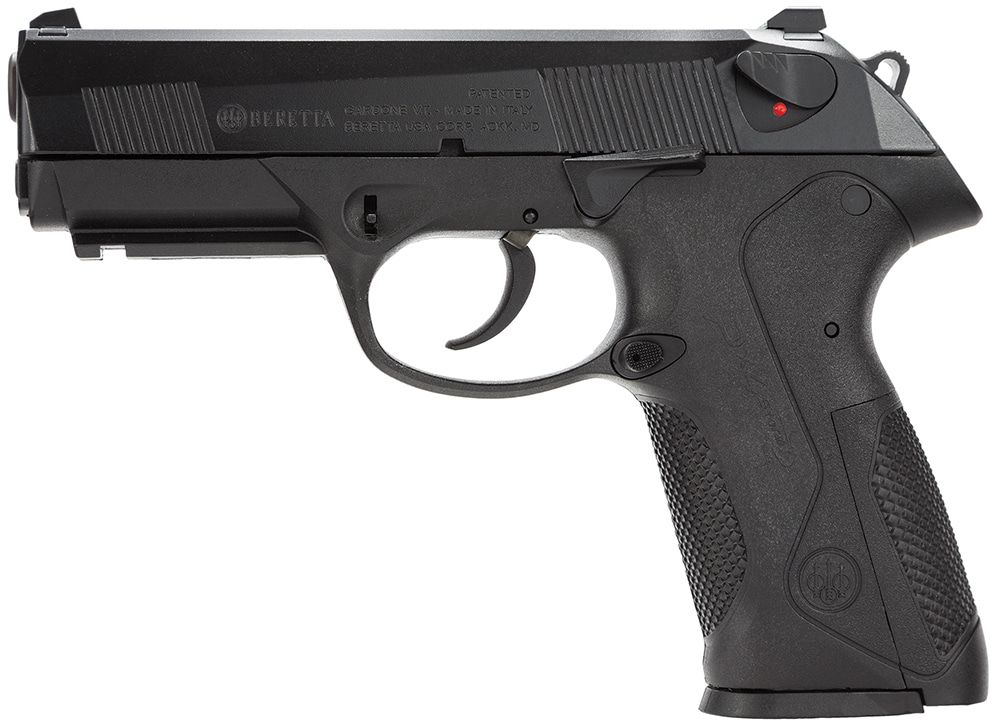
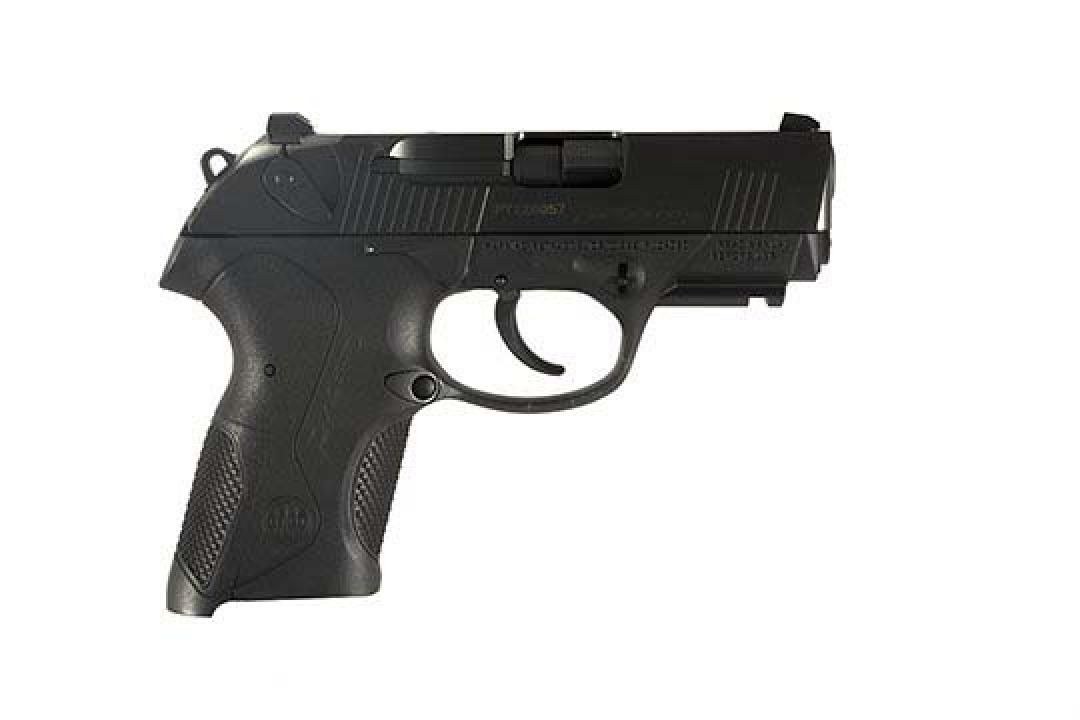
The PX4 does not tilt. Its barrel turns on its own axis instead, and that one difference runs through everything else about the gun.
How the rotation works
A stud on the underside of the barrel rides in a cam track cut into a steel block set in the polymer frame. When the gun fires, barrel and slide recoil together; the stud is forced to follow the curve of the track, which twists the barrel about its own axis until its lugs clear the slide. The slide then continues rearward on its own and the cycle proceeds normally.
Some of the twisting force is free. The barrel's 6-R rifling imparts a counter-clockwise torque as the bullet engages it, and the locking system is arranged to use that torque, so the cam and its 5mm by 2mm pin have less work to do than they otherwise would. Every other pistol absorbs that same force into the frame and gets nothing back.
Invalid Date
More Articles
Beretta's argument for the arrangement is recoil. Unlocking by rotation converts part of the rearward impulse into angular motion, which the shooter does not feel as muzzle rise. The claim is easy to test at a range and it holds up in the direction Beretta says, particularly in .40 S&W.
The rotating barrel is not new, it just keeps getting rediscovered
Gun
Period
Note
Steyr-Hahn Model 1911
1912
Helical lugs on the barrel running in frame grooves, 9mm Steyr
Obregón
1934 to 1938
A Mexican 1911 lookalike with a rotating lock instead of Browning's
Beretta 8000 Cougar
1994
Stud and cam track in a steel frame insert, the PX4's direct ancestor
Beretta PX4 Storm
2004
The same lock on a polymer frame
Grand Power K100 family
2000s
Slovak rotating-barrel pistols
Kel-Tec PR57
recent
Rotating barrel with lugs near the muzzle, stripper-clip fed
Beretta's own Cougar is the important entry. It arrived in 1994 as a compact alternative to the 92, using a stud on the barrel following a cam track in a steel frame insert, and Stoeger later built it under licence in Turkey on Beretta tooling. The PX4 is that lock moved onto a polymer frame with a modular grip and a chassis-style fire control.
What the catalog holds
The PX4 tag here carries 49 records after this article's audit added ten that a name search found sitting untagged, among them four Langdon Tactical guns and a pair of G-SD variants.
Barrel
Records
4.0in
24
3.0in
7
3.3in
5
3.2in
5
3.27in
3
4.5in
2
4.1in
1
The split at four inches is the full-size gun on one side and the Compact and Subcompact on the other, and it is close to even. That is unusual. Most pistol families in this catalog lean heavily toward one size.
The caliber split is more unusual still.
Caliber
Records
9mm
27
.40 S&W
17
.45 ACP
4
More than a third of the PX4 records are .40 S&W, in a market that has spent a decade abandoning that cartridge. The rotating barrel is the reason. The .40's sharp, snappy impulse is exactly what the mechanism is best at smoothing, so the PX4 kept a .40 following after most polymer service pistols lost theirs.
The trigger variants, which the listings rarely spell out
Beretta sells the PX4 in several fire-control configurations, and the letter is the whole difference between two guns that photograph identically.
Type
Trigger
Controls
F
Double action then single action
Decocker and manual safety
G
Double action then single action
Decocker only, no safety to disengage
C
Single action only
Spurless hammer
D
Double action only
Spurless hammer
Type G is what most experienced PX4 buyers want, because the lever decocks and springs back rather than leaving the gun on safe. Types C and D were mostly police purchases. The .45 ACP Special Duty, with its reinforced body and extended barrel, was Beretta's entry in the US military's Joint Combat Pistol programme.
This catalog held two Langdon Tactical PX4 Carry pistols whose action field said single action while their own descriptions correctly called them DA/SA. Both have been corrected. A Langdon gun is a stock Beretta with a trigger job, a reduced hammer spring and better sights, and the point of it is a lighter double-action pull, so filing it as a single action inverts the reason it exists.
The carbine that takes its magazines
Beretta built the Cx4 Storm carbine alongside the pistol, with production starting in 2003. It is a straight-blowback semi-automatic with a 16.6in barrel, offered in 9mm, 9x21mm IMI, .40 S&W and .45 ACP, and its magazine well is deliberately convertible: changing a magwell sleeve and the magazine release lets it feed from 92 and 96 magazines, from 8000 Cougar magazines, or from PX4 magazines.
That is a rarer arrangement than it sounds. Most pistol-caliber carbines are built around one magazine, usually Glock's. Beretta built one that could be configured around whichever Beretta pistol the buyer already owned, which is why a PX4 owner and a 92 owner can both end up with the same carbine and different parts inside the magwell. This catalog holds 12 Cx4 records.
What the rotation is actually worth
The honest reckoning is mixed, and it splits along how much a shooter cares about the trigger.
A rotating barrel gives a genuinely flatter-feeling gun, most obviously in .40 S&W. It also puts the barrel on a fixed axis vertically, which some shooters find helps consistency. Against that, it adds a steel insert and a cam surface to a polymer frame, it makes the gun slightly wider through the slide, and it puts the PX4 outside the aftermarket ecosystem that has grown up around tilting-barrel service pistols.
Beretta 92
Beretta PX4
Frame
Aluminium alloy
Polymer with a steel insert
Locking
Falling block
Rotating barrel
Trigger
Double action then single action
Same, in Types F and G
Aftermarket
Very large
Small
Weight
Heavier
Lighter
Both are DA/SA guns from the same company, and the choice between them is usually made on frame material and feel rather than on the lock. Langdon Tactical, which builds tuned versions of both, frames the question exactly that way.
What to check before buying one
The rotating barrel has one practical consequence people meet late. Because the barrel turns rather than tips, holsters and aftermarket parts made for a tilting-barrel pistol of similar dimensions are not automatically compatible, and threaded-barrel and compensator options are a smaller market than for a Glock or a SIG.
Beyond that:
Check
Why
The type letter
F, G, C and D are different guns; listings often omit it
Full size against Compact
Both share the family name and the same photographs
Whether it is a Langdon
The trigger work is most of the price difference
Caliber
Nearly a third of the used market is .40 S&W
Magazine fit
The Cx4 Storm carbine takes PX4 magazines, which is worth knowing if you own both
The PX4 sits in an awkward spot. It is a modern polymer pistol with a fire-control system most modern buyers have moved away from, and a locking mechanism nobody else in the American market uses. That combination is why it never displaced the 92 in Beretta's own lineup, and why it remains a good pistol that a lot of shooters have never handled.
Nick Sawinyh - Nick Sawinyh is a father, husband, hobby farmer, and gun enthusiast from Kentucky. He founded GunsNation and writes most of what appears on this blog.