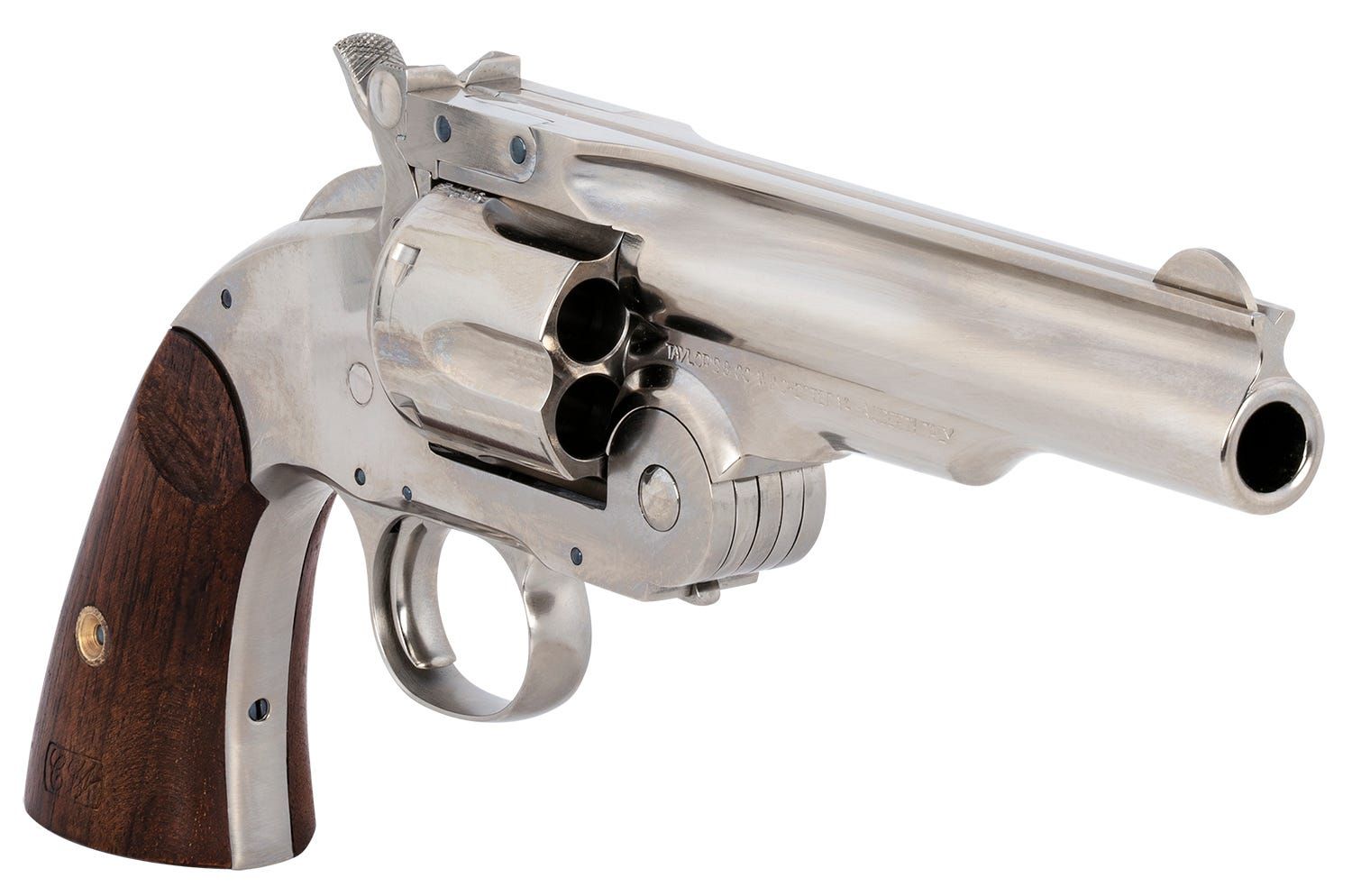
A single-action revolver is loaded and unloaded one chamber at a time. Half-cock the hammer, open the gate, rotate the cylinder, poke each empty case out with a rod under the barrel, then feed six fresh rounds in the same way. That is how a Colt Single Action Army works and it is how nearly every cowboy-pattern revolver on sale today works.
Smith & Wesson sold a faster answer to that for thirty years, and it lost anyway.
What a top-break does
Smith & Wesson introduced the Model 3 around 1870. Release a latch at the top of the frame and the barrel and cylinder hinge downward as one unit. As they swing, a star-shaped extractor rises out of the cylinder and pushes all six empty cases clear at once. The gun is empty, open and ready to reload in a single motion, without a loading gate and without an ejector rod.
Against a cap-and-ball revolver that was a different order of speed, and against a gate-loaded Colt it was simply quicker. A cavalry trooper could work one with a hand still on the reins.
Major Schofield's contribution was a latch
Major George W. Schofield's name is on the gun because of one change: he moved the spring-loaded barrel catch from the barrel to the frame, and specified replaceable heat-treated parts for it so the wear point could be serviced. The frame-mounted latch is what a modern eye recognises as the Schofield profile, and it is the difference between a Schofield and the other Model 3 patterns.
Invalid Date
More Articles
Changes to that latch also separate First Model from Second Model Schofields, with the transition falling around serial number 3,000. The reproductions sold today are usually Second Models, and the better listings say so.
Why the Army gave up on it
The US Army adopted the Model 3 in 1870, and then ran into a supply problem that had nothing to do with the mechanism.
Smith & Wesson had developed its own cartridge for the gun, the .45 Schofield, which is shorter than the .45 Colt the Army already had in service with its Colt revolvers. A .45 Schofield round chambers and fires in a Colt. A .45 Colt round will not fit a Schofield cylinder. An armourer handing out ammunition therefore had to know which revolver each soldier carried, and getting it wrong left the Schofield men with rounds they could not load.
The Army abandoned most of them over exactly that. Surplus guns were reconditioned and sold commercially after 1898, and Wells Fargo bought a batch, cut the barrels to five inches for easier carry, and stamped them "W.F. & Co" beside the original serial numbers. Those Wells Fargo guns are the reason a five-inch Schofield looks right to people who have never handled one.
What killed it
The mechanism did not lose on speed. It lost on pressure and on length.
A top-break frame is hinged at the front and held shut at the top by a latch. Every shot pushes against that joint, and hinge and latch both stretch and wear in a way that a solid frame does not. Black powder was forgiving of this. Smokeless powder, arriving at the end of the nineteenth century, was not: it raises chamber pressure substantially for the same case, and the extra load goes straight into the weakest part of the design.
The second problem was the cylinder window. A top-break's ejection system is sized for the cartridges it was designed around, and the cases that came next were longer. A frame built for .44 Russian or .45 Schofield has no room for a .38 Special, let alone a .357 Magnum.
The solid frame with a swing-out cylinder solved both at once. The frame is continuous, so pressure has nowhere to work a joint loose, and the cylinder can be as long as the designer wants. It also kept most of the reloading advantage, since a swing-out cylinder still ejects all six at one push of the rod. By the time the .357 Magnum arrived in 1935 the argument was settled, and it has stayed settled.
Every serious modern revolver has been a solid frame since, and the top-break survives in this catalog almost entirely as a reproduction of guns designed before the problem arrived.
The catalog remembers all three lengths
The top-break revolver tag built for this article holds 41 records. Setting aside the ten NAA mini revolvers, the 31 large-frame reproductions state exactly three barrel lengths and no others.
Barrel
Records
What it is
7in
14
The standard Model 3 and Schofield length
5in
11
The Wells Fargo cut-down, now a factory option
6.5in
4
The No. 3 Russian length
Nothing sits between them or outside them. The historical dimensions are the product specification here, and a maker offering a 4in or an 8in gun would be selling something that never existed.
The chamberings tell the same story in reverse. The originals were built for .44 S&W American, .44 Russian and .45 Schofield, none of which is easy to buy today.
Chambering
Records
.45 Colt
16
.44-40 Winchester
6
.38 Special
5
.44 Special
1
.44
1
Every one of those is a modern cartridge chosen for availability rather than for history. The .45 Colt entry is the pointed one: the reproductions are chambered for the cartridge that beat the original, because the cylinders are made long enough to take it and because that is what people can buy off a shelf.
Who builds them
Maker
Records
Taylor's & Co
14
NAA
10
Cimarron
9
Uberti
6
Uberti in Italy makes most of what Taylor's and Cimarron sell in the United States, so the top three lines here are closer to one factory and three importers than to three competing designs. The naming reflects each importer's catalog rather than a mechanical difference: a Taylor's Second Model Schofield and a Cimarron Model No. 3 Schofield are the same class of gun.
The Model 3 family also included the American and the Russian, and the catalog carries both under their own names. A Cimarron Model No. 3 American in .44-40 or .44 Special is a reproduction of the earliest of the three, and the Russian pattern, with its distinctive trigger-guard spur and 6.5in barrel, comes from the contract that once made Smith & Wesson's fortune.
The top-break survived, in miniature
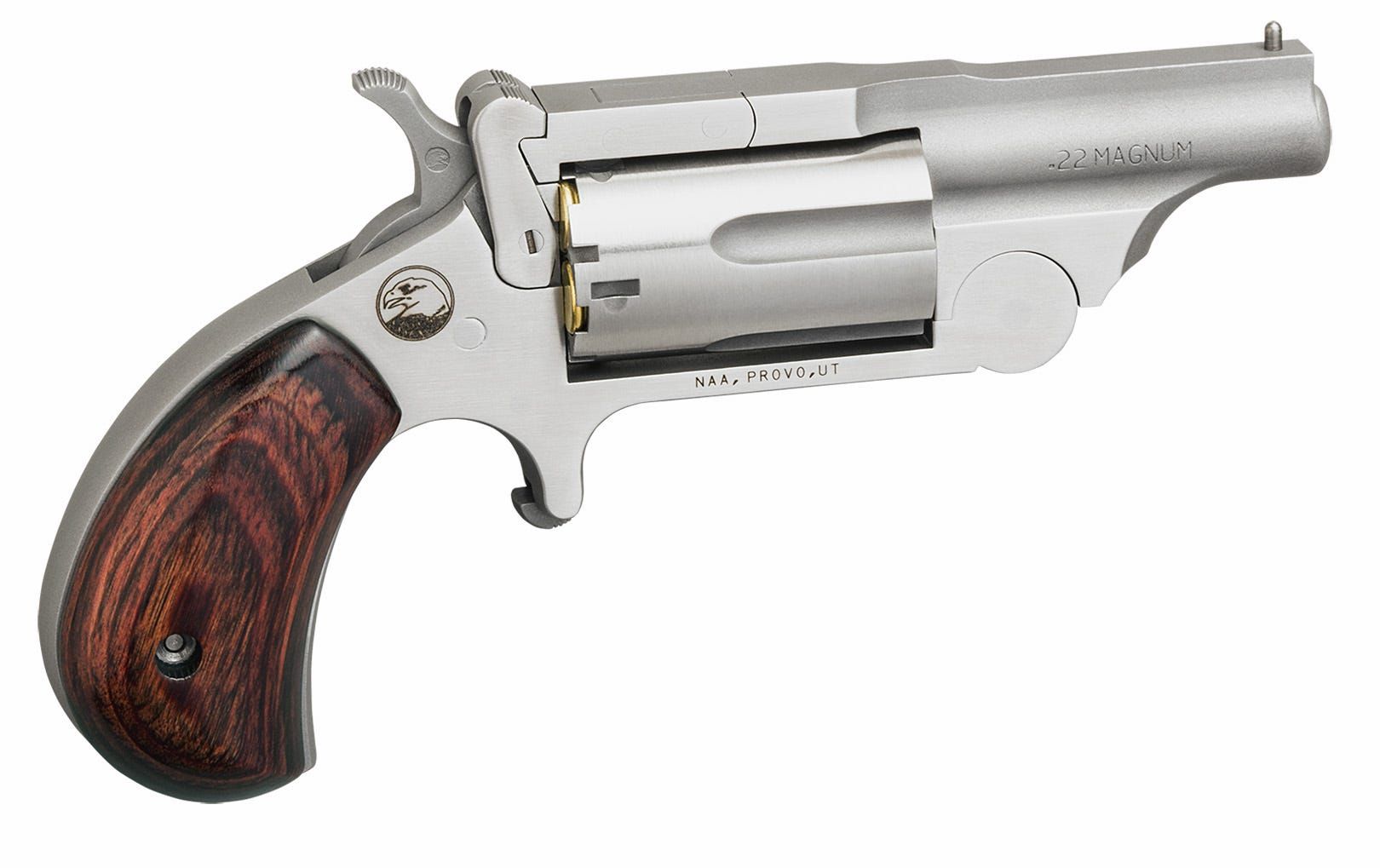
The mechanism did not die out entirely. North American Arms builds the Ranger II, a top-break version of its .22 mini revolver, and the ten records here are the only top-break revolvers in the catalog that are current designs rather than reproductions.
The reason is the one the Model 3 was built on. NAA's standard mini revolvers reload by pulling the base pin out and pushing cases through one at a time, which is slow work on a gun that fits inside a closed fist, and a top-break frame turns it into one movement. A design abandoned for full-size revolvers in the 1890s still earns its keep on a gun barely three inches long.
What to look for in a listing
Check
Why it matters
Schofield or No. 3
The Schofield is the frame-latch pattern; American and Russian are different guns
First or Second Model
The latch differs, and Second Models are the usual reproduction
Barrel length
5in, 6.5in and 7in each mean something historically
Chambering
.45 Colt and .38 Special are modern substitutions, not original
Action field
This catalog listed the frame type where the trigger type belongs
The top-break set contained six records describing the action as break action or as single and double action. Every large-frame gun in the group is single action only, and the break describes the frame rather than the trigger, so those are corrected. A Taylor's Schofield was also carrying an invented "Classic Series" designation in its title and again in its review text.
Nick Sawinyh - Nick Sawinyh is a father, husband, hobby farmer, and gun enthusiast from Kentucky. He founded GunsNation and writes most of what appears on this blog.