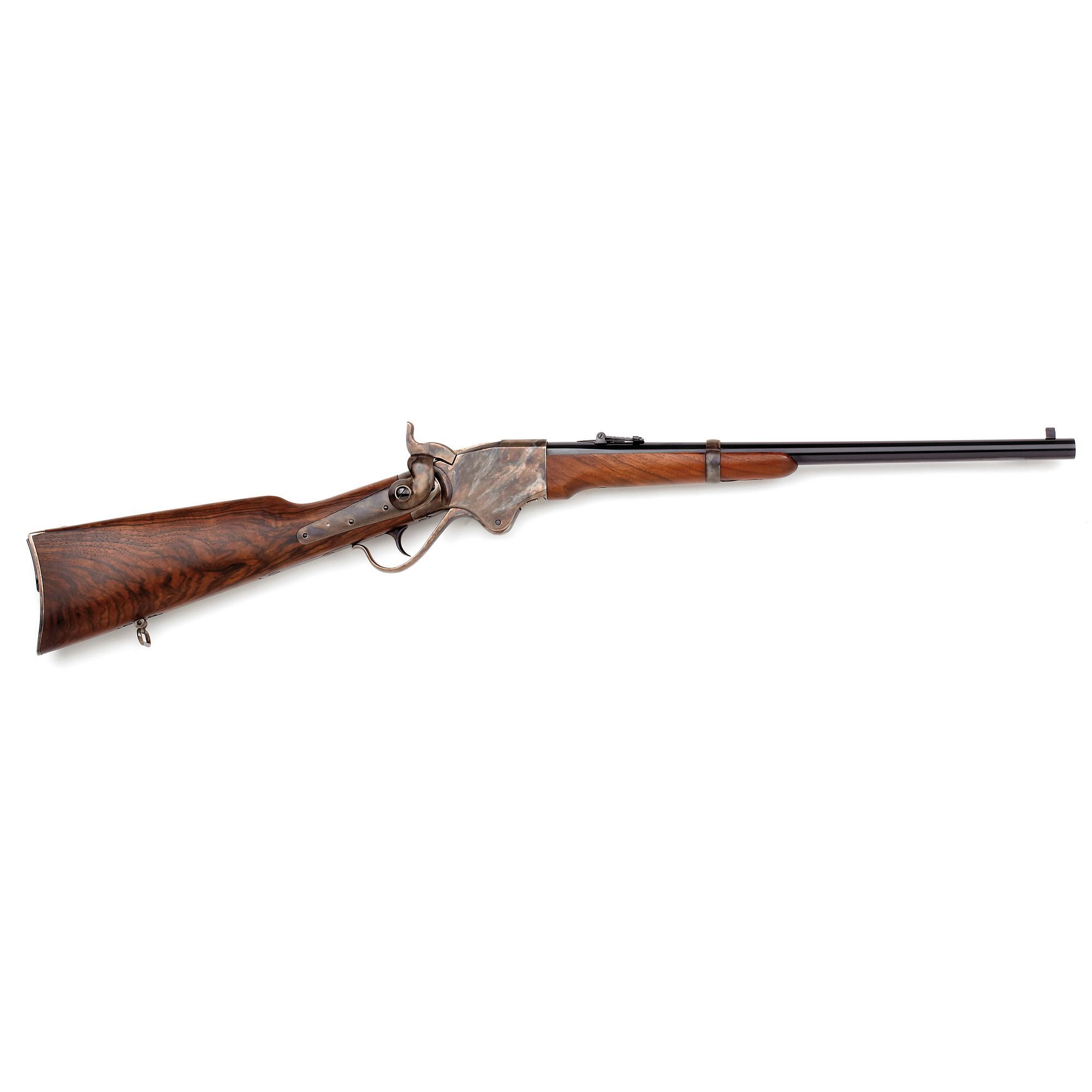
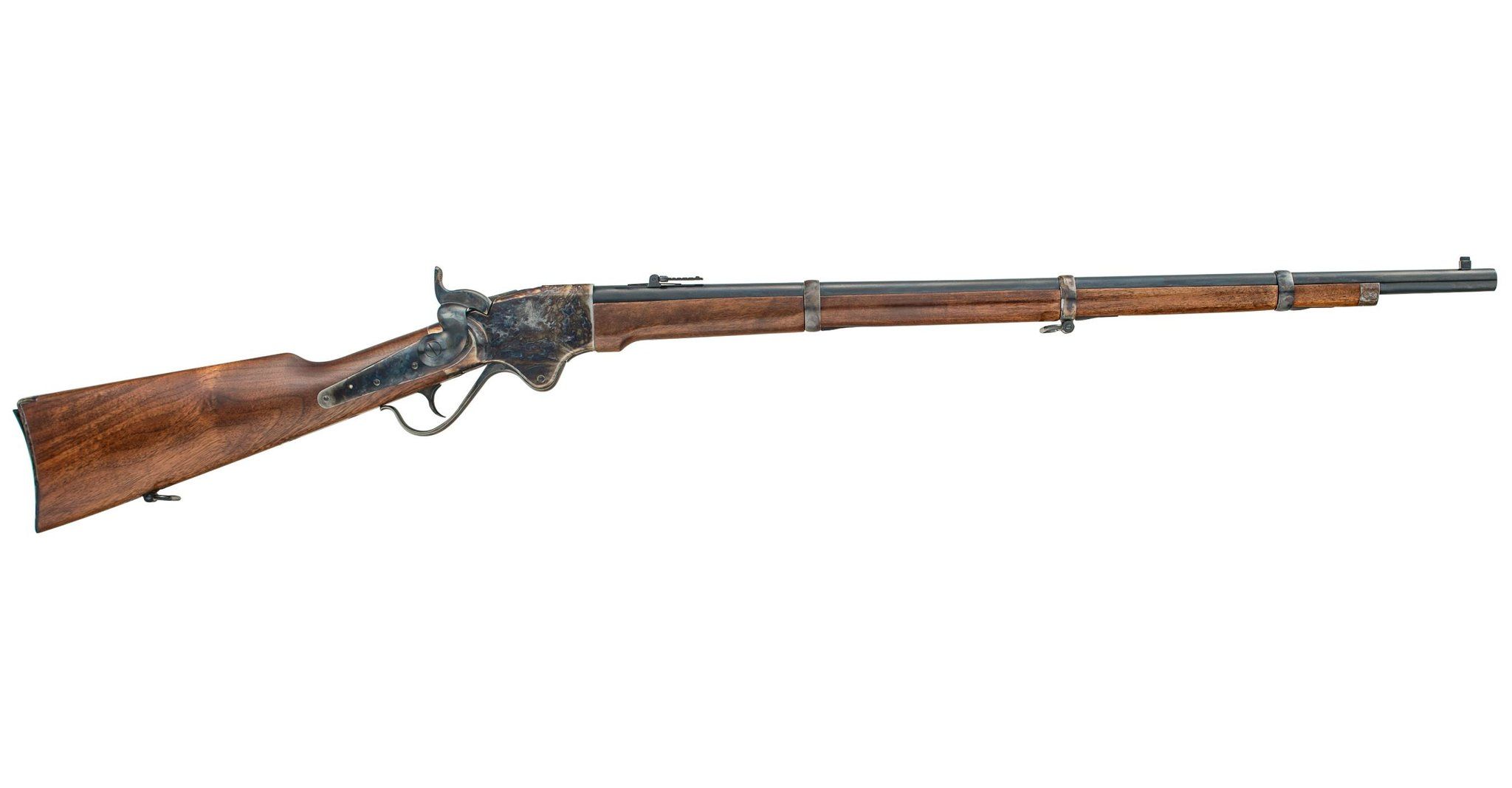
Pick up a Spencer after a Winchester or a Henry and the first surprise comes on the second shot. You work the lever, raise the rifle, press the trigger, and nothing happens. The lever has fed a fresh cartridge into the chamber, but it has not touched the hammer. Every shot on a Spencer takes two motions: the lever, then a thumb on the hammer.
Christopher Spencer's design was a cartridge repeater built for an army that still issued muzzleloaders, and it kept a muzzleloader's side hammer. It became the Union cavalry's carbine by the end of the Civil War, and every new one you can buy is a reproduction of that mechanism, hand-cocked hammer included. The Spencer rifle tag carries the current listings.
How one shot works
The operating lever is also the trigger guard. Swinging it down drops the breechblock, and the carrier it sits in rolls downward with it. That motion pulls the fired case out of the chamber and throws it from the top of the action, while the magazine spring pushes the next cartridge up onto the carrier. Raising the lever drives that cartridge into the chamber and locks the block behind it.
Invalid Date
More Articles
The Spencer Rifle: Seven Rounds in the Stock and a Hammer You Cock by Hand | GunsNation
The hammer is an external, side-mounted one, the same pattern as a percussion rifle's, and the lever never moves it. American Rifleman's "This Old Gun" column gives the original manual of arms: hammer to half cock, lever down, lever up, then cock the hammer and fire. Rifle Magazine's test of a modern Cimarron carbine gives the same sequence and adds that a round can be carried in the chamber with the hammer at half cock.
Step
What you do
What the gun does
1
Thumb the hammer to half cock
Hammer held clear of the firing pin
2
Lower the lever
Breechblock drops, fired case is extracted and thrown out the top, next round rises onto the carrier
3
Raise the lever
Round goes into the chamber, block locks behind it
4
Thumb the hammer to full cock
Nothing else moves
5
Press the trigger
Hammer falls on the firing pin
The magazine is a tube inside the buttstock, loaded from the butt. You turn the latch at the buttplate, pull the spring and follower assembly out, drop cartridges into the tube, and slide the follower back in. Wikipedia's history of the rifle records that the tube was first designed for nine rounds and cut to seven, to lighten the column pushing on the rearmost cartridge and the risk of it firing from inertia.
That rear cartridge is the reason modern owners are told to tip rounds into the tube at an angle. Rifle Magazine passes on Chiappa's own advice: let them slide in, never drop them vertically. The worry is a heavy bullet landing nose-first on the rim of the round below it, the same risk that cut the original tube from nine rounds to seven.
The cartridge and its odd name
Christopher Spencer received U.S. Patent 27,393 for the rifle on March 6, 1860. The original round is the .56-56 Spencer, a rimfire, and its name does not follow the later convention where the second number is a powder charge. Both numbers describe the case: about .56 inch at the base just ahead of the rim, and about .56 inch at the mouth. The bullet inside it was about .52 caliber.
Cartridge
What it was
Bullet diameter
.56-56 Spencer
The original rimfire, 1860
about .52 caliber
.56-52
Later Spencer commercial round
.512 in
.56-50
Army round for the Model 1865
.512 in
.56-46
Smaller commercial variant
.465 in
Figures from the Wikipedia entry on the cartridge, which gives the original load as a 350-grain bullet over about 45 grains of black powder. Rifle Magazine pulled bullets from original .56-56 rounds and measured them at .540 to .555 inch, which is why you will see both figures quoted. The .56-52 and .56-50 used the same bullet and differed only in the crimp.
The .56-50 matters for the reproductions. An Ordnance Department directive of November 1864, reported by American Rifleman, moved the Army's carbine to the .56-50 round. The reproductions copy that cartridge's shape as a centerfire.
Rifles, carbines and the contracts
The Navy bought first. After a demonstration in mid-1861, according to American Rifleman, the Navy ordered 700 rifles, later raised to 1,000. The Army followed with a contract for 7,500 rifles with 30-inch barrels, completed by June 1863.
The carbine took over after that. On July 13, 1863, the Army awarded the Spencer Repeating Rifle Company a contract for 11,000 carbines; in December that was revised to 34,500 carbines for 1864. By the time the wartime contracts closed on January 1, 1866, the Boston factory had delivered 64,685 carbines.
A second maker joined late in the war. The Burnside Rifle Company signed for 30,500 carbines on June 27, 1864, and delivered 30,496 of them as Model 1865s, plus six samples and prototypes.
Original model
Barrel
Overall length
Weight
Model 1860 rifle
30 in
47 in
not stated in the sources used here
Model 1860 carbine
22 in
39 in
8 lb 4 oz
Model 1865 carbine
20 in
37 in
8 lb 5 oz
Carbine figures from American Rifleman. The rifle's length is from the Wikipedia entry.
After the war, Springfield Armory retrofitted about 12,000 Model 1860 carbines to Model 1865 features, and in 1871 it converted 1,109 Burnside carbines into rifles. Wikipedia records the company going out of business in 1869, sold to the Fogerty Rifle Company and, in the end, to Winchester.
Where it was used, and how fast it fired
The Spencer's reputation was made in 1863, before most of the Army had one. Colonel John T. Wilder's mounted infantry, the Lightning Brigade, carried Spencer rifles at Hoover's Gap in June 1863, and Wilder's men were in action again on the opening day of Chickamauga in September. In the East, two regiments of Custer's Michigan Brigade carried them at Hanover and East Cavalry Field during the Gettysburg campaign.
Abraham Lincoln shot one himself in August 1863. Accounts give the date as the 17th or the 18th, and historian David J. Kent's account has him putting seven rounds into a wooden board at about 40 yards. The Washington Times has argued that the demonstration confirmed an adoption already under way, since the 7,500-rifle contract had been filled by the spring. Either way the Chief of Ordnance, James Ripley, who had resisted cartridge repeaters, was replaced later that year.
The rate of fire in most accounts is about 14 aimed shots a minute, against two or three for a rifle-musket. Wikipedia cites about 20 aimed shots a minute with the Blakeslee box, covered below. Both figures include the hand-cocked hammer, which is part of why the Spencer is slower than its seven-round magazine suggests.
Spencers also went abroad after 1865. Wikipedia records Argentine purchases and a Belgian-built run for Brazil. In Japan, the rifle is tied to Niijima Yae, who fought with a Spencer in the defense of Tsuruga Castle at Aizu during the Boshin War of 1868. An X post by @AsianDawn4 about the actress who played her on television drew several hundred likes.
The Blakeslee box and the Stabler cut-off
Two add-ons fixed the Spencer's two weak points: slow reloading and a magazine that emptied too quickly.
The first was the Blakeslee cartridge box, designed by Colonel Erastus Blakeslee of the 1st Connecticut Cavalry and patented in December 1864. It held tin tubes, each loaded with seven cartridges. A trooper pulled the magazine follower, emptied a tube straight into the stock, and replaced the follower. American Rifleman describes the standard box as ten tubes for 70 rounds and records late-war orders for 32,000 boxes; Wikipedia lists versions with six and thirteen tubes as well.
The second was the Stabler cut-off, invented by Edward Stabler of Maryland and added to production in March 1865. It let the carbine be fired as a single-shot, loaded by hand, with the seven rounds in the stock held in reserve. The NRA Museums account on X describes it the same way: the magazine stays full while the shooter fires, ejects and reloads one round at a time.
The Army bought both versions. Of the 30,502 Model 1865 carbines Burnside delivered, counting the six samples, 14,494 had the cut-off and 16,008 did not, according to American Rifleman, and the Spencer factory built nearly 23,000 Model 1865s, of which 12,502 had it.
The Spencer, the Henry and the Sharps
The Spencer is usually compared with two other carbines of the war. The Henry rifle is the other lever-action repeater; the Sharps was the single-shot breechloader the cavalry already carried.
Spencer
Henry 1860
Sharps carbine
Loading
Lever, seven-round tube in the buttstock
Lever, fifteen-round tube under the barrel
Single shot, vertical falling block
Hammer
Cocked by hand every shot
Cocked by the lever
Cocked by hand every shot
Ammunition
.56-56 rimfire, about .52 caliber
.44 rimfire
.52 caliber linen cartridge, fired by a percussion cap
Production
Over 100,000 under the wartime contracts
About 14,000, 1860 to 1866
Over 80,000 carbines bought by the government
Henry figures from the NRA Museum and Wikipedia; the Sharps figure is the one repeated across dealer and auction listings. The Spencer figure is the American Rifleman contract totals above.
On paper the Henry is the faster gun, with twice the magazine and a hammer the lever cocks for you. The Army still chose the Spencer. Rare Winchesters' history of the Henry records that many officers thought the Henry too delicate to issue to ordinary troops: its magazine spring was easily damaged, and a dented tube under the barrel jammed the gun. The Spencer's tube sat protected inside the stock. The government bought only 1,731 Henrys, and the same history puts about 10,000 in the war, most of them bought privately.
The Henry's descendants took over after the war. Winchester's 1866 and 1873, with lever-cocked hammers and tubes under the barrel, are the lever guns most people picture today, and reproductions of the 1860 Henry are on the Uberti lever-action tag.
The reproductions: one factory, three names
Every new Spencer in the catalog comes from Chiappa's Armi Sport factory in Italy. Rifle Magazine dates the reproduction to about 2005. Chiappa sells it under its own name as the 1860 Spencer; Taylor's & Co and Cimarron import it as the 1865 Spencer. The ten records split six under Chiappa, three under Taylor's and one under Cimarron.
Listing
Format
Chambering
Barrel
Chiappa 1860 Spencer Carbine
carbine
.45 Colt
20 in
Chiappa 1860 Spencer Carbine
carbine
.56-50
20 in
Chiappa 1860 Spencer Carbine
carbine
.44-40
22 in
Chiappa 1860 Spencer Rifle
rifle
.45 Colt
30 in
Chiappa 1860 Spencer Rifle
rifle
.56-50
30 in
Chiappa 1860 Spencer Rifle
rifle
.44-40
30 in
Taylor's & Co 1865 Spencer Carbine
carbine
.56-50
20 in
Taylor's & Co 1865 Spencer Carbine
carbine
.45 Colt
20 in
Taylor's & Co 1865 Spencer Rifle
rifle
.56-50
30 in
Cimarron 1865 Spencer Carbine
carbine
.45 Colt
20 in
That is six carbines and four rifles, with four in .45 Colt, four in .56-50 and two in .44-40. The 20-inch carbines weigh 9 lb and run 37 inches overall, which puts them about 11 ounces over an original Model 1865. The 30-inch rifles weigh 10.6 lb and run 47 inches.
The .44-40 carbine comes with a 22-inch barrel on Chiappa's own listing, the length of the original Model 1860 carbine, while the .45 Colt and .56-50 carbines use the 20-inch Model 1865 length. Rifle Magazine's Cimarron test gun arrived with a plug in the magazine tube that limited it to five rounds; removing it gives the full seven. The same test found that a lazy lever stroke could leave the fired case in the action, and a firm one cleared it.
Rifle Magazine's .45 Colt carbine shot four-shot groups of 2.3 to 3.2 inches at 50 yards with factory ammunition, and the reviewer advised keeping handloads within the cartridge's 14,000 psi SAAMI limit.
Choosing one
Most Spencers built were carbines, and the 20-inch Model 1865 is the one that went west with the cavalry after the war, so the carbine is the historical default. The 30-inch rifle is the infantry pattern of Wilder's brigade and the Navy order, and it suits a reenactment unit that carried one.
For chambering, .45 Colt is the easy answer. Factory ammunition is everywhere, and it matches a single-action revolver. An owner on X, @AndlBequet, pairs his with a Cimarron 1851 Richards-Mason conversion in the same cartridge. The .44-40 does the same job for a Winchester 1873 or a .44-40 revolver. The .56-50 is the authentic one, and it is a handloading project, since the centerfire brass and bullets are specialty items. The Chiappa, Taylor's and Cimarron lever-action tags carry the listings by importer.
At a cowboy action match the Spencer runs slower than a Winchester-pattern gun, since every shot is lever, thumb, trigger, and the seventh is followed by a tube change.
Nick Sawinyh - Nick Sawinyh is a father, husband, hobby farmer, and gun enthusiast from Kentucky. He founded GunsNation and writes most of what appears on this blog.