A revolver rifle looks like a mistake the first time you see one: a rifle stock and a rifle-length barrel, with a revolver's cylinder and hammer sitting where a lever or a bolt should be. Colt sold one before the Civil War, and the idea has come back every few decades since, most recently as the Rossi Circuit Judge and the Heritage Rough Rider Rancher Carbine.
Below is how the mechanism works, why Colt's version faded, and each family that turns up in the revolver rifles listings, with the specifications that tell them apart.
How the mechanism works
The action is a revolver's. A cylinder holds five to nine cartridges in bored chambers, a hand rotates it as the hammer is cocked, and each chamber lines up behind the barrel in turn. Nothing feeds from a magazine and nothing cycles on recoil or gas. Reloading happens exactly as it does on the handgun the mechanism came from: through a loading gate one cartridge at a time on a single-action, or by swinging the cylinder out on a double-action.
The stock and barrel are the rifle part. A shoulder stock makes a handgun cartridge easier to hold steady, and a barrel of 16 to 18.5 inches adds velocity. You end up with a light, short long gun that shoots the same ammunition as a revolver on your belt.
Invalid Date
More Articles
The design also keeps the cylinder gap, a small space between the front of the cylinder and the rear of the barrel. Every shot vents hot gas and fine particles sideways out of it. On a handgun your hands are behind the cylinder. On a rifle, a shooter's instinct is to reach forward with the support hand, which puts it right beside that gap.
Why Colt's version did not last
Colt's New Model revolving rifle, the Model 1855, was built from 1855 to 1864 on Elisha Root's sidehammer revolver design, with five or six chambers and calibers from .36 to .64. It used paper cartridges and loose powder, and that combination produced the design's famous failure. Gas escaping from the gap could ignite powder in the neighbouring chambers, firing several at once, and the first Root rifles were meant to be held with the support hand under the cylinder, directly in the path.
Berdan's Sharpshooters were issued the rifle and wrote most of what was said against it. Their discarded guns went to the 21st Ohio, which used them at Chickamauga in 1863. Self-contained metallic cartridges ended chain fires, but by then the lever action had arrived and did the same job with nothing venting beside the shooter's hand, and the revolving rifle dropped out of use.
What the catalog holds
The tag holds four families, and they split cleanly on mechanism and chambering.
Across those 36 records, every chambering is either a .22 rimfire or a revolver cartridge. None is a rifle cartridge, because a cylinder long enough for a .30-30 would make a very large revolver.
The Rossi Circuit Judge
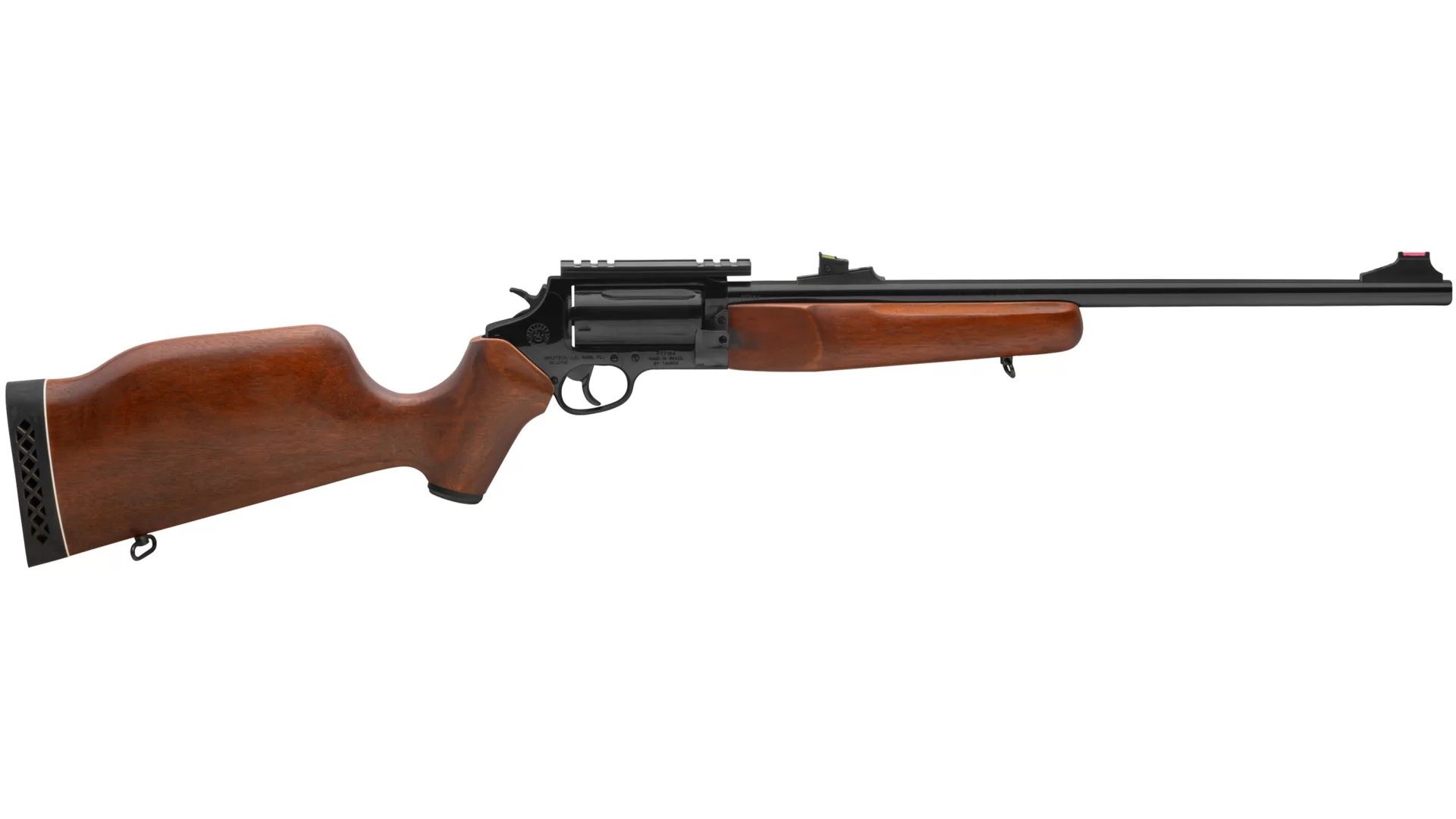
The Circuit Judge is a joint product of Taurus and its sister company Rossi, and American Rifleman described it in its 2012 review as Taurus revolver actions fitted with Rossi barrels and stocks. A shooter posting on X found that a Circuit Judge stock fits a Taurus Tracker revolver's grip frame, because the two share it.
It is the only double-action gun in the set: the trigger will cock and drop the hammer in one long pull, or break lightly after you thumb the hammer back, and the cylinder swings out to the left for loading. The flagship chambers .45 Colt and .410 shotshells in the same five chambers, including 3-inch shells.
The barrel is rifled, which is why a gun that fires shotshells is a rifle. Rossi ships a removable choke with straight rifling to keep a column of shot from spinning out into a doughnut, and American Rifleman got 7 to 10 inch birdshot groups at 7 yards with it installed. For the gap, it has gas-deflector shields beside the cylinder and a flared forend that keeps the support hand clear.
Chambering
Records
Capacity
.45 Colt/.410
7
5
.44 Magnum
1
6
.22 LR
1
9
The .45 Colt/.410 guns come with a hardwood Monte Carlo stock or a polymer thumbhole, and the thumbhole models are the ones sold as the Circuit Judge Tuffy, not to be confused with Rossi's Tuffy single-shot .410 shotgun. The .44 Magnum and .22 versions come and go; Rossi's own product page lists only the .45 Colt/.410 models, and the rimfire gun was built to take interchangeable .22 LR and .22 Magnum cylinders. Recorded weights run from 73.6 to 84.8 ounces, or about 4.6 to 5.3 pounds.
The Heritage Rough Rider Rancher Carbine
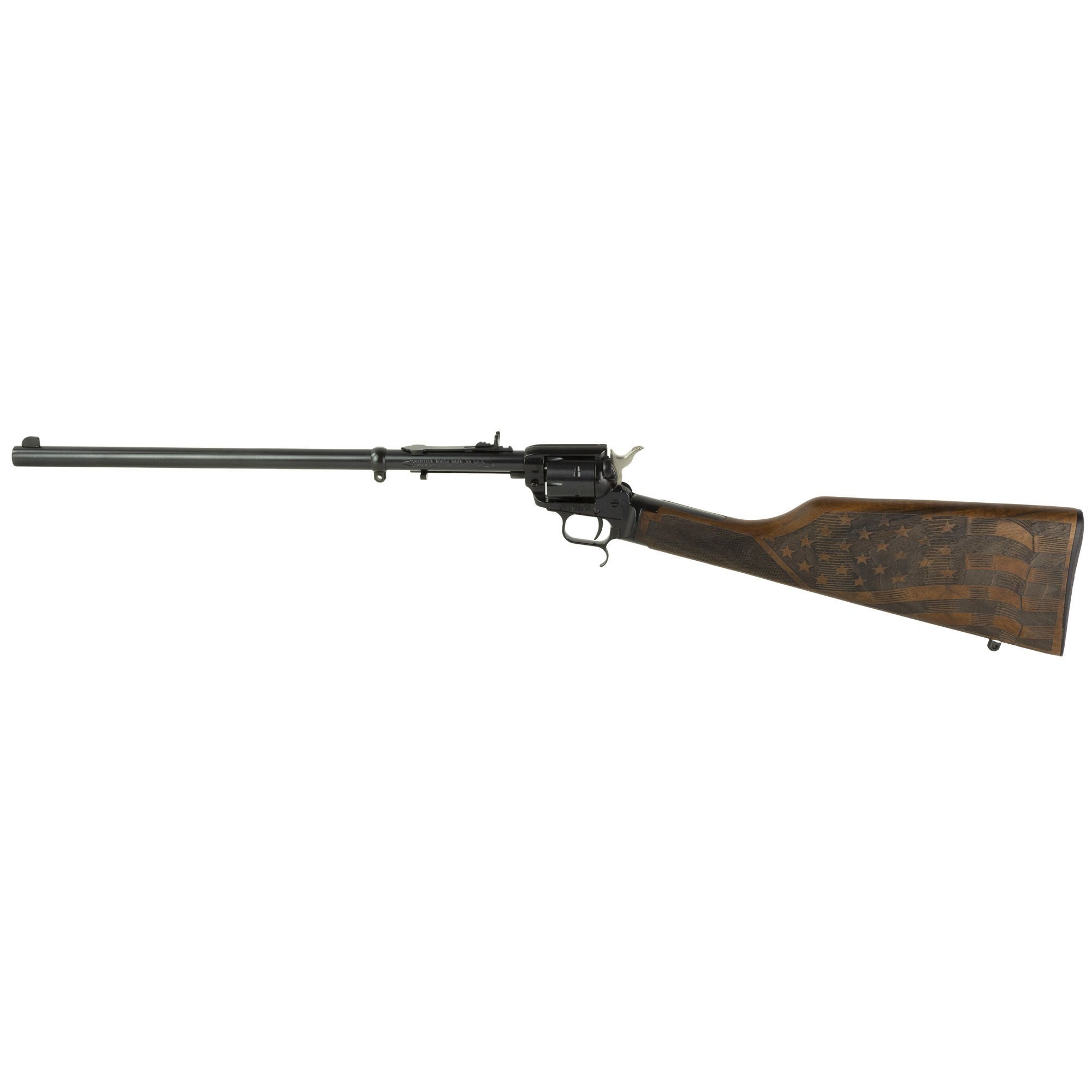
Heritage introduced the Rancher during 2020, putting a shoulder stock and a 16-inch barrel on its Rough Rider single-action .22 revolver, and it won an NRA Editor's Choice award that year. It accounts for 20 records, more than any other family, because Heritage sells it in a long list of stock finishes: plain walnut, cocobolo, camo laminate and several engraved patterns.
The six-round cylinder loads through a gate on the right side, the hammer has to be cocked by hand for every shot, and there is no double-action mode. The frame is aluminum alloy, which keeps the weight to 4 pounds 1.92 ounces, and the length to 32 inches overall.
There is no forend, so both hands stay on the stock behind the cylinder, which keeps them out of the path that caught Colt's shooters. American Rifleman's reviewer still recommended shooting glasses after feeling blowback from the gap across his face.
The 1873-pattern and 1858 carbines
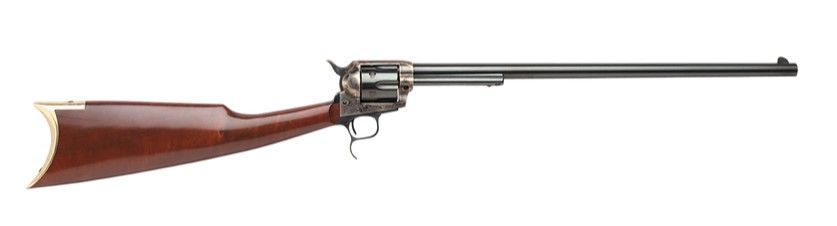
The Italian replica trade builds the same idea around bigger cartridges. Uberti, and the importers Cimarron and Taylor's, each sell a Colt Single Action Army action with an 18-inch barrel and a shoulder stock, in .357 Magnum, .45 Colt or .44-40. They are single-action only and load six through a gate. Most buyers are cowboy shooters who want a carbine in the same chambering as their revolvers.
Uberti's 1858 New Army Target Carbine is the closest thing in the catalog to the original Colt: a percussion .44 on the Remington 1858 frame, loaded with loose powder and ball. It is also the one gun in the set where the chain-fire warning from 1855 still applies in full, so seal the chambers with grease or wads before firing.
Revolving shotguns
Two smoothbore guns share the layout without being rifles. The Landor Arms TXS-804 and the Adamson REV-410 are .410 shotguns with five-round cylinders, 20.25 and 28 inch barrels, and interchangeable chokes. Neither has rifling or a .45 Colt option, so they are straightforward shotguns that happen to revolve.
Reading a listing
Listings for these guns often get the basic identity wrong. Before this guide was written, the catalog had records calling a Rancher Carbine semi-automatic, another calling it double-action, eight more titling it a revolver, and two giving it a weight of under three pounds against the correct 4 pounds 1.92 ounces. A Circuit Judge was listed under an invented model name.
When reading a listing, check the action first. Only the Circuit Judge is double-action, so a Rancher or an 1873-pattern carbine described as double-action is wrong. Capacity follows chambering: five for .45 Colt/.410, six for .44 Magnum and the single-action carbines, nine for the rimfire Circuit Judge. Then look at the forend. The Circuit Judge has one with shields behind it; the Rancher has none, and neither do the Taylor's and Uberti carbines in their listing photos. On any of them, keep the support hand behind the front of the cylinder.
Nick Sawinyh - Nick Sawinyh is a father, husband, hobby farmer, and gun enthusiast from Kentucky. He founded GunsNation and writes most of what appears on this blog.