Search for "Tokarev" in a firearms catalog and two unrelated things come back. The first is a handful of pistols built on Fedor Tokarev's TT-33 design, the Soviet service pistol of the 1930s. The second is a line of modern 12 and 20 gauge shotguns that have nothing to do with Tokarev, the Soviet Union or the 7.62x25 cartridge. They are made in Turkey and sold in the United States under the Tokarev USA name by a company based in Knoxville, Tennessee.
The gunsnation catalog mixes them the same way. A name search for Tokarev returns three pistols (two in 7.62x25, one Zastava in 9mm) next to 41 shotgun records. The shotguns are the subject here, and the useful part of their names is the letters in front of the model number, which tell you which of several quite different guns a listing is for.
How the lineup splits by action and layout
People tend to say "Tokarev shotgun" as if it named one design. Sorted by model family, the 41 shotgun records split into pump and gas semi-auto actions, fed from tubes or box magazines, in conventional, AR-style and bullpup stocks.
Family
Mechanism
Feeds from
Records
TX3, TX1, TSP-12
Pump action, conventional layout
Invalid Date
More Articles
Tokarev Shotguns: How to Read the Model Codes | GunsNation
Tube under the barrel
12
Bullpump
Pump action, bullpup layout
Detachable box magazine
1
TTF, T300, TTS 12, TSA-12
Gas semi-auto, conventional layout
Tube under the barrel
8
TAR, TT-12 PRO
Gas semi-auto, AR-style layout
Detachable box magazine
11
TBP
Gas semi-auto, bullpup layout
Detachable box magazine
9
So 13 of the 41 are pumps, 8 are conventional semi-autos that load like any field shotgun, and 20 are magazine-fed semi-autos in either an AR-style or a bullpup stock. That last group is usually what people picture when they hear the name, and it behaves least like a traditional shotgun.
Decoding the letters
Code
What it means
TX
The pump guns. TX3 is the main model, TX1 the plain bead-sight version
TX3 12HD, 20HD
Gauge first, then HD for the heavy-duty walnut and blued configuration
HDM
The same gun with a corrosion-resistant nickel finish
A1
The current TX3 and T300 versions, with an adjustable rear sight on a receiver rail
TAR
AR-style semi-auto, with the stock, grip and controls laid out like an AR carbine
TBP
Bullpup semi-auto, with the action behind the trigger
TTF, T300
Conventional tube-fed gas semi-autos. Tokarev sells one as the TTF 12 T300A1
M, FDE, ODG, SP, UC, AF
Finish codes: nickel, flat dark earth, OD green, splatter camo, urban camo, American flag
Buyers and dealers get caught out by the finish codes. The urban camo graffiti finish exists on both a TAR and a TBP, so a listing that says "graffiti 12 gauge semi-auto" could be either gun. They share a barrel length and a magazine and differ by about nine inches overall. On this site, two records had the names crossed, a bullpup filed under the TAR name and the AR-style gun under the TBP name, with overall lengths that contradicted their own titles. The UPCs settled it: 723551446133 is the TBP 12 UC bullpup and 723551446140 is the TAR 12 UC. When the finish name is ambiguous, check the three letters in front of it, since nothing else in the listing gives the layout.
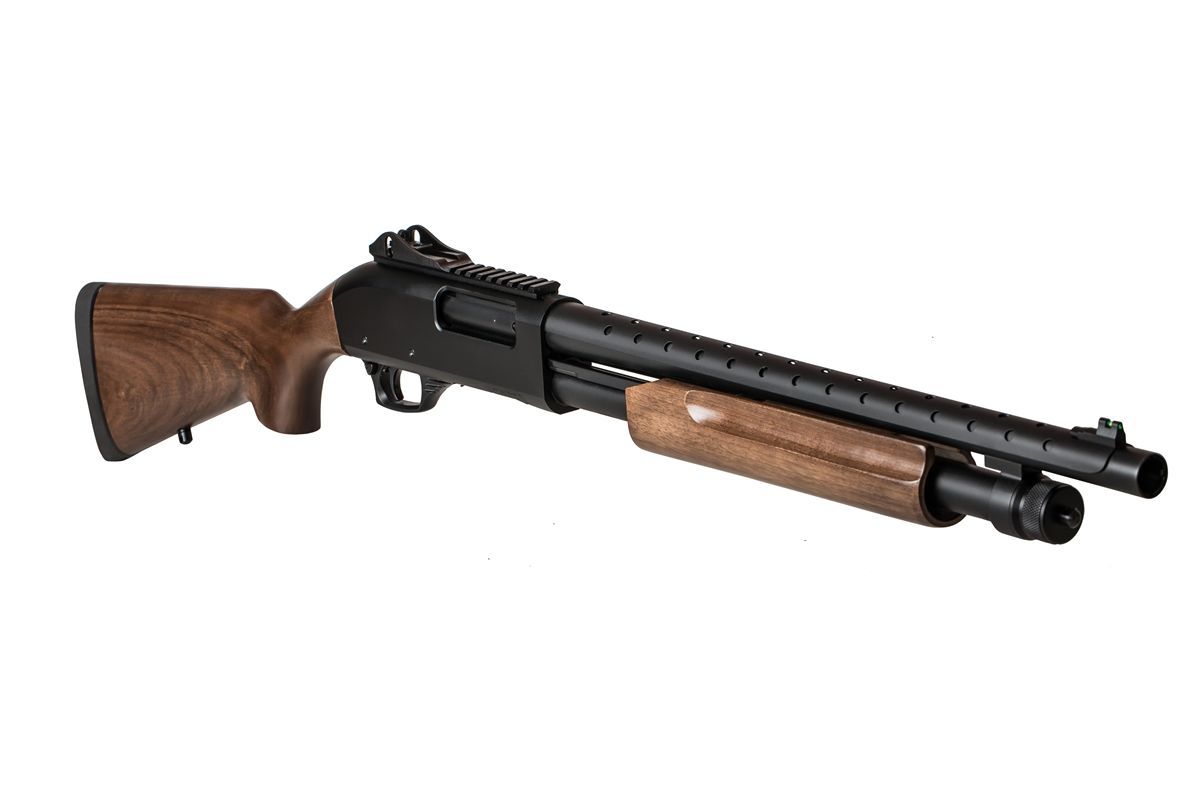
The TX3 is built around Mossberg furniture
The TX3 is the model with the most records and the most traditional shape. It is a pump gun with an 18.5 inch chrome-lined barrel, a 3 inch chamber, a ventilated heat shield over the barrel, a fiber optic front sight and a ghost ring rear on a short receiver rail. Dealer listings for the 12HD A1 give 38.27 inches overall and 6 lb 10 oz, with a 4+1 capacity (some list 5+1).
For an owner, compatibility matters more than any of that. Tokarev USA states that the TX3's polymer stock and forearm are Mossberg 500/590 compatible, and that 500/590 pistol-grip stocks need some material removed to fit. That opens the large aftermarket for the most common American pump shotgun to a budget import. The Firearm Blog's review of the 20 gauge TX3 20HD A1 made the same point and noted that the 20 gauge weighs the same 6 lb 10 oz as the 12, which suggests a 20 gauge barrel on the 12 gauge receiver.
The heat shield, the ghost ring and the walnut give the TX3 a deliberately retro military look, and the accessory list leans into it. Tokarev USA sells a bayonet mount kit, and Gun Tests' SHOT Show write-up of the TX3 12HD and 12HDM was titled "Tokarev Shotguns Are Ready for the Trenches". Underneath the trench-gun styling it is a modern Turkish pump on 590-pattern furniture.
TX3 configuration in the catalog
Gauge
Barrel
12HD A1, walnut and blued
12
18.5 in
12HDM A1, walnut and nickel
12
18.5 in
Nickel with synthetic stock
12
18.5 in
TX3 Hammer, black synthetic
12
18.5 in
Black and walnut field gun
12
28 in
TX3 20 gauge, walnut
20
18.5 in
TX3 20 gauge, nickel and walnut
20
18.5 in
The magazine-fed guns share one magazine
The TAR, the TBP and the TT-12 PRO all feed from a detachable box magazine rather than a tube, and they share a magazine: Tokarev USA lists the TBP and TT-12 PRO as compatible with T-1919 pattern magazines, the pattern named after the MKA 1919 AR-style shotgun, and dealers list the TAR the same way. The guns ship with a five-round magazine, and Tokarev states capacities up to 20 rounds are available in the pattern. A shared pattern matters to an owner because a box-fed shotgun is only as reliable as its magazines, and spares wear out.
A shotshell is a poor thing to feed from a box. It has a rim, a soft wall and a crimp, and stacking it under spring pressure is harder than stacking rifle cartridges. Box-fed shotguns in general have a reputation for preferring full-power loads, and the TBP's box contents acknowledge the tuning problem. All4shooters' review of the TBP 12 describes a gas system mounted at the rear, inside the stock, and notes that a heavier replacement piston is included for heavy loads.
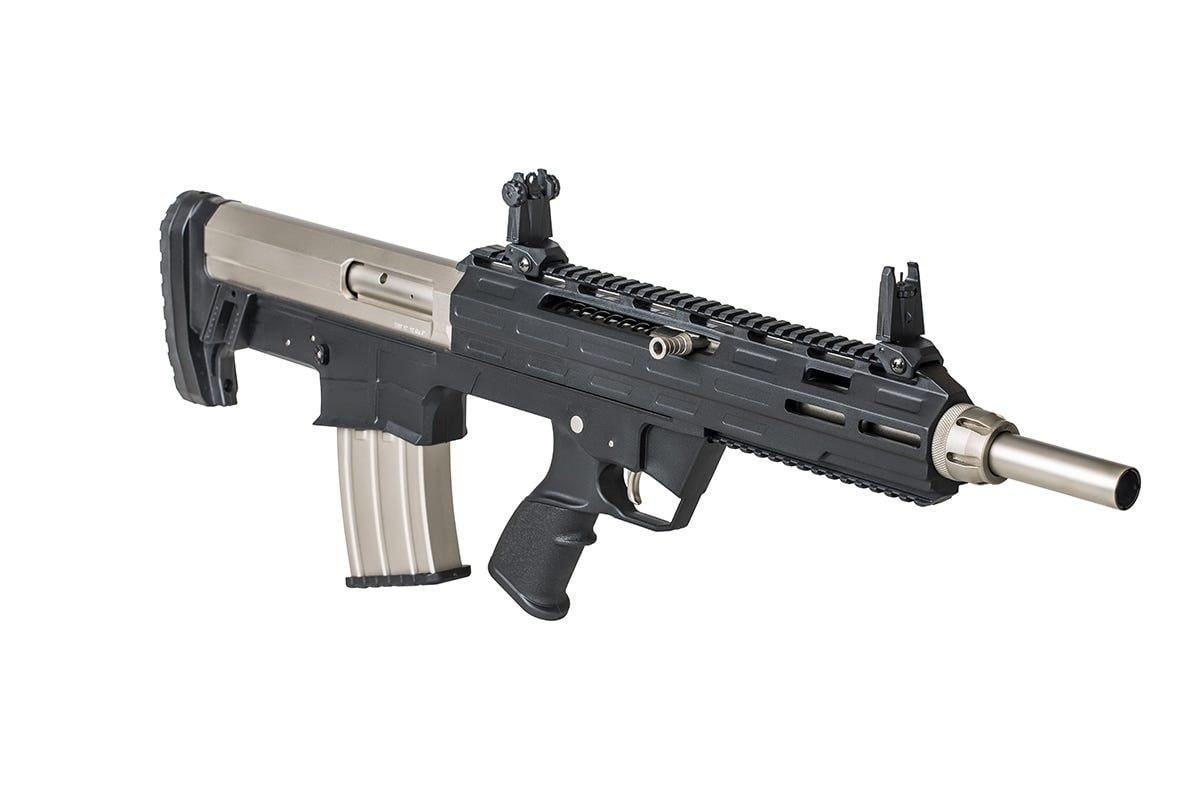
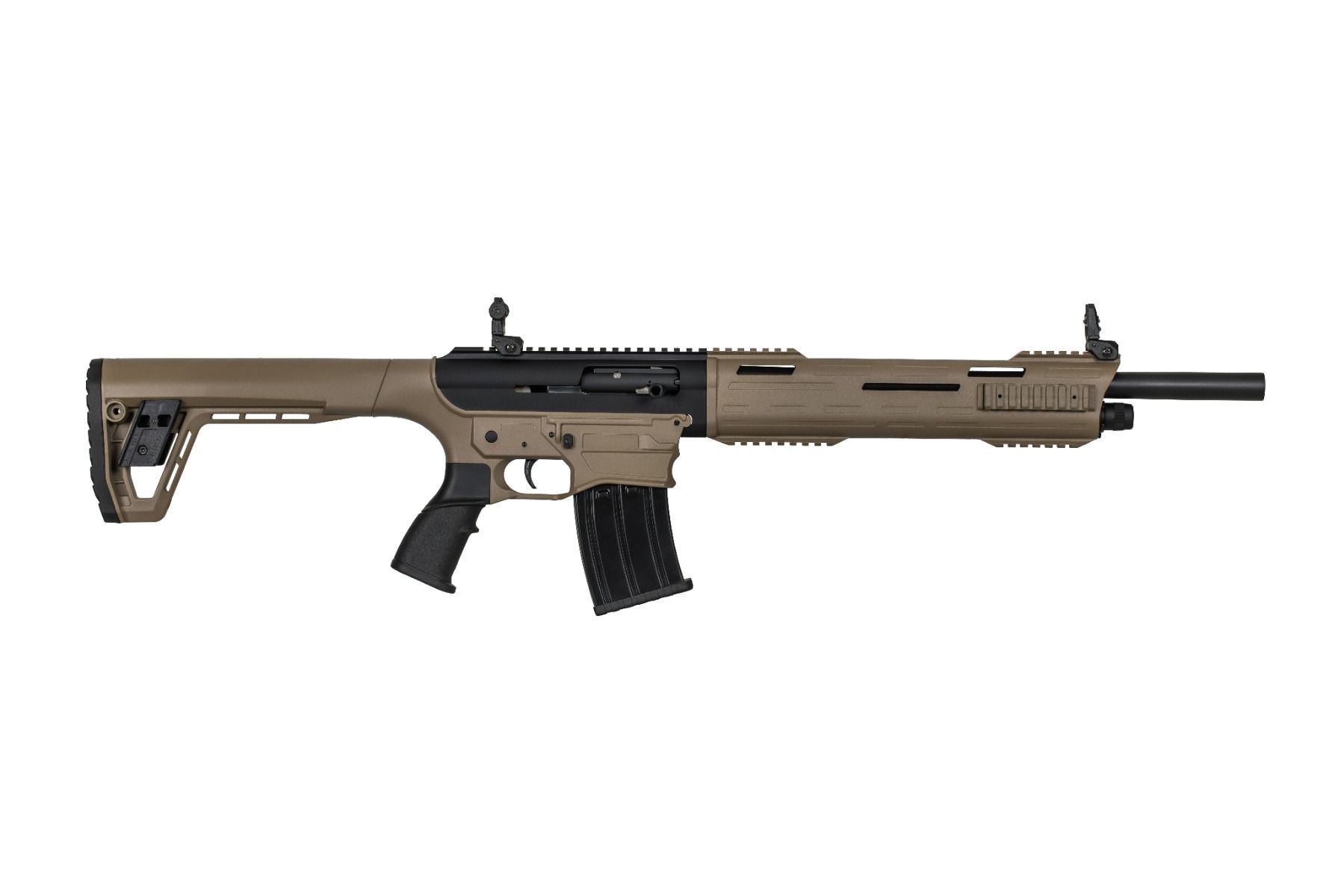
Bullpup or AR-style: the same barrel, nine inches apart
The TBP and the TAR take the same 18.5 inch barrel and the same magazines. What differs is where the action sits.
TBP (bullpup)
TAR (AR-style)
Barrel
18.5 in
18.5 in
Overall length
28.5 in
37.75 in
Action position
Behind the trigger, in the stock
In front of the trigger
Magazine well
Behind the pistol grip
In front of the trigger guard
Trigger
Linkage running forward to the grip
Direct
The bullpup buys roughly nine inches of length for the same barrel. All4shooters measured the TBP at 72 cm, which agrees with the 28.5 inch figure dealers list. The cost is the usual bullpup trade: the trigger works through a long linkage, and the magazine change happens back by your shoulder. The TAR keeps every control where an AR shooter expects it, and is as long as a conventional 18.5 inch pump gun as a result. The bullpup shotgun piece covers the layout across every maker; the TBP is one of the value-tier examples there.
There is also a pump bullpup, the Bullpump, which takes the TBP shape and replaces the gas system with a sliding forend. It is a single record in the catalog.
The conventional semi-autos
The TTF, T300, TTS 12 and TSA-12 are tube-fed gas semi-autos in a standard shotgun stock. Tokarev USA describes the T300 A1 as a dual-stage gas piston gun with an 18.5 inch barrel, 5+1 capacity, a heat shield and a Mossberg 500/590 compatible polymer stock, and Athlon Outdoors lists the TTF 12 T300A1 at 38 inches overall and 6.1 pounds. The TSA-12 is described by the maker as gas-regulated and piston-driven with a 4+1 capacity. A 28 inch TTF with Turkish walnut and a 3.5 inch chamber is the catalog's one Tokarev built as a bird gun.
What every model shares
Every Tokarev shotgun record that gives a barrel length, in its spec field or its title, is 18.5 inches except two 28 inch field guns, a TX3 and the TTF. Nearly the whole line is sized for home defense and the range.
The TX3, the TBP and the T300 all take Benelli/Mobil pattern choke tubes and ship with a set, so replacement and aftermarket tubes are easy to find.
The 20 gauge guns are three records, two TX3 pumps and the TAR 20B. Everything else is 12 gauge, nearly all with a 3 inch chamber.
Nick Sawinyh - Nick Sawinyh is a father, husband, hobby farmer, and gun enthusiast from Kentucky. He founded GunsNation and writes most of what appears on this blog.