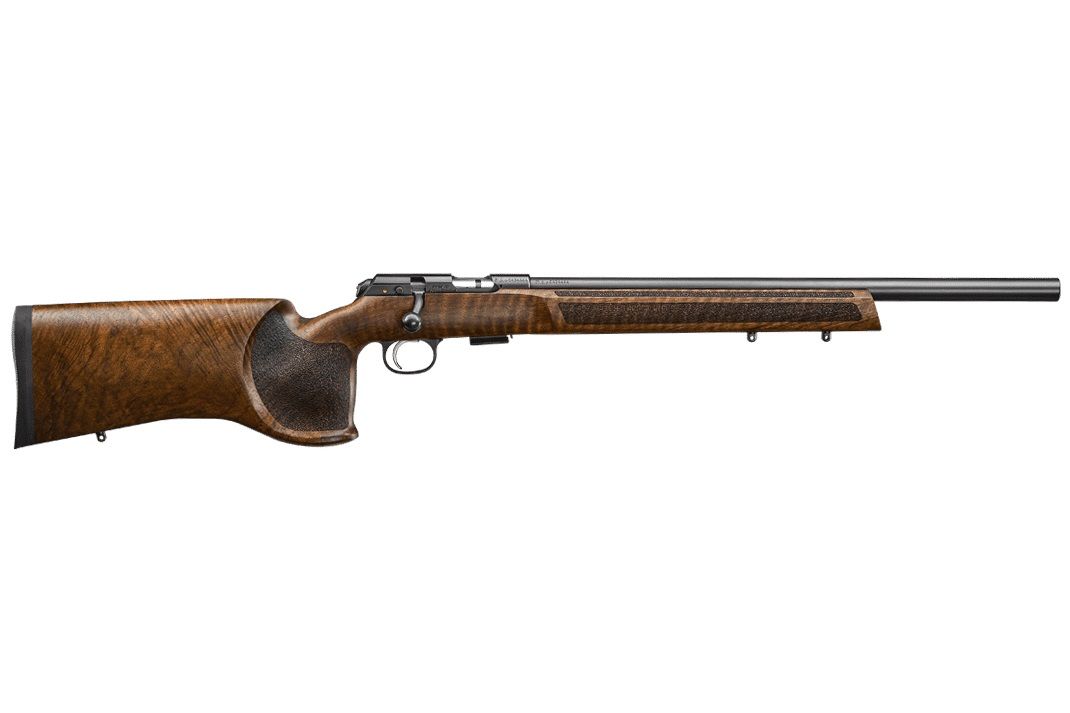
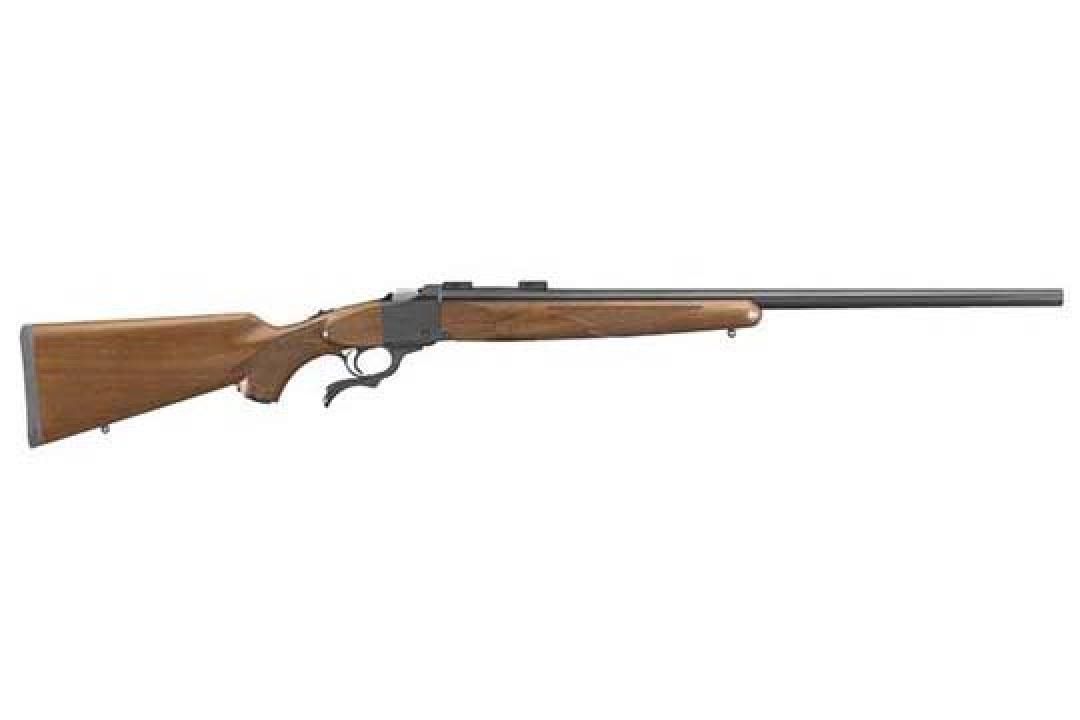
The word turns up in places that look like mistakes. Tikka sells a Super Varmint in .300 Winchester Magnum, CZ sells a 457 Varmint in .22 LR, and Remington put its Varmint SF label on a 700 in 6.5 Creedmoor. None of those is a classic varmint cartridge, and all three names are correct.
On a maker's label, varmint describes how the rifle is built. When a maker adds Varmint, Varminter or Varmintmaster to a model name, it almost always means a heavier barrel, a stock built to sit still on a rest, and a better trigger than the hunting version of the same rifle. The fast .22 centerfires grew up alongside that build, so people tend to treat the two as one thing.
What the label changes
Comparing each maker's varmint model with the rest of the same rifle family shows what the label buys. The figures are medians across this catalog's listings.
Rifle family
Varmint barrel
Varmint weight
Other barrel
Other weight
Remington 700 SPS
26in
8.5lb
25in
7.3lb
Tikka T3x
23.7in
8.4lb
Invalid Date
More Articles
22.4in
6.6lb
Ruger Hawkeye
26in
9.7lb
22in
7.9lb
Winchester XPR
24in
8.0lb
22in
6.8lb
CZ 457
20.5in
7.2lb
24in
6.2lb
Browning T-Bolt
22in
5.5lb
22in
4.9lb
The varmint versions run 0.6lb to 1.8lb heavier. Most also carry a longer barrel, though the CZ 457 Varmint has a shorter barrel than the other 457s and still weighs a pound more, because its barrel is thicker. The Browning T-Bolt gains weight without gaining length at all.
The stock changes with it. Varmint stocks usually get a wide, flat forend that sits on a bag or a bipod without rocking, a more vertical grip, and on several models a thumbhole or an adjustable comb so the shooter's eye lines up with a large scope. In this catalog, Winchester's XPR varmint models and Savage's Model 25 Lightweight Varmint come with thumbhole stocks.
Why the barrel is heavy
Varmint shooting is often volume shooting. A day on a prairie dog town or a gopher field can mean hundreds of rounds fired from the same position at small targets a long way off. @bdmolnar wrapped up a season of farm gopher control on X with "another 36 today" and "at least a few hundred on the year" from a .22-250.
A light hunting barrel is built for one or two shots from a cold start, and over a long string it heats, flexes more and can start to walk its shots. A thick barrel is stiffer and has more steel to soak up the heat, so it holds its point of impact longer. The extra weight also settles the rifle on a rest and keeps the scope on target through recoil, so you can see your own hits. You would not want to carry one up a mountain, but a varmint rifle is rarely carried far.
The same logic explains why some makers put the label on .308 and 6.5 Creedmoor rifles. Those buyers shoot steel or long-range targets from prone and want the same heavy, stable barrel. Some of them shoot prairie dogs too: @MAC_Arms posted about hitting them at 500 yards with a 6.5 Creedmoor.
The cartridges that grew up with it
The classic varmint cartridges are small-bore centerfires built to run a light bullet very fast, so the trajectory stays flat over the uncertain ranges of open country and the bullet comes apart on impact rather than ricocheting. Most came out of the same few decades, and several borrowed each other's cases.
Cartridge
Arrived
Origin
Load or speed
.220 Swift
1935
Winchester, for the Model 54
48-grain at about 4,100 fps
.22-250
1937 as the .22 Varminter, standardized 1965
Wildcatters' necked-down .250-3000 Savage; adopted by Remington
can exceed 4,000 fps
.222 Remington
1950
Mike Walker at Remington, for the Model 722
50-grain at 3,200 fps
.17 Remington
1971
.223 case necked to .17, for the Model 700
25-grain hollow point, over 4,000 fps
.204 Ruger
2004
Hornady and Ruger, on the .222 Remington Magnum case
32-grain at 4,225 fps
The .220 Swift was the first factory cartridge over 4,000 fps, and it earned a reputation for wearing out barrels to match. The .22-250 started as a wildcat: Jerry Gebby, Grosvenor Wotkyns and J.B. Smith called their version the .22 Varminter, Browning chambered rifles for it in 1963 while it was still a wildcat, and Remington made it a factory round two years later. The .222 Remington was the first commercial rimless .22 centerfire in the United States, designed from scratch, and it later fathered the .223 Remington. The .204 Ruger was the only commercial centerfire for .204in bullets when it arrived.
Remington's own X account put the modern shortlist as a poll, asking which its followers were "picking for prairie dogs" between the 22-250 Remington, 204 Ruger and 223 Remington. Savage's account named the same three when it described its Model 110 Varmint as available "in 223 Rem, 204 Ruger and 22-250 Rem with a heavy barrel and threaded muzzle."
What varmint rifles are chambered in
Across the 259 rifles in this catalog that carry a maker's varmint designation, the cartridge split looks like this.
Cartridge group
Rifles
Small centerfire, .17 to .224 (.22-250, .223, .204 Ruger, .22 Hornet, .17 Hornet, .220 Swift)
138
6.5mm and larger (.308 Winchester, 6.5 Creedmoor, 6.5 PRC, 7mm Rem Mag, .300 Win Mag)
48
Rimfire (.22 LR, .17 HMR, .22 WMR, .17 WSM)
44
.243, 6mm and .25 Creedmoor
25
Not stated
4
The .22-250 leads with 47 rifles and the .223 Remington follows with 41. More unexpected is the second row: about one varmint-labelled rifle in five is chambered for a deer or long-range cartridge, 22 of them in .308 Winchester and 15 in 6.5 Creedmoor. On those rifles the label describes the barrel and stock, so check the cartridge separately.
The .243 and 6mm row sits between the two. The .243 Winchester was designed to do both jobs, varmints and deer.
Rimfire varmint rifles
Rimfire varmint rifles apply the same idea at a smaller scale: a .22 LR or .17 HMR bolt action with a heavy barrel for small pests at shorter range, where a centerfire would be too loud or too much. CZ's 457 Varmint, Browning's T-Bolt Varmint and Target/Varmint, Savage's Mark II FV and BRJ and Marlin's XT-17 and XT-22 varmint models all follow it, along with the Crickett and Keystone 722 Varmint for younger shooters.
Among the rimfires, two break the pattern. Savage's A17 and A22 Pro Varmint models are semi-automatics, and the Henry Varmint Express is a lever action in .17 HMR, the rare varmint rifle that does not use a bolt.
Semi-automatics and single shots
Bolt actions are 205 of the 259. The semi-automatics number 37, and most are AR-pattern rifles: APF's Varmint line on both the AR-15 (.223 Wylde, .22 ARC, 6mm ARC) and the AR-10 (.22-250, .243, 6mm Creedmoor), Rock River's LAR-15 Varmint and LWRC's IC Precision Varmint. A semi-auto gives faster follow-up shots on a coyote or a busy prairie dog town, with a heavier rifle and more parts than a bolt gun.
At the other end, Ruger's No.1 Varminter and Winchester's 1885 varmint rifle are falling-block single shots with long, heavy barrels, and H&R's Varmint is a break-action single shot.
What the catalog had wrong
The varmint tag held 59 rifles while the catalog held about four times as many under a maker's varmint name. The missing ones have been added, two rifles without the designation were taken out, and several dozen listings were corrected.
The most widespread error came from the cartridge's name. The Ruger brand had been attached to 13 .204 Ruger varmint rifles made by Savage, CZ, CVA, Sako and Alex Pro, because the cartridge carries Ruger's name; they now sit under their real makers. A CZ 457 Varmint bolt action had been filed as a semi-automatic, a Remington 597 had been described as a bolt action in every field when the 597 is a semi-auto, and Savage's A17 WSM had been called a bolt-action rifle while its own description explained its delayed-blowback action. The falling-block single shots had been filed as single action or break action.
A naming pass had also invented model names and generations: "Varmint Master" and "Precision Varmint Hunter" tails on rifles that are not varmint models at all, "Gen 2" and "3rd Gen" on Savage and Winchester rifles that were never sold by generation, a "Varmint Pro" Henry that is the Varmint Express, and a Savage "VarmintMaster" that its own specification lists as a Model 25 Walking Varminter. Those names are corrected, and the rifles that only looked like varmint models because of the invented tail were left out of the tag.
Choosing one
If you shoot
Look at
Because
Ground squirrels and pests inside 150 yards
.22 LR or .17 HMR varmint bolt action
Quiet, cheap to feed, heavy barrel holds its zero
Prairie dogs in volume
.223 or .204 Ruger heavy-barrel bolt action
Mild recoil lets you spot your own hits
Long shots across open fields
.22-250, .220 Swift or .204 Ruger
All three run light bullets at 4,000 fps or more
Coyotes and varmints in one rifle
.223 semi-auto or .243 bolt action
Faster follow-ups, or more bullet for the bigger animal
Steel and paper at distance
A varmint-pattern .308 or 6.5 Creedmoor
The same heavy barrel and flat forend, with a target cartridge
The tag page lists every rifle above with live prices.
Nick Sawinyh - Nick Sawinyh is a father, husband, hobby farmer, and gun enthusiast from Kentucky. He founded GunsNation and writes most of what appears on this blog.