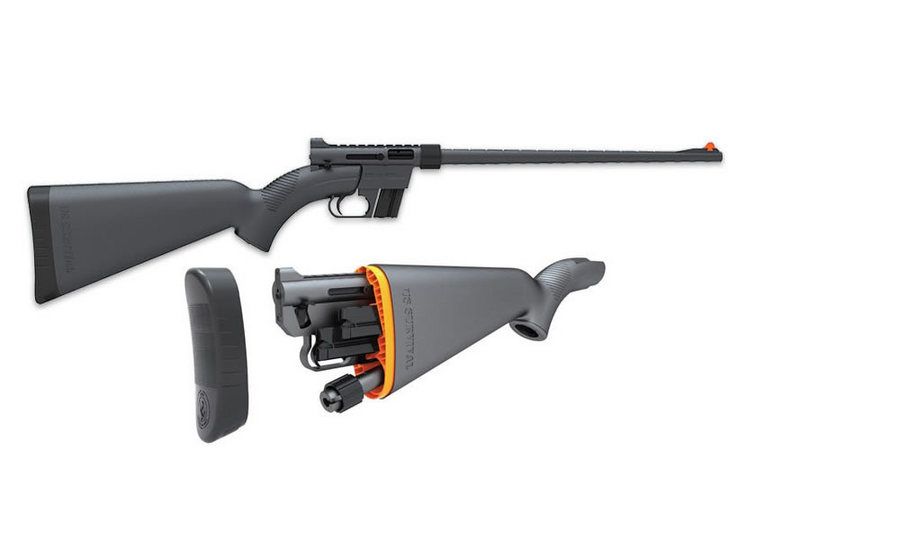
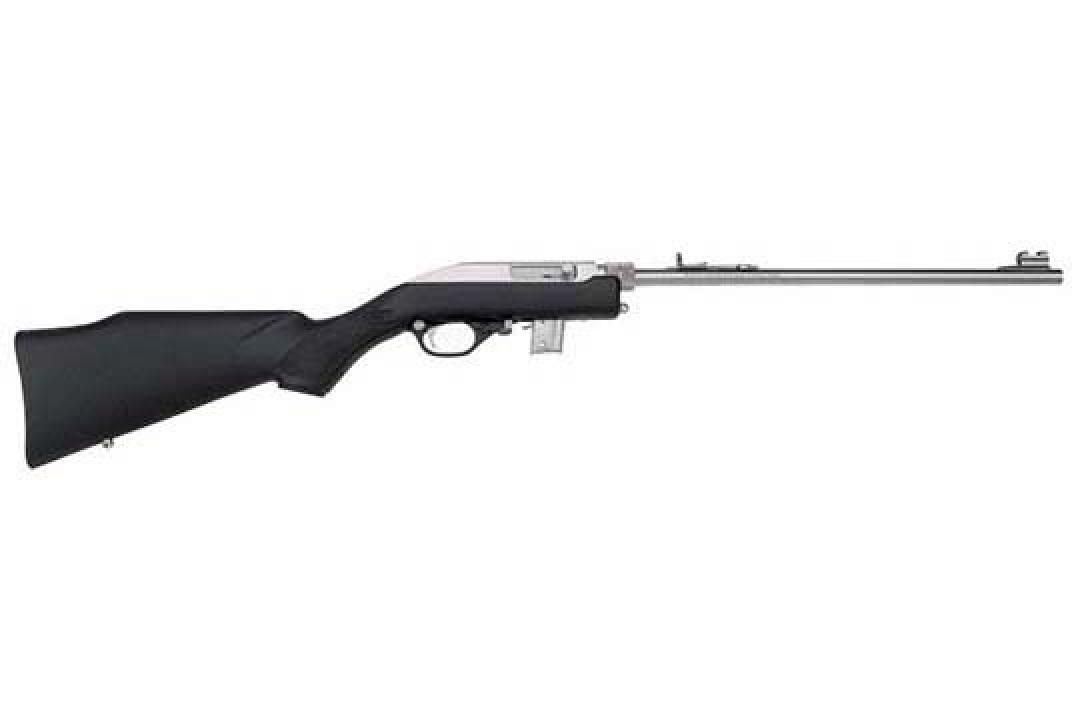
The Henry U.S. Survival AR-7 is a .22 LR semi-automatic that fits inside its own stock. Assembled it is 35 inches long and weighs 3.5 lb; taken apart, the barrel, the action and the magazines slide into the hollow ABS buttstock, the butt cap goes back on, and the whole package is 16.5 inches long. Henry's own specification sheet gives those figures for the black H002B and the two camo versions, all with a 16.125-inch barrel and two eight-round magazines.
That is the gun most people mean when they search for a survival rifle. It is also a small part of what the word "takedown" covers. The takedown rifle listings on this site hold 250 records, and only four of them are AR-7s. The other 246 fall into six other groups by how they come apart, and a buyer who wants an AR-7 will be disappointed by most of them.
Where the AR-7 came from
In 1956 the U.S. Air Force adopted ArmaLite's AR-5, a bolt-action survival rifle in .22 Hornet, as the MA-1. American Rifleman puts the number actually bought at about a dozen. ArmaLite, where Eugene Stoner was chief designer, turned the idea into a civilian .22 LR semi-auto called the AR-7 Explorer. Production began late in 1959 and the first rifles shipped in the summer of 1960.
Invalid Date
More Articles
The Henry AR-7 and Every Other Way a Rifle Comes Apart | GunsNation
The design then changed hands several times. ArmaLite built it until 1973, Charter Arms from 1973 to 1990, then Survival Arms and AR-7 Industries in turn. Henry Repeating Arms took it up in the late 1990s and has built it ever since, first in Brooklyn and now in New Jersey. Henry's changes, per American Rifleman, include a steel barrel inside a plastic shroud, a Teflon-finished receiver, a stock that holds three magazines instead of two, and an optics rail from 2007.
The original ArmaLite stock was foam-filled, so the rifle floated. Henry's stock is hollow, and when American Rifleman tested an assembled Henry in water, it took on water and sank after about six minutes. Stowed with the butt cap on, which is how it is meant to be carried, the package floats.
What owners actually say about it
When the collector account @AutoMagArchive asked on X in March whether a Charter Arms AR-7 was "really that bad", most of the answers turned on who had made the gun. An owner who had a Charter gun in the 1980s said the aluminum "cross threaded without any effort"; another said it "could not be sighted in". The most useful reply came from @Trashbike2, who owns one and called Henry magazines the "biggest upgrade", saying they "drastically improve reliability". Several people simply answered "get the Henry".
Magazines came up more than anything else in that thread, along with feeding that depends on the ammunition. Accuracy got blunter treatment: @Trashbike2 called it acceptable "for minute of grouse or squirrel", and another owner complained about the sights and a trigger with sharp edges. Nobody in the thread expected more than small game at short range.
A pair of replies simply named the Marlin Papoose and a Ruger 10/22 Takedown as better takedown .22s, which is a fair summary of the catalog below.
What "takedown" covers
A takedown rifle separates into two or more pieces without tools and goes back together without losing much of its zero. Beyond that, the makers agree on very little. Here are the 250 takedown listings grouped by how they come apart:
How it comes apart
Examples
Listings
Barrel and forend twist off the receiver
Ruger 10/22 Takedown, Ruger PC Carbine, Tactical Solutions X-Ring
81
Break-open, barrel lifts off the hinge
CVA Scout, Savage 42, Traditions Outfitter G3
54
Lever action, barrel unscrews from the receiver
Winchester 1892 and 1886, Chiappa 1892, Taylor's Alaskan, Browning BLR
45
Other semi-autos with their own systems
Browning SA-22, Savage 64 and A22, Marlin 70PSS, JRC, TNW Aero Survival
37
Folds in half at the hinge
Chiappa Little Badger, Chiappa and TPS Arms M6
20
Bolt action with a removable barrel
Tactical Solutions Owyhee, CVA Cascade
9
Stows inside its own stock
Henry AR-7
4
Only the AR-7 packs into a closed container. Everything else leaves you with two shorter pieces and a need for a case.
The twist-lock semi-autos
Ruger's 10/22 Takedown is the largest single family here. A spring-loaded lever releases the barrel and forend, which turn a partial turn and pull forward off the receiver. A threaded ring on the barrel sets how tightly the two halves lock, so the fit can be adjusted as parts wear. Ruger's first takedown 10/22 was featured by American Rifleman in March 2012, and the same system went into the Ruger PC Carbine in 9mm and .40 S&W, which is why those carbines sit in this group too. Our Ruger PC Carbine guide covers the pistol-caliber side.
Tactical Solutions builds its X-Ring rifles to the same interface, so their barrels and receivers swap with Ruger's. Magpul's X-22 Backpacker stock is the part that brings a 10/22 Takedown closest to the AR-7: it holds three ten-round magazines in the buttstock. On X, @pnwguerrilla said a 10/22 in that stock "reminds me heavily of the AR-7".
Folding guns and the M6 line
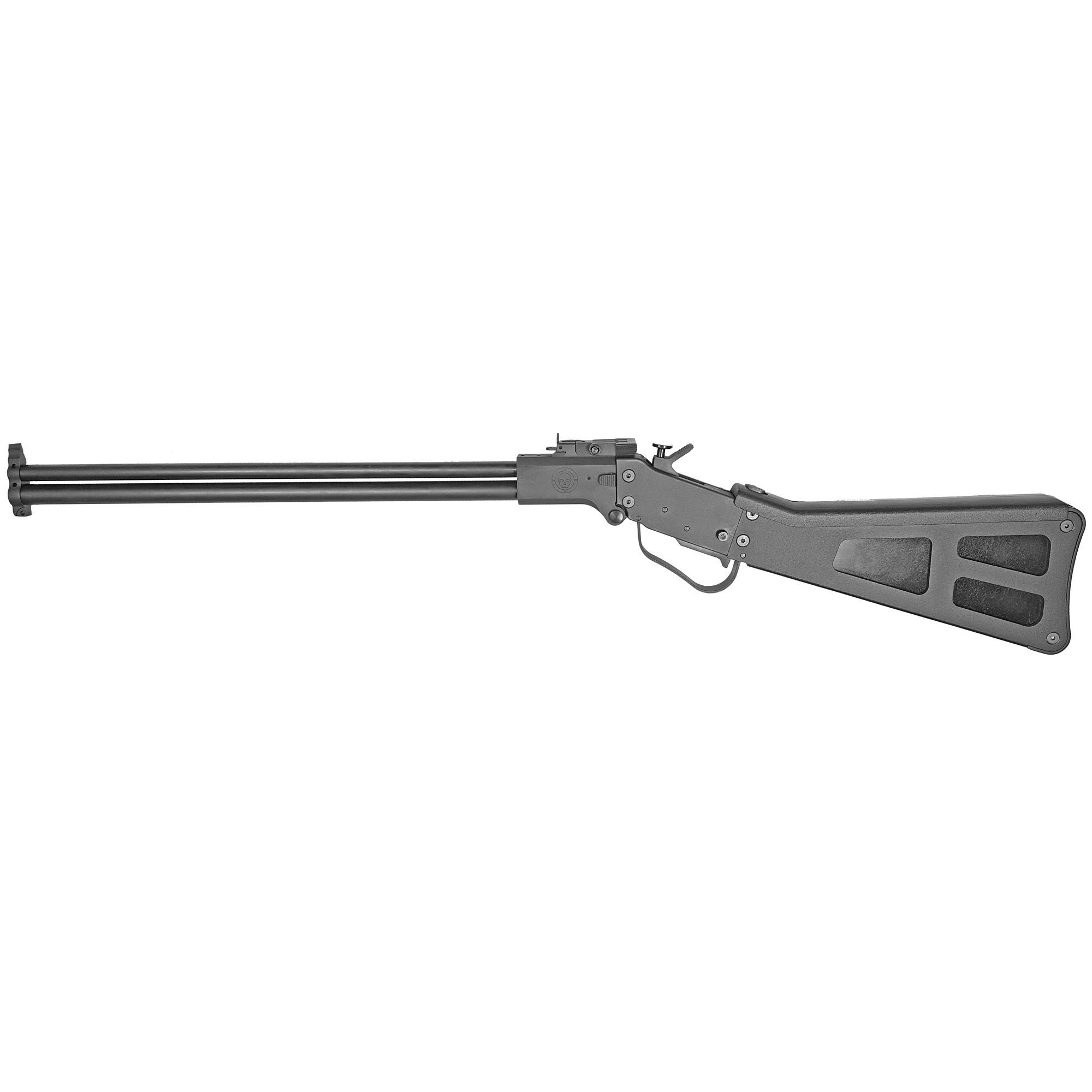
The folding guns carry the oldest survival-rifle lineage. The U.S. Air Force issued the M6 aircrew survival weapon from the 1950s: an over/under with a .22 Hornet rifle barrel on top and a .410 shotgun barrel below, 14-inch barrels, and an oversized trigger meant to be worked with a gloved hand. Civilian versions had to move to 18.25-inch barrels to stay clear of the National Firearms Act, and the TPS Arms M6 listings here use exactly that length.
Chiappa's M6 shares the name and not much else. The X-Caliber version is a 12-gauge over a .22 LR with 18.5-inch barrels, it folds at the trigger guard to 18.5 inches, and it comes with adapter sleeves that let the shotgun barrel fire several handgun cartridges. Its catalog record had described it as a single-shot .22 LR rifle with a one-round capacity, and that has been corrected.
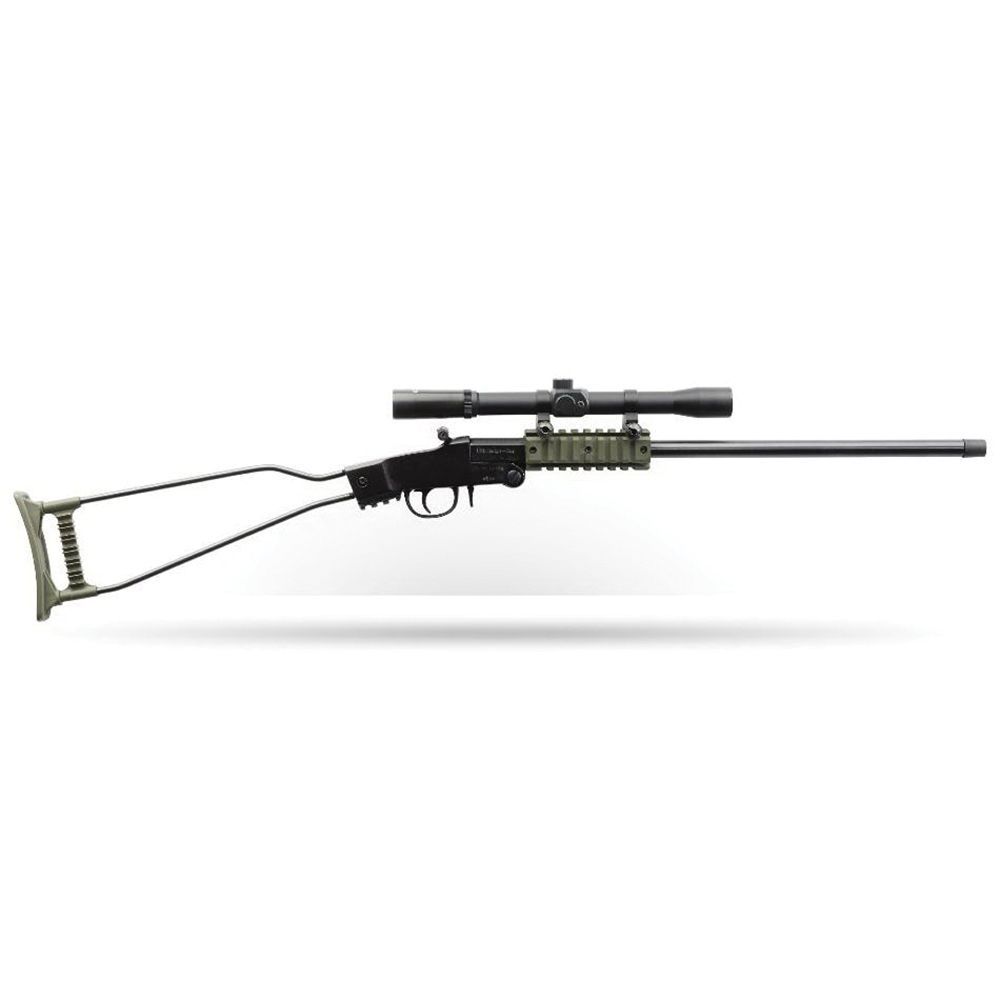
The Chiappa Little Badger is the lightest gun in the category, a single-shot break-open with a bent-wire stock, 16.5-inch barrel, 31 inches long, and 2.9 lb, and it folds in half at the hinge. The .17 HMR version had been listed at 1.32 lb, less than half its real weight.
Savage's Model 42 Takedown is the same over/under idea with a full synthetic stock: a .22 LR or .22 WMR barrel over a .410, 20-inch barrels, 6.1 lb, and one button to separate the barrels from the action. It ships with a carry bag.
Lever actions and the old Winchester system
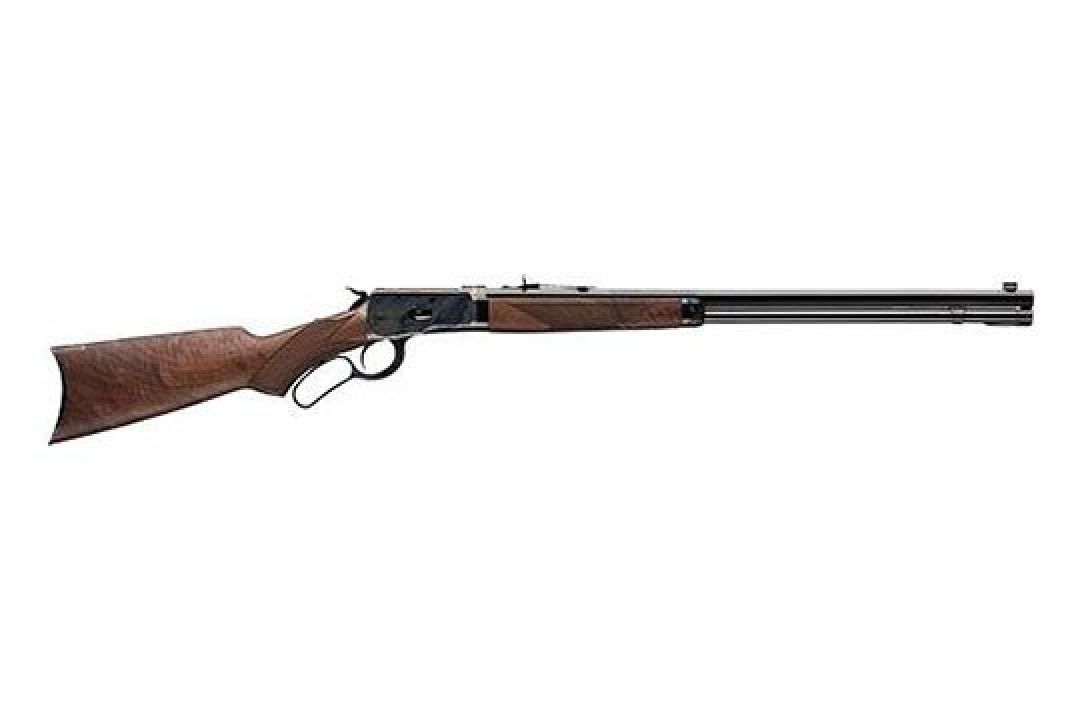
Winchester was selling takedown versions of its lever rifles in the 1890s. The barrel and magazine tube unscrew from the receiver as a unit and the rifle breaks into two halves of roughly equal length. The modern Winchester 1892 and 1886 Deluxe Takedowns, and the Chiappa and Taylor's 1892 Alaskan and Wildlands rifles, carry that layout forward. The Browning BLR Takedown uses a lever in the forend instead of a thread. These are the heaviest guns on the list: hunting rifles that pack shorter for travel.
A CVA Scout Takedown is a single-shot hunting rifle in chamberings from .223 to .45-70 whose barrel comes off the frame, so a hunter can carry several barrels for one action.
The Papoose and the other semi-autos
Marlin's 70PSS, sold as the Papoose, is the rifle the AR-7 thread kept recommending. It is stainless, 16.3-inch barrel, 3.3 lb, with a seven-round magazine, and its barrel comes off the receiver so both halves pack into a carry case. Its listing did not mention the takedown at all, or the Papoose name; it now does.
The Browning SA-22 is the oldest design here. It is John Browning's .22 semi-auto, loaded through a port in the buttstock, and it splits into two halves just ahead of the receiver. Savage's 64 and A22 Takedowns and the Volquartsen VT2 are newer semi-autos with their own takedown systems, and the TNW Aero Survival rifles apply the same idea to pistol-caliber carbines.
The survival rifles side by side
The guns built as survival rifles first are gathered on the survival rifle page. These are the five that get compared most.
Rifle
Action
Chamberings
Barrel
Weight
Henry U.S. Survival AR-7
Semi-auto, stows in stock
.22 LR
16.125 in
3.5 lb
Chiappa Little Badger
Single-shot break-open, folds
.22 LR, .22 WMR, .17 HMR
16.5 in
2.9 lb
Marlin 70PSS Papoose
Semi-auto, two-piece
.22 LR
16.3 in
3.3 lb
Savage 42 Takedown
Over/under break-open
.22 LR or .22 WMR over .410
20 in
6.1 lb
Chiappa M6 X-Caliber
Over/under break-open, folds
12 ga over .22 LR
18.5 in
about 6 lb
The AR-7 is the only one fully enclosed when packed. The Little Badger is lighter but holds one round. The over/unders are heavier and carry a shotgun barrel, which is the M6's original argument: a .410 or 12-gauge shell is more use than a .22 against a bird on the wing.
What was corrected before this was written
The takedown page held 113 records, and 137 more takedown rifles in the catalog were not attached to it, including every CVA Scout TD, every Savage 42 and every Winchester 1892 Deluxe Takedown. They are attached now, and the survival rifle page was created for the kit guns above.
The AR-7 records had errors of their own. A listing gave the assembled rifle's weight as 6.5 lb, nearly double the real 3.5 lb. Another called the camo rifle a "Gen 2", which is not a Henry designation, and quoted it at 2.5 lb with a 16.5-inch barrel. Elsewhere in the set, a Ruger 10/22 Takedown and a TNW Aero Survival carried an invented "Gen 1", a Winchester 1892 was listed at 14 ounces, and several CVA Scout break-opens were filed as single-action or bolt-action rifles.
Nick Sawinyh - Nick Sawinyh is a father, husband, hobby farmer, and gun enthusiast from Kentucky. He founded GunsNation and writes most of what appears on this blog.