Plenty of people meet the Chiappa Rhino on a screen before they see one in a gun case. Escape from Tarkov added it in a spring 2022 patch, in 9x19 and .357, and a Fallout 4 mod had it years earlier. On X, the threads that get real engagement are nearly all the same argument: the Rhino against the Mateba, the Italian autorevolver it descends from. As a @NRA_Rifleman post put it, the Rhino is the only current revolver with its barrel at the bottom of the frame, firing from the chamber at six o'clock.
Most of what is odd about the gun follows from that barrel position, including the hammer that is really a lever. Below is how it works, how to read the model code printed on every listing, and which variant is which. The Rhino Revolvers tag carries the live listings.
Why the bottom chamber
A conventional revolver fires from the top chamber, so the barrel sits well above the web of the hand. When the gun recoils, the force acts along the bore line, above the grip, and the gun rotates muzzle-up around the wrist. The higher the bore, the longer that lever.
The Rhino drops the barrel to the bottom of the cylinder, level with the top of the shooting hand. Recoil comes back into the palm and forearm rather than twisting the muzzle upward. It still kicks. The push is straighter, though, and the sights settle back on target sooner. Owners on X mostly agree: one shooter wrote that a friend's .357 Rhino had "0 recoil", which overstates it, while an owner of the .44 Magnum model described a violent recoil impulse with the sights still "right where I left them".
Invalid Date
More Articles
Seen end on, the cylinder is a flat-sided hexagon rather than a round drum, which keeps the gun thin for carry. The spur at the back looks like a hammer and is actually a cocking lever linked to an internal hammer: pull it back and it cocks the hammer, then drops back into place, so the gun looks the same cocked or uncocked. Most Rhino frames are CNC-machined from a solid block of high-strength aluminum alloy (Ergal, a 7075 grade), with a steel barrel and cylinder. The exceptions come up below.
The design is credited to Emilio Ghisoni and Antonio Cudazzo. Ghisoni had already built the Mateba autorevolvers, which also fire from the lowest chamber, and the Rhino was his last design: he died before it reached production, which began two years later.
Reading the model code
Every Rhino carries a code like 40DS or 60SAR. The number is the barrel length and the letters are the action.
Code
Barrel
Notes
200D, 200DS
2in
The carry size. The 200 is a 2-inch gun, not a 20-inch one
30DS, 30SAR
3in
Compact
40DS, 40SAR
4in
The all-round length
50DS, 50SAR
5in
Range and field
60DS, 60SAR
6in
The most common size in the catalog
120DS
12in
A long-barrel version
DS means double/single action: pull the trigger for a double-action shot, or thumb the cocking lever first for a light single-action break. D means double action only. There is no cocking lever at all, so nothing on the back of the frame can snag on a draw, and every shot is the long pull. SAR is the single-action version, which has to be cocked for every shot. Dealers sell it as the California-compliant Rhino, and several Rhinos sold with a CF part number are SAR guns.
Of the 143 Rhino records on the site, 82 are double/single action, 48 are single action only and 13 are double action only. Nearly all of the single-action guns are SARs: 46 records carry a SAR code.
What each size weighs
The aluminum frame keeps the Rhino lighter than a steel .357 of the same barrel length. These are the weights the catalog records carry, in ounces, grouped by model code:
Model
Barrel
Catalog weight
200D, 200DS
2in
24 to 25.6 oz
30DS, 30SAR
3in
27.2 to 28.8 oz
40DS, 40SAR
4in
29.9 to 30.4 oz
50DS, 50SAR
5in
31.5 to 32 oz
60DS, 60SAR
6in
31.5 to 33.6 oz
30DS X
3in
44.8 oz
60DS Match Master
6in
46.4 to 46.56 oz
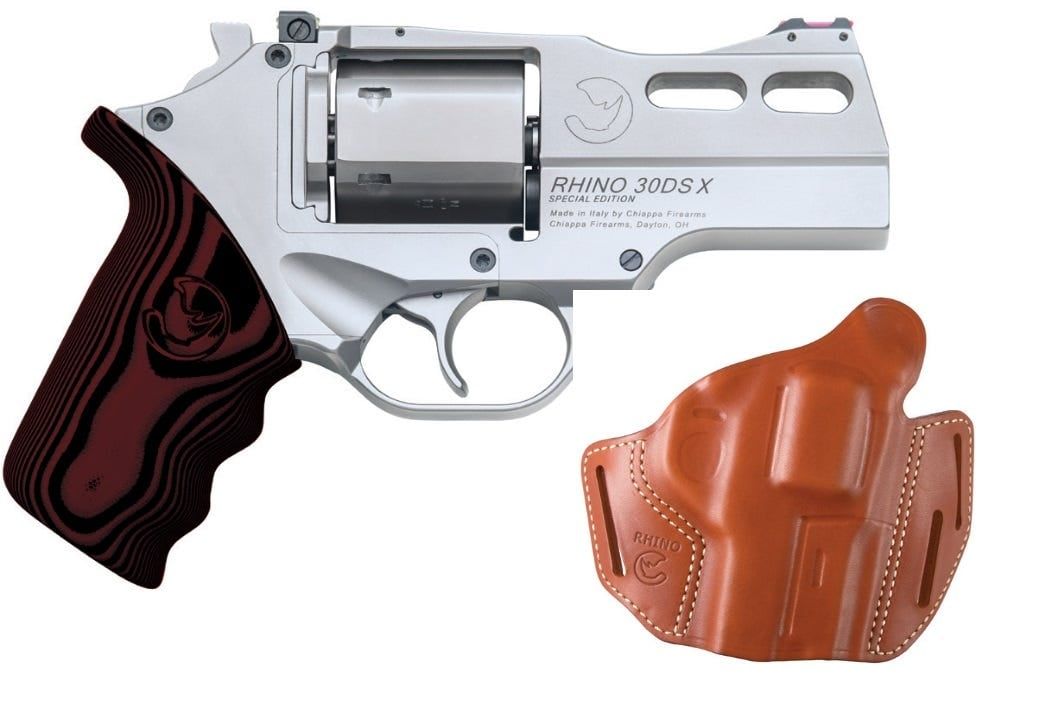
The last two rows are correct. The 30DS X has a stainless steel frame instead of aluminum, so a 3-inch gun weighs about as much as a steel 6-inch revolver, and the Match Master .38 Special target model is listed at 2.91 lb. The .44 Magnum 60DS on the larger L frame is listed by Chiappa at 2.92 lb.
Calibers
The Rhino started as a .357 Magnum and most of them still are. Every .357 Rhino also fires .38 Special.
Chambering
Records
.357 Magnum
97
.40 S&W
18
9mm
15
10mm Auto
8
.38 Special
2
.44 Magnum
2
The 9mm, .40 S&W and 10mm guns fire rimless pistol cartridges, so the rounds ride in moon clips that hold all six together for loading and extraction; the 10mm guns ship with three of them. The .44 Magnum is a different gun: the 60DS on an enlarged L frame, with a 7075-T6 aluminum frame, Hogue rubber grips and an 11-inch overall length. A single record in the tag does not state its chambering.
The named variants
Most Rhino listings also carry a finish or edition name. All of these are Chiappa's own:
Nebula is a rainbow PVD finish, sold on the 30DS, 60DS and SAR guns.
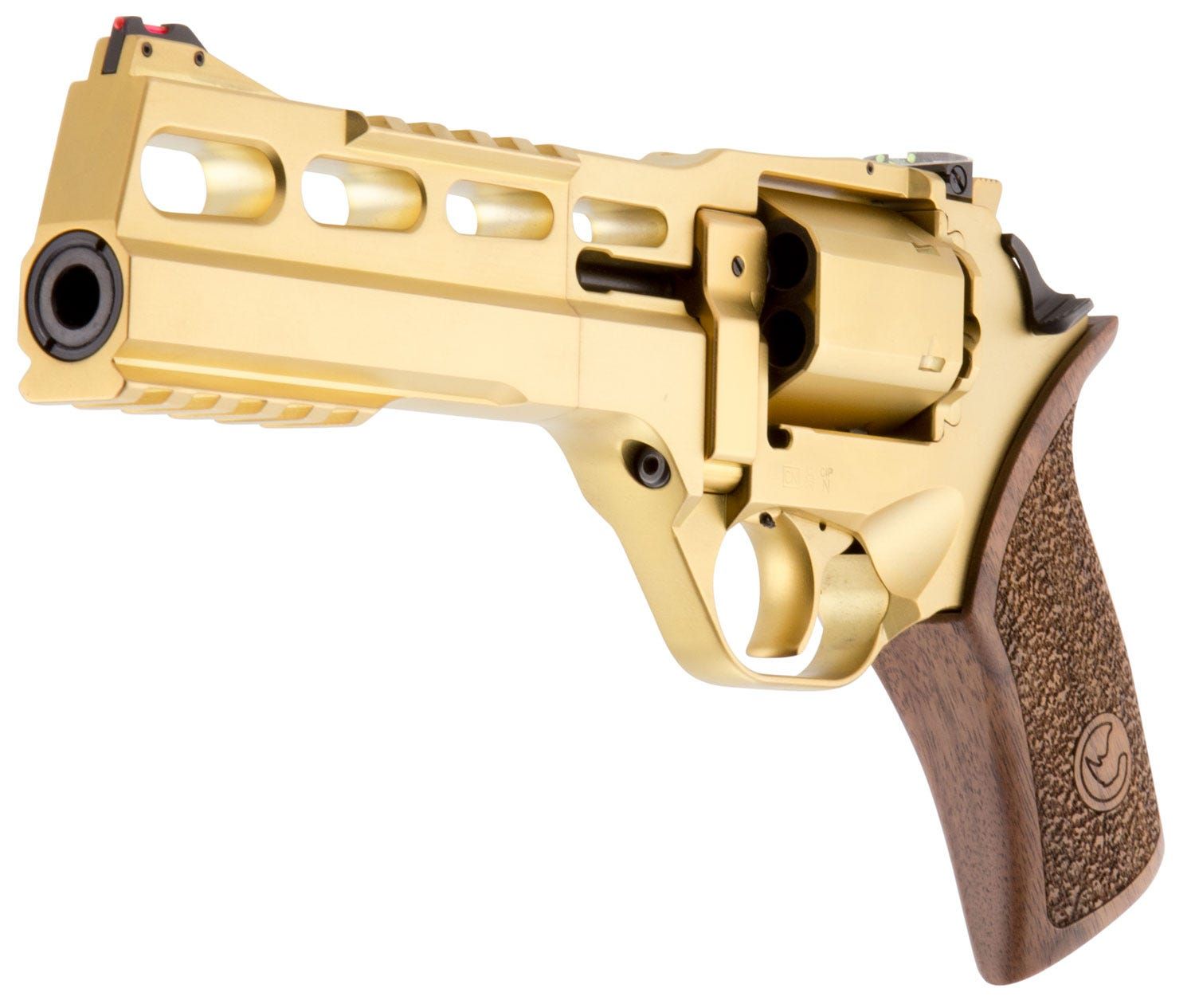
Gold is a gold PVD finish, on the 60DS and 60SAR.
White Rhino is the name used on hard chrome and nickel guns.
Stormhunter is a limited 60DS with an optics mount and a light rail.
Hunter is a 6-inch or 3-inch edition, usually in OD green.
30DS X is the stainless steel frame, noted above.
Match Master is the 6-inch .38 Special target gun in grey PVD.
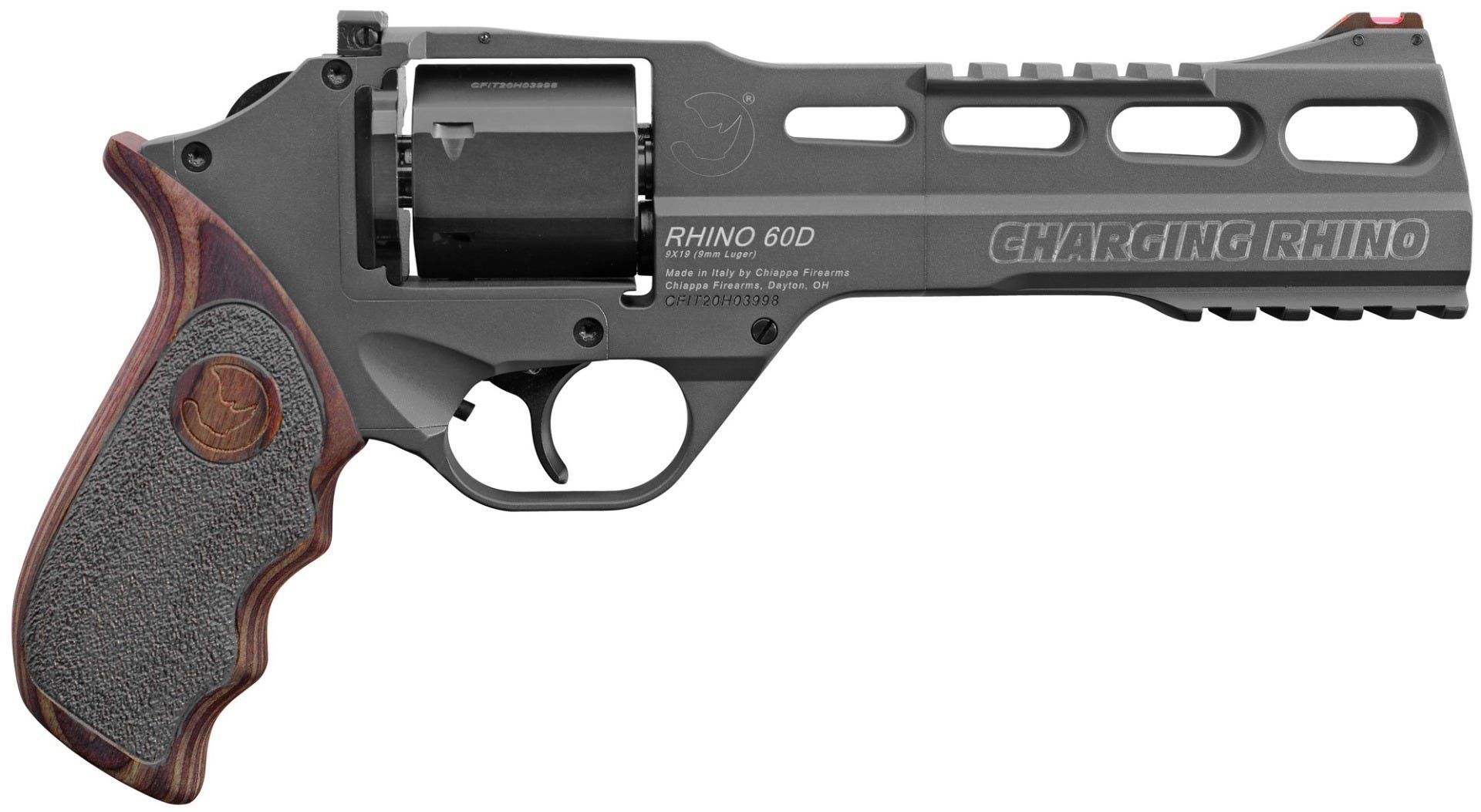
Charging Rhino Gen II is the competition 9mm. Chiappa sells it in black as a double-action-only 60D and in grey as a single-action-only gun, both with a 6-inch barrel.
The name also turns up on two guns that are not Rhino revolvers. The Chiappa CBR-9 Black Rhino is a 9mm carbine and pistol, and the Rizzini Rhino Express is an Italian side-by-side double rifle. Both have been taken out of the Rhino tag.
Why some Rhinos were listed as Hi-Point
A Rhino barcode starts with one of three prefixes. Most carry Chiappa's own, 8053670 or 8053800 (sometimes printed without the leading 8). A small group start with 752334. That prefix belongs to MKS Supply of Dayton, Ohio, which marketed the Rhino in the United States and is also the marketer for Hi-Point Firearms. Chiappa's own US operation is in Dayton too, and many Rhinos are engraved "Chiappa Firearms, Dayton, OH" on the frame.
That shared prefix is what misled the catalog's brand matching. Of the 12 Rhino records with a 752334 barcode, 9 carried the Hi-Point brand and 8 of those were titled as Hi-Point pistols, one of them a "semi-auto". Every one was a Chiappa Rhino, which the part numbers (340.071 to 340.079) and the photographs both confirmed. Hi-Point has never made a revolver. The records have been corrected and moved to Chiappa.
Choosing one
For carry, the 200DS gives you the double/single trigger and the 200D removes the cocking lever entirely. The 40DS is the length most owners describe as the best all-rounder. The 60DS is the range gun and the most listed. If you are in California, the SAR guns are the ones you will find. If the appeal is recoil control with heavy loads, look at the 30DS X and the L-frame .44 Magnum, which are heavier guns for exactly that reason.
Nick Sawinyh - Nick Sawinyh is a father, husband, hobby farmer, and gun enthusiast from Kentucky. He founded GunsNation and writes most of what appears on this blog.