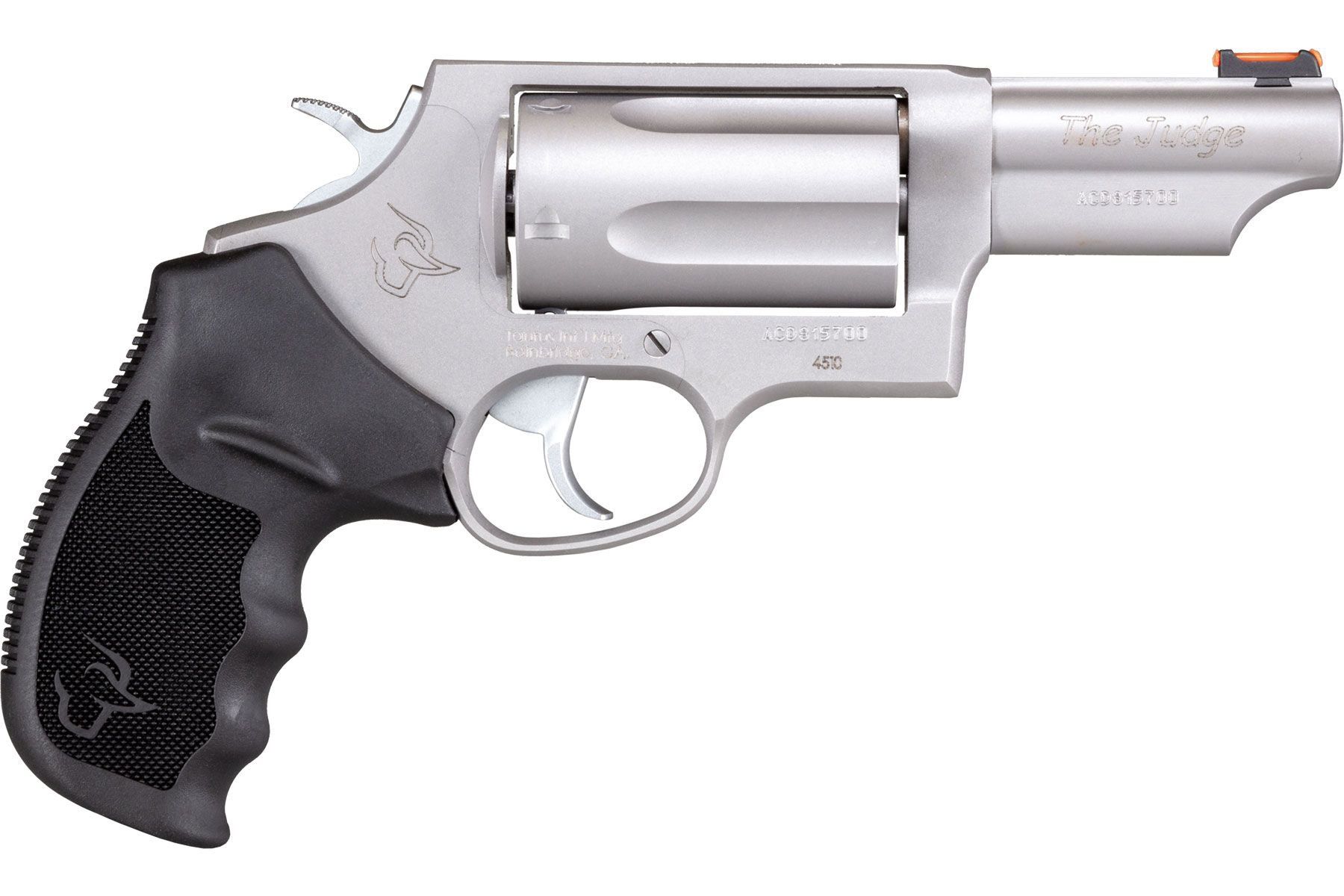
The Taurus Judge is the gun most people mean when they say ".410 revolver": a double-action revolver whose five chambers take either a .45 Colt cartridge or a .410 shotshell. It has sold well since 2006 and has been a punchline for just as long: jokes about it from the X account @DocStrangelove2 have passed four thousand likes three times, while Taurus's own "410 Day" post asked followers to choose between four Judge variants. Both come down to it being a handgun that fires shotgun shells, which dictates the cylinder length, the rifled barrel and the pattern it throws.
Below is how .410 revolvers work, which models exist, and what separates them in the .410 revolvers and Taurus Judge listings.
How a revolver fires a shotshell
A .410 shell is far longer than a .45 Colt cartridge, so a .410 revolver starts with a long cylinder. The bore of the shell and the .45 Colt bullet are close enough in diameter that one chamber can hold either: the .45 Colt's rim seats at the back, and a .410 shell fills the chamber to the front. A standard .45 Colt revolver has a cylinder cut short for the cartridge, and a shell will not fit in it.
Every production .410 revolver has a rifled barrel, because the rifling is what keeps it a handgun rather than a short-barreled shotgun, and because the same barrel has to stabilise a .45 Colt bullet. Rifling spins the shot column as it leaves, and centrifugal force throws the pellets outward, so a .410 load from a revolver spreads faster than the same load from a smoothbore shotgun. This limits the shot load's useful range, and it is why the defensive .410 loads made for these guns use a few large pellets or discs rather than fine birdshot.
Invalid Date
More Articles
Chamber length also varies. A standard Judge accepts 2.5-inch shells; the Judge Magnum and Home Defender accept 3-inch shells as well. A 3-inch shell will not fit a cylinder cut for 2.5-inch shells, so the chamber length marked on the gun decides which ammunition it takes, and it is the first thing to check on a used one.
The Taurus Judge family
The name dates from 2006, when Taurus heard that judges in Miami were buying the gun to keep in the courtroom, and by 2009 it was the company's best-selling firearm. The model number spells out the chambering: 4510 for .45 Colt and .410. Everything since has been a variation on the same five-shot double-action revolver with an exposed hammer.
Variant
Barrel
Chamber
What changes
Public Defender
2 in
2.5 in
Compact frame, bobbed hammer spur, the carry version
Judge
3 in or 6.5 in (earlier 2.5 and 4 in)
2.5 in
The original
Judge Magnum
3 in or 6.5 in
3 in
Longer cylinder for 3-inch shells
Judge T.O.R.O.
3 in
2.5 or 3 in
Cut for a red dot sight
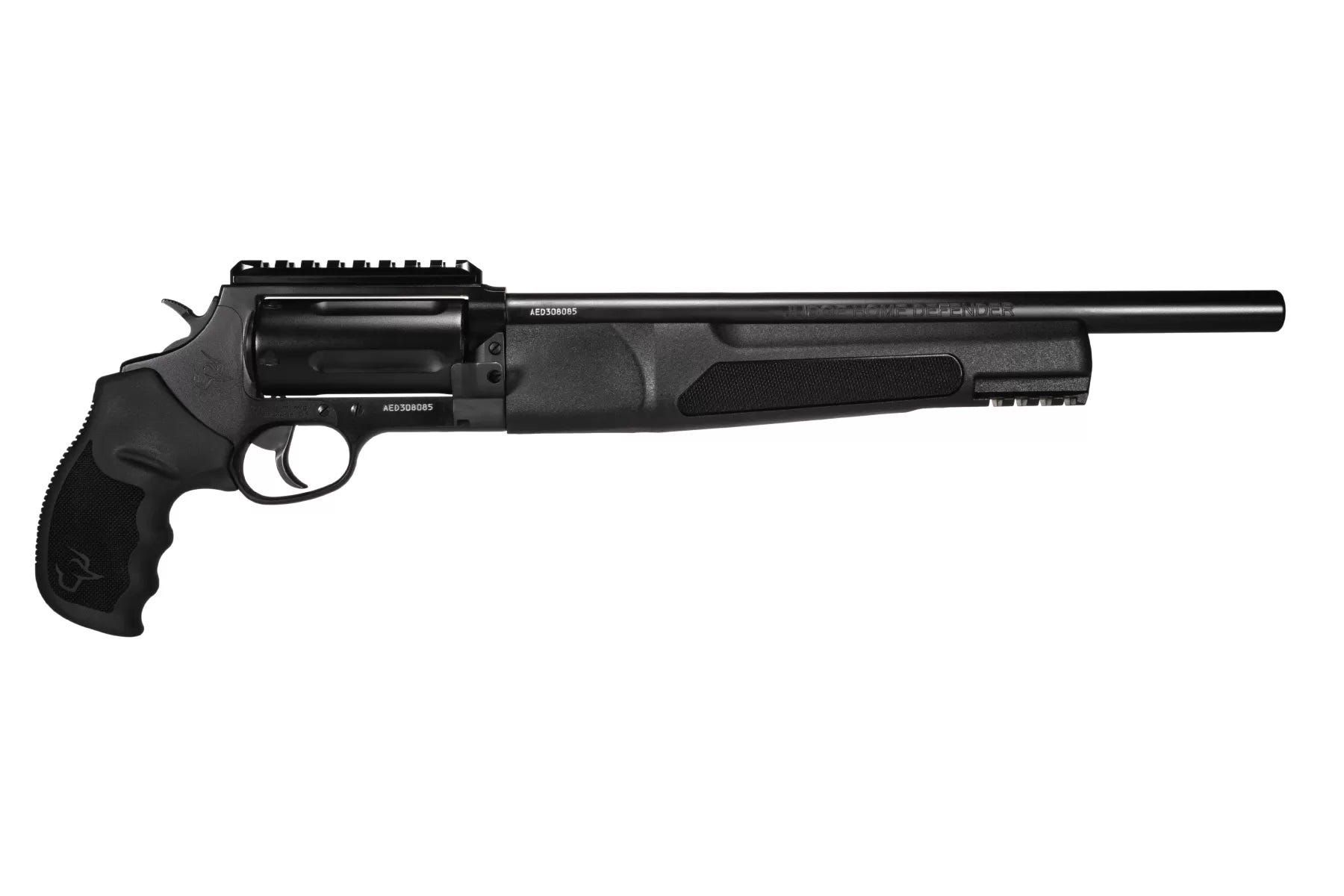
Judge Home Defender
13 in
3 in
Long barrel, Picatinny rail
Raging Judge
3 in or 6.5 in
3 in
Large frame, six or seven chambers
The Raging Judge is a different gun on a larger frame. The Raging Judge Magnum 513 adds .454 Casull to .45 Colt and .410 in a six-round cylinder, which puts a heavy hunting cartridge and a shotshell in the same gun, and the 3-inch version weighs a little over 60 ounces. The Raging Judge Ultra-Lite drops the .454 and holds seven .45 Colt or .410 rounds.
The Judge Home Defender takes the opposite approach to the Public Defender. Its 13-inch barrel adds velocity and sight radius, and makes the gun 19.5 inches long and 58.6 ounces heavy. It is still a handgun: there is no shoulder stock, and the barrel is rifled.
The Smith & Wesson Governor
Smith & Wesson answered the Judge at the 2011 SHOT Show with the Governor, a six-shot revolver on its large Z-frame with a 2.75-inch barrel. It takes 2.5-inch .410 shells and .45 Colt like a Judge, and it also fires .45 ACP from the moon clips that come with it, which no Judge does. The black version has a scandium alloy frame and weighs 29.6 ounces. The trade for the sixth chamber and the moon clips is that there is no 3-inch version.
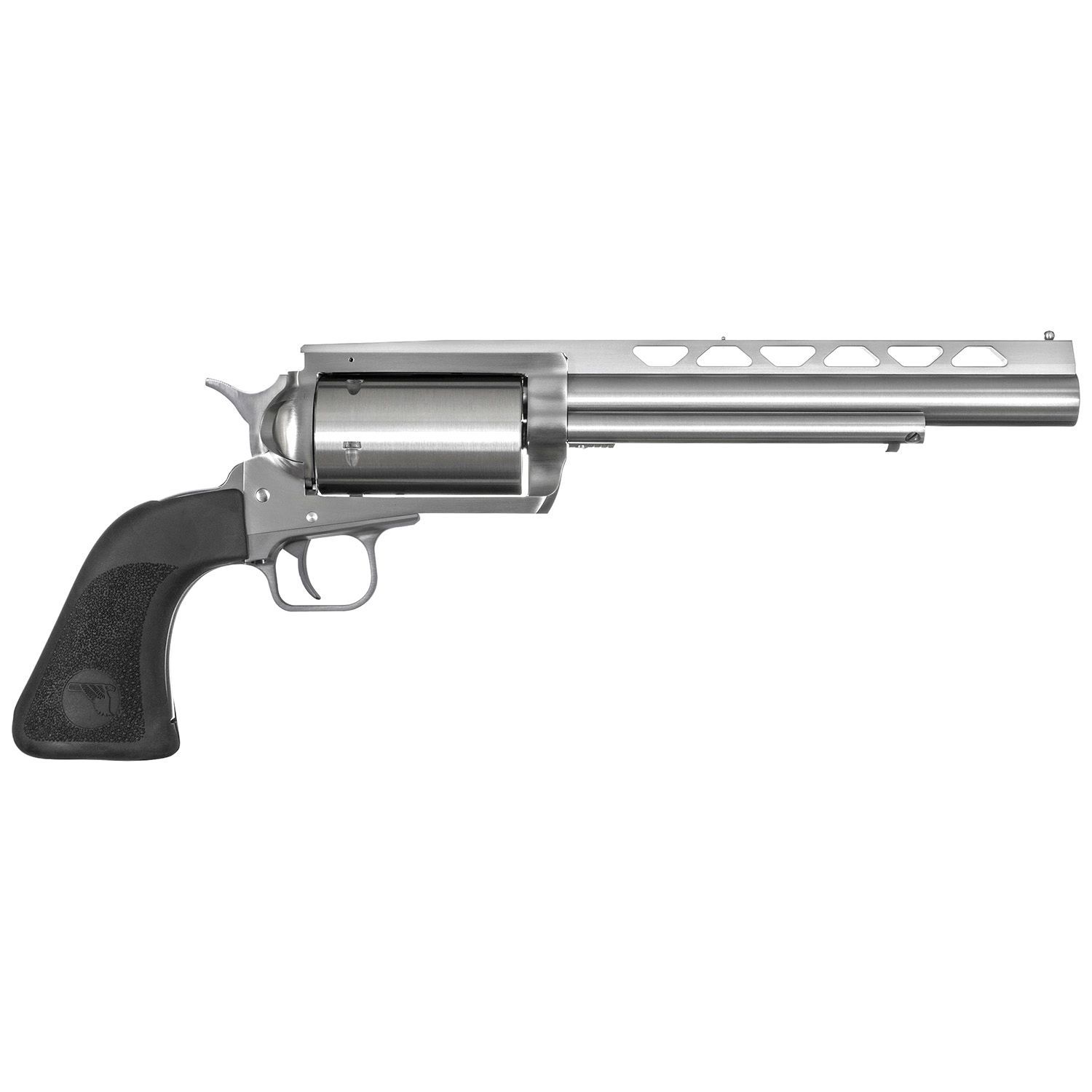
The BFR is the odd one: a single-action revolver in stainless steel with a 7.5-inch barrel, about 15 inches long and roughly 4.5 pounds. It is a hunting revolver built on a long frame originally meant for rifle cartridges, and the .45 Colt/.410 chambering is one option among many. It loads through a gate one round at a time and has to be cocked for every shot, which makes it a field revolver for snakes and small game rather than a defensive one.
What the catalog holds
The .410 revolvers tag holds 68 records: 61 Taurus Judges of every variant, 4 Smith & Wesson Governors and 3 BFRs. Barrel length separates them more usefully than brand:
Barrel
Records
Typical models
Under 3 in
14
Public Defender, Governor
3 in
28
Judge, Judge Magnum, T.O.R.O., Raging Judge
4 in
3
Judge
6 to 6.5 in
13
Judge, Judge Magnum, Raging Judge
7.5 in
3
BFR
13 in
5
Judge Home Defender
Two records have no barrel length recorded. The 3-inch barrel is the default, twice as common as the next most common group.
Revolvers that do not take a .410
While this guide was being written, six catalog records were found claiming .410 capability for revolvers that cannot chamber a shell: a Ruger Redhawk and a Ruger Super Redhawk Alaskan, three Cimarron single-actions and a Taylor's 1873 Cattleman. All six are ordinary .45 Colt (or .454 Casull) revolvers with standard-length cylinders. The mix-up is easy to make, since .45 Colt is the cartridge every .410 revolver shares, but acting on it would mean trying to load a shotshell into a cylinder too short for it. Those records now say plainly that the guns do not take .410.
A revolver takes .410 shells only if its maker says so, and only in the chamber length it names. The Judge, Public Defender, Judge Magnum, Home Defender, Raging Judge, Governor and the .45 Colt/.410 BFR are the handguns that do. Long guns built on the same idea, like the Rossi Circuit Judge, are a separate category.
Nick Sawinyh - Nick Sawinyh is a father, husband, hobby farmer, and gun enthusiast from Kentucky. He founded GunsNation and writes most of what appears on this blog.